
Wiki Gonzalez named to Mobile BayBears All-Time team
Catcher Wiki Gonzalez, an early fan favorite at Hank Aaron Stadium, was named to the Mobile BayBears All-Time team ahead of the franchise's final game.
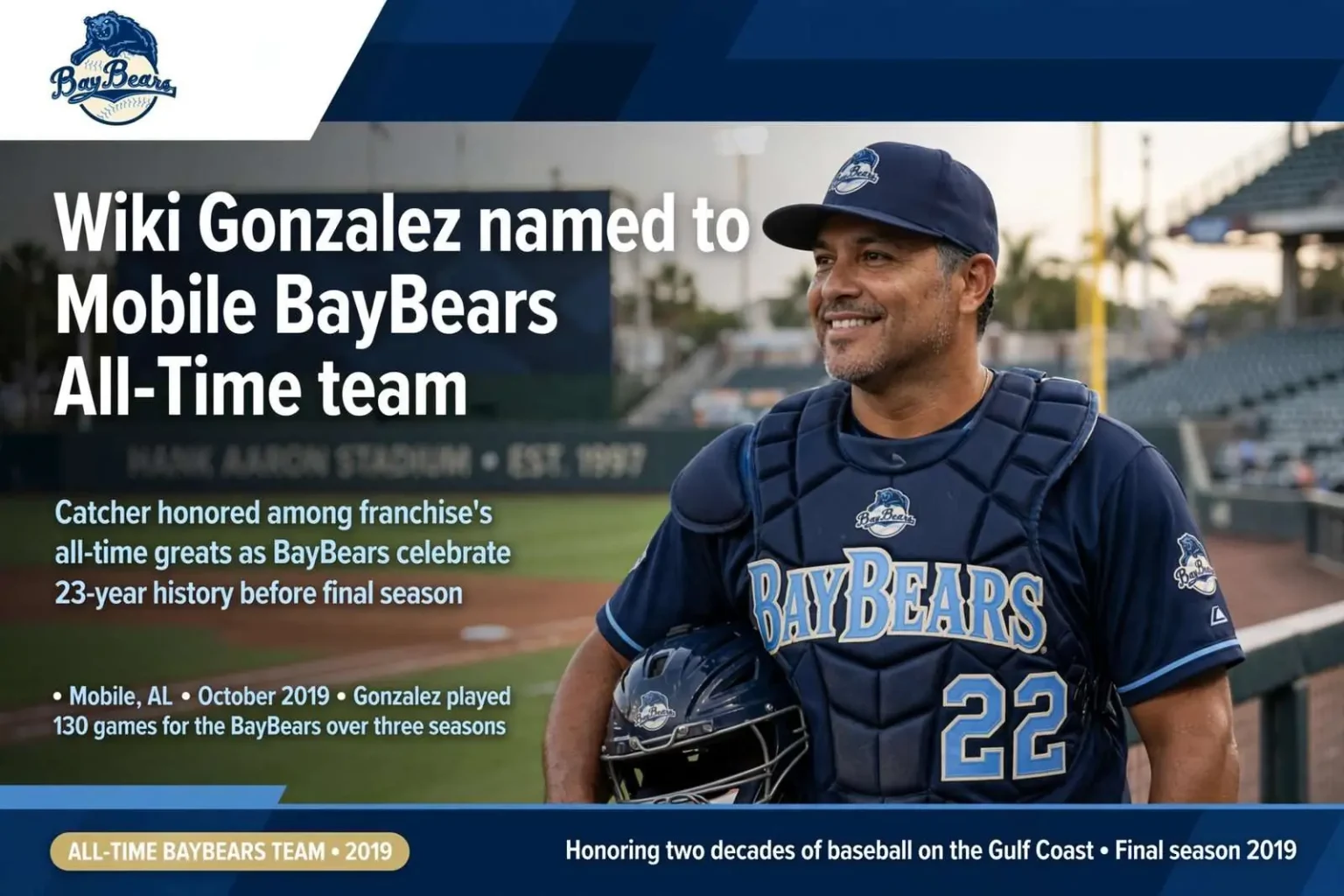
As the Mobile BayBears prepared to close out a 23-year run in the city, the team began revealing its All-Time BayBears roster, and catcher Wiki Gonzalez earned a spot.
The honor placed Gonzalez among the players who defined the franchise’s two decades on the Gulf Coast, and it was a fitting one. An early fan favorite at Hank Aaron Stadium, Gonzalez brought big-league pedigree and infectious energy to the BayBears’ dugout during his time in Mobile, and his connection to the city outlasted his stint on the roster. When the franchise chose to honor its history ahead of its final game, Gonzalez’s name was on the list alongside the best players ever to wear the uniform.
Gonzalez played seven seasons in the major leagues with the San Diego Padres, Seattle Mariners and Washington Nationals. His best big-league season came in 2001, when he hit .275 with eight home runs. He appeared in 130 games for Mobile over parts of three seasons, splitting time between the minors and the majors during the years the BayBears were establishing themselves as the Padres’ Double-A affiliate.
A franchise with deep roots
The BayBears arrived in Mobile in 1997, when the franchise moved from Asheville, North Carolina, and took up residence in a brand-new ballpark built on the site of the old Hartwell Field area near downtown. Hank Aaron Stadium, named for Mobile’s most famous native son, opened that year as a modern Double-A facility, complete with a museum honoring Aaron’s career. The team began its life as the Mobile BayBears affiliated with the San Diego Padres, a relationship that brought a steady stream of future major leaguers through Mobile during the late 1990s and early 2000s — Gonzalez among them.
For a city with one of the richest baseball heritages in America, Double-A ball was a natural fit. Mobile has produced more major leaguers than nearly any city its size: Hank Aaron, Ozzie Smith, Satchel Paige, Willie McCovey, Billy Williams, Amos Otis and a long list of others came out of the city’s sandlots and schoolyards. The BayBears gave local fans a chance to watch the next generation of stars up close at affordable prices, and over 23 seasons the team won Southern League championships, sent dozens of players to the majors, and became part of the rhythm of Mobile springs and summers.
Gonzalez’s place in that history came early in the franchise’s run. A native of Maracaibo, Venezuela, he signed as a young catcher and rose quickly through the Padres system, reaching Mobile as one of the organization’s top catching prospects. Catchers occupy a special place in minor league fandom — they are involved in every pitch, they manage the game from the field, and their immediacy makes them easy for season-ticket holders to embrace. In Mobile, Gonzalez was that kind of presence from the start.
The climb to the big leagues
The road from Mobile to the majors is one of the sport’s most traveled, and Gonzalez rode it in both directions. The BayBears’ years as a Padres affiliate coincided with one of the strongest stretches of talent the organization produced, and the catcher was part of a clubhouse in Mobile that understood its purpose: develop players for San Diego, win games along the way, and prepare young professionals for the jump to Triple-A and beyond. For a Venezuelan signee far from home, the Gulf Coast’s warm climate and the BayBears’ Spanish-speaking players made Mobile a familiar-feeling stop on a long climb.
Gonzalez’s major league career began in San Diego, the organization that had developed him through its minor league system. He spent parts of several seasons with the Padres, with his 2001 campaign standing out: a .275 average with eight home runs across significant playing time, numbers that represented real production from a catcher and made him one of the more dependable backstops in the National League at the time.
His career path then wound through the usual journeyman route that defines so many big-league careers. He later joined the Seattle Mariners, adding depth behind the plate during the period when Seattle was among the American League’s powers, and finished his major league tenure with the Washington Nationals. Seven seasons in the majors is a career most professional players never approach — the vast majority of minor leaguers never reach the top at all — and Gonzalez’s ability to stick as a catcher across multiple organizations spoke to his durability and his defensive reliability behind the plate.
The 130 games he appeared in for Mobile over parts of three seasons are a reminder of how minor league careers actually work. Players move up and down constantly — sent down to play every day, recalled when injuries create a need, optioned back when a roster spot is required. For BayBears fans in those years, that meant the same familiar faces disappeared and reappeared across seasons, and Gonzalez’s multiple stints in Mobile built the kind of accumulated familiarity that makes a player a favorite. The All-Time BayBears recognition captured exactly that: not a single memorable game, but the accumulated presence of a player fans watched grow up.
The All-Time team and the franchise’s finale
Catchers, meanwhile, have a way of dominating these honors. The position’s demands are unique in baseball: a catcher is involved in every pitch, absorbs the physical toll of squatting through nine innings in Gulf Coast heat, manages pitching staffs that rotate constantly in the minors, and serves as the field general whose mistakes are the most visible on the roster. Teams that find a dependable catcher tend to hold onto him, and fans come to know him better than any position player. Gonzalez fit that mold in Mobile, which is why his selection surprised no one who watched the BayBears in those years.
The All-Time BayBears roster was revealed in installments as the franchise approached its final game at Hank Aaron Stadium, a farewell that gave the organization and its fans a chance to take stock of 23 seasons. The selections spanned the team’s entire history and its successive major league affiliations, and the franchise invited fans to celebrate the honorees in person before the last out. For Gonzalez, the honor meant his name would be permanently attached to the franchise’s memory — a recognition that travels with a player long after his playing days end.
The BayBears’ departure from Mobile in 2019, when the franchise moved to Madison, Alabama, to become the Rocket City Trash Pandas, ended an era for the city. The move was part of a broader pattern in Double-A baseball, with newer ballparks and growing northern Alabama suburbs drawing franchises away from older facilities. Mobile was left without professional baseball for the first time in generations, a loss compounded by the city’s outsized contribution to the sport’s history.
What the honor means
All-time rosters are the way minor league baseball keeps memory alive. Unlike major league franchises with century-old record books, Double-A teams churn through rosters completely every few years — players arrive as prospects and depart for Triple-A or the majors so quickly that even devoted fans can struggle to recall who played where and when. A franchise’s all-time team, chosen for combination of on-field performance and connection to the community, is therefore both a tribute and an archive, and the names on Mobile’s list will outlast the team itself.
Gonzalez’s inclusion says something about what BayBears fans valued. Not every honoree was a future star — some were players whose major league careers were brief but whose time in Mobile left a mark. An early fan favorite who went on to seven big-league seasons, including his best year in 2001, Gonzalez combined both qualities: he was good enough to reach the sport’s highest level and stay for a while, and he was present and engaging enough in Mobile that fans remembered him decades later.
The 130 games in a BayBears uniform also connect Gonzalez to a specific period of the franchise’s rise. The late 1990s and early 2000s were the team’s establishing years, when Mobile was learning what it had in Hank Aaron Stadium and the Southern League was sending future stars through Gulf Coast ballparks. Players from those seasons tend to dominate all-time teams everywhere, because they were the ones fans watched when the seats were new and the novelty of Double-A baseball in Mobile was fresh.
As the BayBears prepared to close out a 23-year run in the city, the All-Time BayBears roster became the centerpiece of the franchise’s farewell. Gonzalez earned his spot the way all such honors are earned — through the accumulation of seasons, at-bats, innings behind the plate and memories made in a ballpark named for the greatest player this city ever produced. For Mobile fans, his name now sits permanently in the franchise’s record alongside the best of two decades of BayBears baseball, a final salute to a catcher who helped start it all.


