Wilcox County court weighs youthful offender status in motorcyclist killing
Two suspects accused in a Wilcox County motorcyclist's death face youthful offender hearings this week, with Marlon Mendenhall denied status and bond.
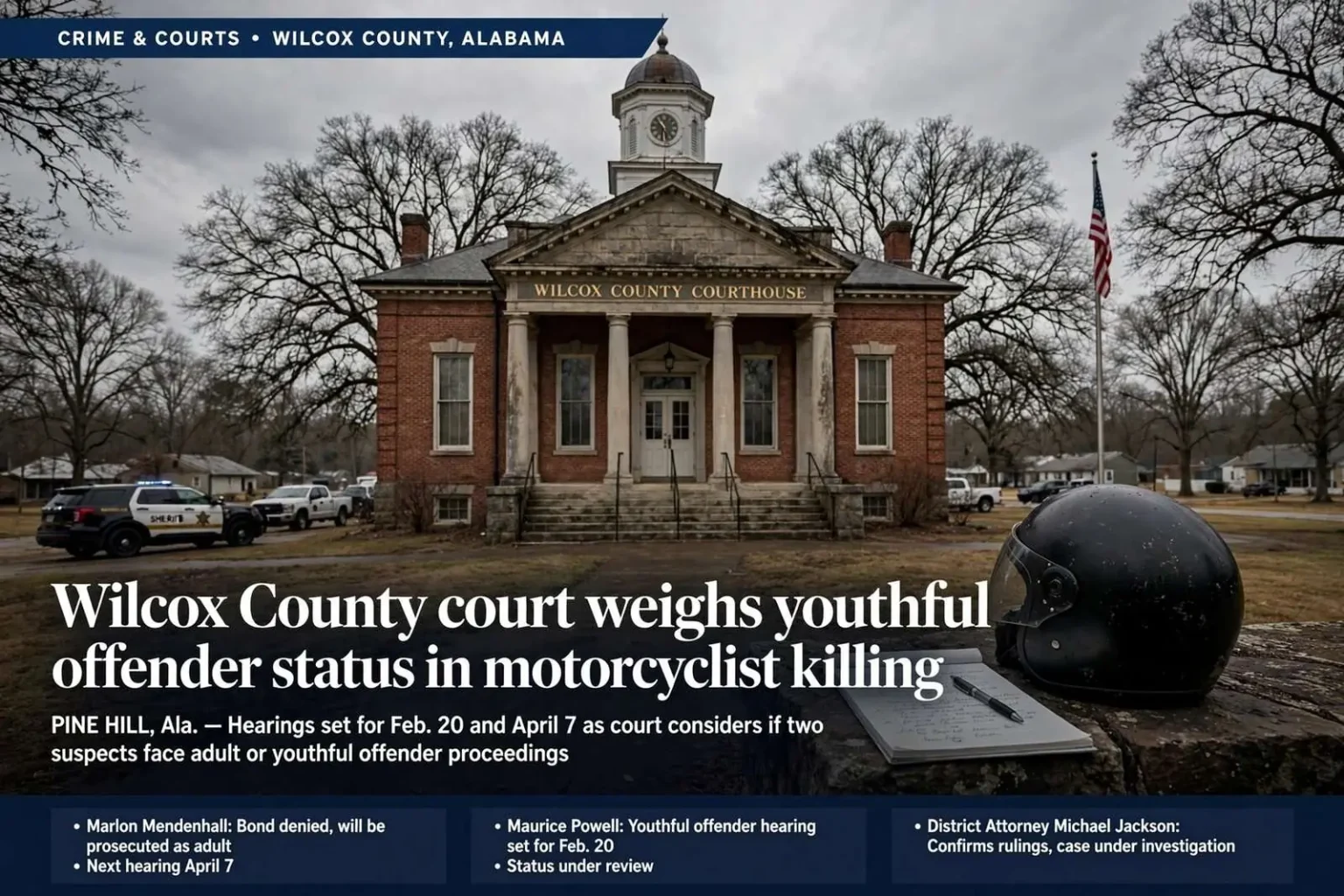
PINE HILL, Ala. — A Wilcox County court is weighing youthful offender status for two suspects accused in a motorcyclist’s death, with hearings in the case stretching into the spring. The determinations will decide whether the suspects face prosecution as adults with public proceedings or in the closed, sealed process Alabama law provides for young defendants.
Wilcox County District Attorney Michael Jackson confirmed that Marlon Mendenhall was denied youthful offender status and that bond was denied in his case. The case is set to continue on April 7, keeping Mendenhall’s prosecution on the docket while other matters in the same case move on separate tracks.
A separate hearing for Maurice Powell on his youthful offender status will continue on February 20, according to court updates. The split schedule means the two defendants’ eligibility questions are being resolved through individual hearings rather than a single joint proceeding.
The suspects are accused in the killing of a motorcyclist in Wilcox County, a sparsely populated Black Belt county between Selma and Monroeville where circuit court proceedings draw close attention from a small community of residents. The court updates did not describe the circumstances of the killing, and further details were expected as the hearings continue.
What Youthful Offender Status Means in Alabama
Alabama’s youthful offender law gives courts discretion to treat certain young defendants differently from adults. Defendants who were under 21 at the time of an alleged offense may be designated youthful offenders at the court’s discretion, a status that changes nearly every aspect of how the case proceeds.
If granted, the designation closes the courtroom to the public and the press, seals the court record, and shields the defendant from public identification as the case moves forward. Sentencing also works differently: a youthful offender conviction carries a maximum commitment of three years, far shorter than the sentences available in adult court for the same offenses.
Because the stakes are so different, eligibility hearings are contested matters in serious cases. Prosecutors weigh the severity of the alleged offense and the defendant’s record when arguing for adult prosecution, while defense counsel emphasize age, maturity, and prospects for rehabilitation. The judge’s decision on youthful offender status is typically made after considering evidence on both sides.
A denial, as Mendenhall received, leaves the defendant in the adult system, where proceedings are public and the full range of adult penalties applies. That is why the question of youthful offender status is often the most consequential early ruling in a case involving a young defendant charged with a serious crime.
The Role of the District Attorney
Michael Jackson serves as district attorney for the Fourth Judicial Circuit, which includes Wilcox County and neighboring Black Belt counties, with his office centered in Selma. Jackson has been a prominent figure in the region’s prosecution of serious crime and has spoken frequently about the challenges rural prosecutors face — thin budgets, sparse juries pools, and caseloads that stretch across multiple counties.
In cases of this kind, the district attorney’s office makes the initial recommendation on youthful offender eligibility, and prosecutors must also take positions on bond. Bond denials in serious felony cases typically reflect the court’s assessment of the charges’ severity, the defendant’s history, and concerns about flight or danger to the community.
Bond matters in Alabama have drawn statewide attention in recent years, as courts and lawmakers have debated how bail practices affect defendants who cannot afford release. A denial rather than a high amount means the defendant remains in custody for the duration of the case unless circumstances change.
How the Case Will Proceed
With Mendenhall’s youthful offender question resolved and bond denied, his case moves toward the April 7 setting. That date is likely to be used for further motion practice or preliminary steps toward trial rather than a final resolution, as felony cases in rural circuits often take months of hearings before reaching trial.
Powell’s situation remains open. His youthful offender hearing continuing on February 20 means the court will take further evidence or argument before ruling on whether his case proceeds in the closed youthful-offender track or in adult court alongside Mendenhall’s.
The two defendants’ cases could ultimately follow very different paths depending on the rulings. If Powell receives youthful offender status, his proceedings would be closed and his exposure capped at three years; if denied, he would face the same public adult-court process as his co-defendant.
Court watchers in Wilcox County are accustomed to the slow rhythm of rural justice. The county’s circuit court handles felony matters from across the county at the courthouse, and serious cases commonly span multiple terms of court between arrest and resolution. Continuances are common as evidence is gathered, motions are briefed, and hearing dates are fitted into the circuit’s schedule.
Wilcox County and Its Courts
Wilcox County, with a population of roughly 11,000, is among Alabama’s least populous counties. Its seat, Camden, hosts the courthouse, and towns like Pine Hill — where this case was reported — sit along the county’s southern reaches, closer to the Monroe County line than to Camden itself.
The county is part of Alabama’s Black Belt, a region named for its rich soil that has long faced economic hardship, population loss, and strained public services. Courts and prosecutor’s offices in the region handle serious caseloads with modest resources, and cases involving deaths draw particular community attention in small towns where news travels quickly.
Motorcyclist deaths are a recurring concern on rural Alabama roads, where two-lane highways carry fast traffic and riders are exposed to the full force of any collision. State safety data has consistently shown motorcycle fatality rates running above national averages in rural counties, with many crashes occurring on the kind of country roads that cross Wilcox County.
Prosecutors in such cases typically rely on State Trooper and sheriff’s investigators for the underlying crash and death investigation, with the district attorney’s office then determining charges. The charging decisions set the framework within which questions like youthful offender eligibility are then argued.
The Legal Stakes
For the defendants, the next hearings carry everything: Mendenhall’s April 7 setting comes in a case where he will be prosecuted as an adult with bond denied, while Powell’s February 20 hearing will determine whether he stays in the adult system or moves to the youthful offender track.
For the victim’s family, the proceedings represent the first structured step toward answers. In Alabama, families of homicide victims are notified of major hearings under the state’s crime victims’ rights provisions, and prosecutors typically consult with them on plea decisions and sentencing positions as the case matures.
The law’s design reflects a longstanding split in criminal justice thinking: young defendants are treated as more amenable to rehabilitation, and the youthful offender statute embodies that philosophy — but only when a judge agrees it fits the case. Homicide cases test that philosophy most directly, which is why eligibility fights in such cases are hard-fought and closely watched.
Defense attorneys in youthful offender hearings often present school records, family circumstances, and psychological evaluations to argue for the designation. Prosecutors counter with the facts of the alleged offense and any prior history. Judges weigh the evidence case by case, with no bright-line rule dictating the outcome.
The spring calendar — February 20 for Powell, April 7 for the case overall — sets the rhythm for the coming months. As those dates arrive, further details about the allegations are likely to emerge through filings and hearing testimony, gradually filling out the public record in a case that began with few confirmed details.
Until then, the confirmed facts remain as the court updates state: two young suspects, accused in the death of a motorcyclist in Wilcox County; one denied youthful offender status and bond; the other’s eligibility question awaiting a continuing hearing; and a rural county courthouse preparing to handle one of the most serious cases on its docket.
Bond and Pretrial Detention in Rural Circuits
The denial of bond in Mendenhall’s case places him in the county jail for the duration of the proceedings, a circumstance that shapes everything from attorney access to trial preparation. Rural jails like Wilcox County’s house pretrial detainees alongside sentenced inmates, and defendants in custody typically meet with their lawyers in restricted settings.
Alabama judges weigh several factors in bond decisions: the nature of the charge, the weight of the evidence, the defendant’s ties to the community, criminal history, and whether release would pose a danger. In homicide cases involving young defendants, prosecutors frequently argue that the seriousness of the allegation alone justifies detention, and judges often agree pending trial.
Defendants whose bond is denied can revisit the question through later motions, particularly if circumstances change — a co-defendant’s ruling, new evidence, or delays in the court schedule. That means the April 7 setting could carry both substantive and bond-related significance for the case.
Pretrial detention also intersects with the youthful offender question in practical ways. A defendant held in an adult jail while awaiting an eligibility ruling experiences the adult system even before any determination is made — one of the criticisms defense advocates raise about how youthful offender decisions unfold in serious cases.
Looking Ahead to Spring
The case’s spring calendar gives both sides time to prepare. Prosecutors will assemble the investigative file from the law enforcement agencies that worked the death, while defense counsel for each defendant will pursue their own tracks — one litigating an already-denied eligibility question, the other still fighting for the designation.
Rural circuit schedules mean that hearing dates can shift, but the February and April settings establish the framework the court will follow. News of the proceedings will continue to circulate in a county where court cases of this seriousness are rare enough to remain a topic of community conversation between hearings.
What is already clear from the court’s early rulings is that the system is treating the case with the gravity its charges demand. Whether that treatment ultimately includes a youthful offender designation for one or both defendants will be settled in the hearings ahead.