
Woman at Center of Viral Saraland Waffle House Arrest Found Guilty
Chikesia Clemons was found guilty of disorderly conduct and resisting arrest after her viral Waffle House arrest in Saraland drew petitions and protests.
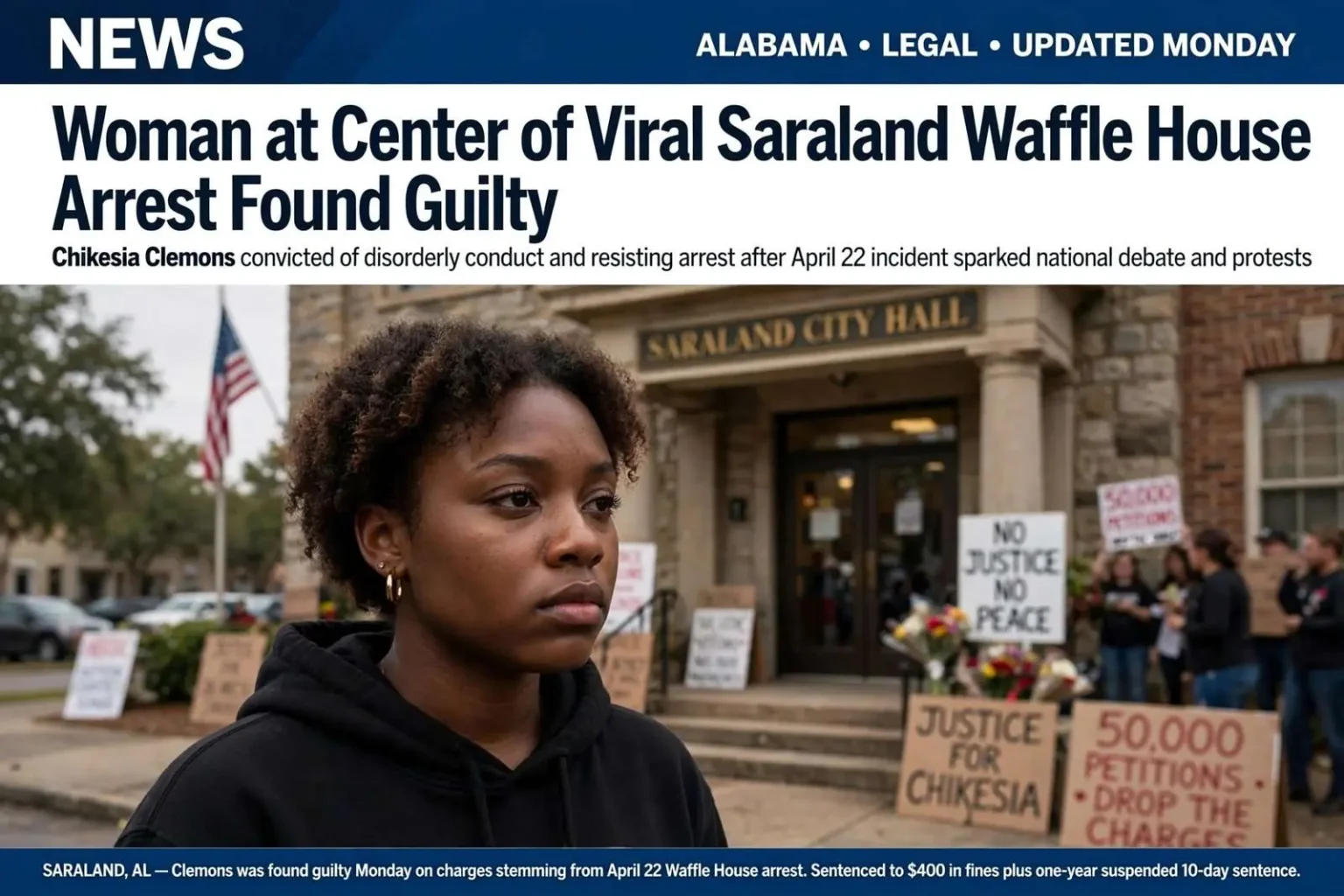
Chikesia Clemons, whose arrest at a Saraland Waffle House sparked national attention after video of the incident spread online, was found guilty Monday of disorderly conduct and resisting arrest in a case that drew protests, petitions, and national scrutiny to the small city just north of Mobile.
The charges stemmed from the April 22 arrest captured on cellphone video, which showed police taking Clemons to the floor of the restaurant. Saraland police said Clemons was intoxicated and that the video also showed her threatening employees and refusing repeated requests to leave, while Clemons and her supporters told a very different story about what happened that morning.
The judge presiding over the case said he found Clemons guilty because the legal definitions of the offenses had been met — not because of any emotion surrounding the high-profile case. The verdict, delivered after months of national debate over the arrest, drew an immediate response from activists who had rallied to Clemons’ side since the video went viral.
The Arrest That Sparked a National Firestorm
The incident began at the Waffle House on Saraland’s main commercial corridor in the early morning hours of April 22, when restaurant employees called police after a dispute with Clemons escalated. By the time officers arrived, the confrontation had already been captured on video by a friend accompanying Clemons — footage that would soon be seen millions of times online.
The video showed officers grappling with Clemons and taking her to the floor of the restaurant, her top slipping during the takedown as bystanders cried out in protest. Those images transformed a local disturbance call into a national conversation about policing, race, and the use of force in mundane commercial settings — a conversation amplified by civil rights organizations and by the sheer reach of the footage.
Critics questioned whether the force used was proportional to the situation, noting that Clemons was unarmed and that the confrontation stemmed from a dispute over a complaint she wanted to make about her service. Supporters staged protests outside the restaurant and at Saraland City Hall, demanding that charges be dropped and that officers be held accountable.
Police and Prosecutors Tell Their Side
Saraland police maintained that officers responded appropriately to an intoxicated and combative customer who refused to leave after being asked multiple times. Investigators said the video showed Clemons threatening employees — a key point, because verbal threats combined with refusal to leave private property form the factual basis for the disorderly conduct charge.
Prosecutors argued that whatever the optics of the takedown, the legal questions before the court were narrower: whether Clemons refused a lawful order to leave the restaurant and whether her conduct rose to the level of disorderly conduct under Alabama law. The arrest itself, they maintained, was a separate question from the charges she faced.
The Defense: A Customer Trying to File a Complaint
Clemons’ attorney argued she was only trying to obtain a corporate phone number to file a complaint about her experience at the restaurant, framing the confrontation as a customer-service dispute that escalated unnecessarily. From the defense’s perspective, the case was about a young woman who refused to be brushed off — not a criminal actor threatening anyone.
She and her supporters contended the charges should be dropped because of how she was treated during the arrest. The push gained momentum through the spring, with activists organizing in Saraland and drawing connections to a broader national debate about the treatment of Black women by police — a debate that had already been reshaped by other viral arrests across the South.
In June, the group delivered petitions bearing roughly 50,000 signatures to Saraland city hall demanding dismissal of the charges. The delivery was among the most visible moments of the campaign, bringing national civil rights figures and news cameras to the small municipal building in a city of fewer than 15,000 residents.
The Court’s Reasoning
The judge’s explanation of the verdict sought to separate law from controversy. By stating that he found the legal definitions of the offenses had been met — and explicitly noting that emotion around the case played no role — the court signaled that its focus was on the evidence of what happened inside the restaurant, not on the public campaign surrounding it.
Under Alabama law, disorderly conduct covers conduct that annoys or endangers others, including refusing to leave premises after being asked, and resisting arrest covers nonviolent refusal to submit to a lawful arrest. The court’s job was to determine whether the facts fit those definitions, a standard narrower than the fairness questions the viral video had raised.
The Sentence
The court instead ordered a $200 fine plus court costs on the resisting arrest charge and another $200 fine on the disorderly conduct count. Clemons was also sentenced to 10 days in jail, suspended for one year of informal probation — meaning she avoided jail time unless she violated the terms of her probation during the year.
Clemons had 14 days to file an appeal, leaving open the possibility that the case would continue in a higher court even after the municipal verdict. Appeals in municipal cases move to circuit court, where a defendant can seek a new trial before a different judge — a route her legal team would have weighed against the costs and publicity of continued litigation.
Saraland: The Setting of the Case
Saraland, a growing suburb of roughly 15,000 people just north of Mobile along U.S. Highway 43 and Interstate 65, is one of the fastest-developing cities in Mobile County. Its commercial strips along the highway carry heavy traffic between Mobile and the northern suburbs, and the Waffle House where the arrest occurred sits amid the restaurants, gas stations, and hotels that serve that corridor.
The city’s police department, a mid-sized force for a municipality of Saraland’s size, had rarely been the subject of national attention before the April arrest. The viral video changed that overnight, with journalists, activists, and commentators descending on the city and its small municipal court system suddenly handling one of the most watched cases in the country.
For local officials, the episode tested the institutions of a small city: the police department’s internal review of the arrest, the municipal court’s handling of a politically charged trial, and the city government’s response to protests at city hall. The petition delivery in June put direct public pressure on the city council, which had no formal role in the prosecution but absorbed much of the public frustration.
The Wider Debate Over the Arrest
The Clemons case became part of a string of viral arrest incidents that fueled national conversations about policing in the late 2010s. Civil rights advocates argued the case showed how quickly a minor dispute can escalate into physical force when police are called to handle what might otherwise be a customer complaint.
Law enforcement voices countered that officers cannot base decisions on how an arrest might look on video, and that employees of a business have the right to have an unwelcome, threatening, and intoxicated customer removed. The gap between those framings — public perception versus legal standard — is precisely what the trial was designed to resolve.
What Happens After the Verdict
The fines and suspended sentence mean Clemons’ immediate legal exposure is modest, but the case’s aftermath extended beyond the courtroom. A civil lawsuit against the city and its officers remained a possibility for Clemons and her family, as is common in cases where an arrest goes viral and a criminal case concludes without acquittal.
The appeal window — 14 days from the verdict — gave her attorneys a deadline to decide whether to continue fighting in circuit court. Either way, the record of the case, including the video and the trial testimony, would remain part of the public archive of an arrest that already had a lasting place in the national conversation about policing.
For Clemons, who was a young woman when the arrest made her name known across the country, the verdict closed one chapter while leaving the broader questions open. Her supporters pledged to continue pressing for accountability and policy changes regardless of the court’s decision.
The Case’s Place in Saraland’s History
Few events have put Saraland in the national spotlight the way the Clemons arrest did. The city, which incorporated in 1957 and has grown rapidly as Mobile’s northern suburbs expand, found itself handling international media inquiries, protest permit questions, and a trial that attracted cameras to a municipal courtroom.
The case also became a reference point in Mobile-area discussions about policing, race, and the power of viral video. In the years since, incidents across the Gulf Coast have been measured against the Clemons case — proof that a single cellphone recording from a restaurant booth can reshape a city’s public life and force institutions built for local disputes to answer to a national audience.
The guilty verdict and sentence ended the criminal phase of the case, but the questions it raised — about how police handle disturbances at businesses, how force is used against unarmed suspects, and how communities respond when they believe justice has gone astray — continued to echo in Saraland and across the country long after the courtroom emptied.