
Woman seriously injured after being struck by vehicle during Order of Inca parade in Mobile
A woman was seriously injured after being struck by a vehicle during Mobile's Order of Inca parade; the driver fled but was stopped by police.
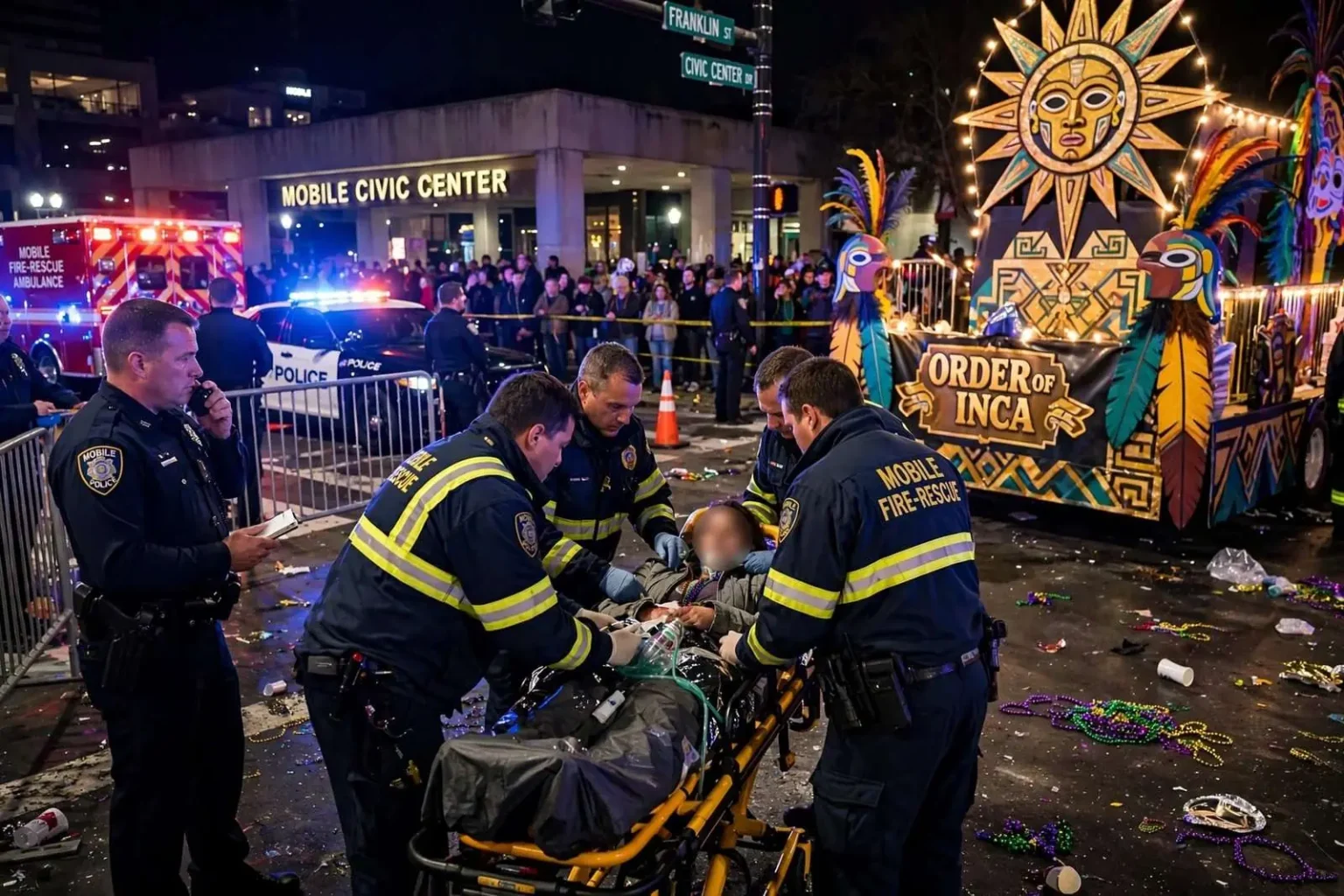
MOBILE, Ala. — A woman was seriously injured Friday night when she was struck by a vehicle during the Order of Inca parade in downtown Mobile, according to Mobile Police. The driver of the vehicle fled the scene but was stopped a short time later by police.
The collision happened on Franklin Street at Civic Center Drive, near the Mobile Civic Center, along the parade route. Mobile Fire-Rescue said a person was struck by a vehicle during the parade; the extent of their injuries was not immediately known, and the person was treated and transported to a local hospital. Police continue to investigate.
A crash in the middle of carnival
Parade nights transform downtown Mobile. Tens of thousands of people line the streets for hours before the first float rolls, staking out spots along the route with coolers, chairs and bags for throws. The Order of Inca, one of the city’s long-established mystic societies, draws one of the larger crowds of the season, and the streets around the Mobile Civic Center and the parade route fill with families, vendors and partiers moving between the route and the parking that surrounds it.
That density is what makes any vehicle-pedestrian collision during a parade so serious, and it is also what makes policing the event so demanding. Officers close streets, control intersections and manage the constant flow of pedestrians crossing to and from parking areas. A vehicle moving through or near a packed crowd — during or alongside a parade — poses a risk to everyone nearby, which is why the response to Friday’s crash was immediate and the driver’s decision to flee drew such quick police attention.
The hit-and-run and its consequences
Under Alabama law, a driver involved in a collision that injures someone is required to stop, remain at the scene and provide aid and identifying information. Leaving the scene of an injury collision is a felony, and it compounds whatever charges may follow from the crash itself. In this case, the driver did not get far: officers stopped the vehicle a short time later, meaning the investigation now includes both the circumstances of the crash and the flight that followed it.
The escape attempt rarely helps a driver. Witnesses at a parade are numerous, and the route a fleeing vehicle must take through downtown on a parade night is crowded and slow. Police noted that the driver was stopped a short time later, and investigators will now work to determine speed, impairment, attention and any other factors that contributed. Charges in cases like this can range from traffic offenses to assault counts, depending on what the investigation shows and how severely the victim was hurt.
The victim and the response
Mobile Fire-Rescue crews treated the woman at the scene and transported her to a local hospital, the standard response for a serious pedestrian strike. Pedestrian collisions often cause injuries that are not fully apparent at first — internal injuries, head trauma and fractures among them — which is why paramedics transport struck pedestrians even when they appear to be conscious and talking. Initial reports described her injuries as serious, with her condition not immediately known as the investigation got underway.
Responding to any call during a parade requires navigating crowds and closed streets, and crews on carnival nights stage to keep access routes open for exactly this kind of emergency. The intersection of Franklin Street and Civic Center Drive sits near the Civic Center itself, a landmark along the parade routes, and it filled with emergency vehicles as police and fire units converged on the scene while the parade continued around them.
Mardi Gras in Mobile and the Order of Inca
Mobile likes to remind the country that its carnival celebration predates New Orleans by more than a century and a half, with roots reaching to the early 1700s and organized mystic societies that have rolled parades for generations. The Order of Inca, founded in the early twentieth century, is among the city’s storied societies, known for its elaborate floats, masked riders and the throws — moon pies, beads and cups — that rain down along the route. For weeks each winter and early spring, downtown becomes a nightly festival ground as society after society parades.
The parades are family events for many Mobilians, and they are also big business, drawing visitors who fill hotels and restaurants across downtown. The crowds along Government Street, Royal Street and the streets around the Civic Center number in the thousands on the biggest nights. With that scale comes the need for security planning that begins months in advance: barricades, closure orders, officer assignments and coordination among police, fire and parade societies all work together to keep the celebration safe.
Safety along the route
Police and parade organizers repeat the same safety guidance every season. Pedestrians should stay behind barricades and on sidewalks, never dart into the street between floats, and keep children close in the crowd. Cross the route only at intersections where officers allow it. Spectators who drive downtown should park in designated areas, expect street closures, and walk with awareness of the traffic moving on the edges of the event — the collisions that happen on carnival nights most often involve vehicles and pedestrians mixing near, rather than during, the parade itself.
Drivers, for their part, are urged to be patient and sober through the season. Downtown streets on parade nights are full of pedestrians who may step out unpredictably, and officers conduct enforcement aimed at impaired driving throughout carnival. For anyone attending, designating a sober driver or using a ride service removes one of the largest risks of the night, both for the driver and for the crowds walking the route.
What the investigation will examine
Investigators will piece together Friday night’s crash from the evidence available at a crowded parade scene: witness statements, any video from nearby businesses or bystanders’ phones, the physical evidence at the intersection, and the condition of the vehicle and driver after the stop. Toxicology results, if sought, can take weeks, and the findings will determine the charges the District Attorney’s Office pursues, if any.
The woman’s recovery is the outcome that matters most, and police typically release updated information about the victim’s condition as it becomes available. Investigators also continue to ask anyone who saw the crash or the moments before it, and who has not spoken to officers, to come forward, since witness accounts from a crowd are often the most complete record of what happened.
For the city, the crash is a dark moment in a season that defines Mobile. The Order of Inca parade rolled on amid flashing lights, as carnival nights always have, and the crowds went home with throws and memories — while one family waited for word from a hospital. The message police carry out of nights like this is the same one they give every year: the parades belong to everyone, and keeping them safe depends on drivers slowing down, spectators staying alert, and everyone looking out for one another in the crowd.
Emergency response during large events
Friday’s crash tested systems that Mobile’s police and fire departments build specifically for carnival season. During parades, commanders staff a coordinated detail, keep emergency lanes open through the closed street grid, and stage ambulances and fire units at points where they can reach any part of the route within minutes. When a serious call comes in, officers can hold crowds, clear an intersection and escort medics through in a way that routine traffic plans could never accommodate. That preparation is why the injured woman received treatment and transport quickly despite the thousands of people around her.
Large events also change how investigators work. A scene that would be quiet on an ordinary Friday is packed with witnesses during a parade, which is an advantage for investigators — but those witnesses are moving, distracted and sometimes recording rather than observing. Officers work the crowd in the immediate aftermath, asking for statements and video while memories are fresh, and the department can follow up through its social media channels and crime line for additional tips in the days that follow.
When a fleeing driver is caught
The short pursuit and quick stop of Friday’s driver spared the case the uncertainty that comes with an unsolved hit-and-run. When drivers are caught immediately, officers can document the driver’s condition on the spot — including any signs of impairment — and impound the vehicle for examination. Skid marks, paint transfer, dashcam footage and the pattern of damage on the vehicle all help investigators reconstruct speed and movement at the moment of impact.
Leaving the scene typically changes the legal posture of a case in the driver’s disfavor. Prosecutors treat flight as evidence of consciousness of guilt, and sentences in Alabama can be enhanced when a driver flees and is later apprehended. The Baldwin County District Attorney’s Office, which handles felony prosecutions from Mobile County’s eastern neighbor, and Mobile County’s own prosecutors review such cases based on where the crash occurred and what the evidence supports.
The Order of Inca parade will roll again, as it has for more than a century, and most nights pass without a serious incident. Friday’s crash stands as a reminder to the crowds and the drivers alike: downtown on parade night belongs to pedestrians first, and every driver moving through the city during carnival carries the responsibility that comes with a full street. Anyone with information about the crash is asked to contact Mobile Police as the investigation continues.