
Woman Shot in the Neck During Altercation at Theodore Metro PCS Store
Mobile police say a 21-year-old woman was shot in the neck during an altercation at a Metro PCS store on Theodore Dawes Road.
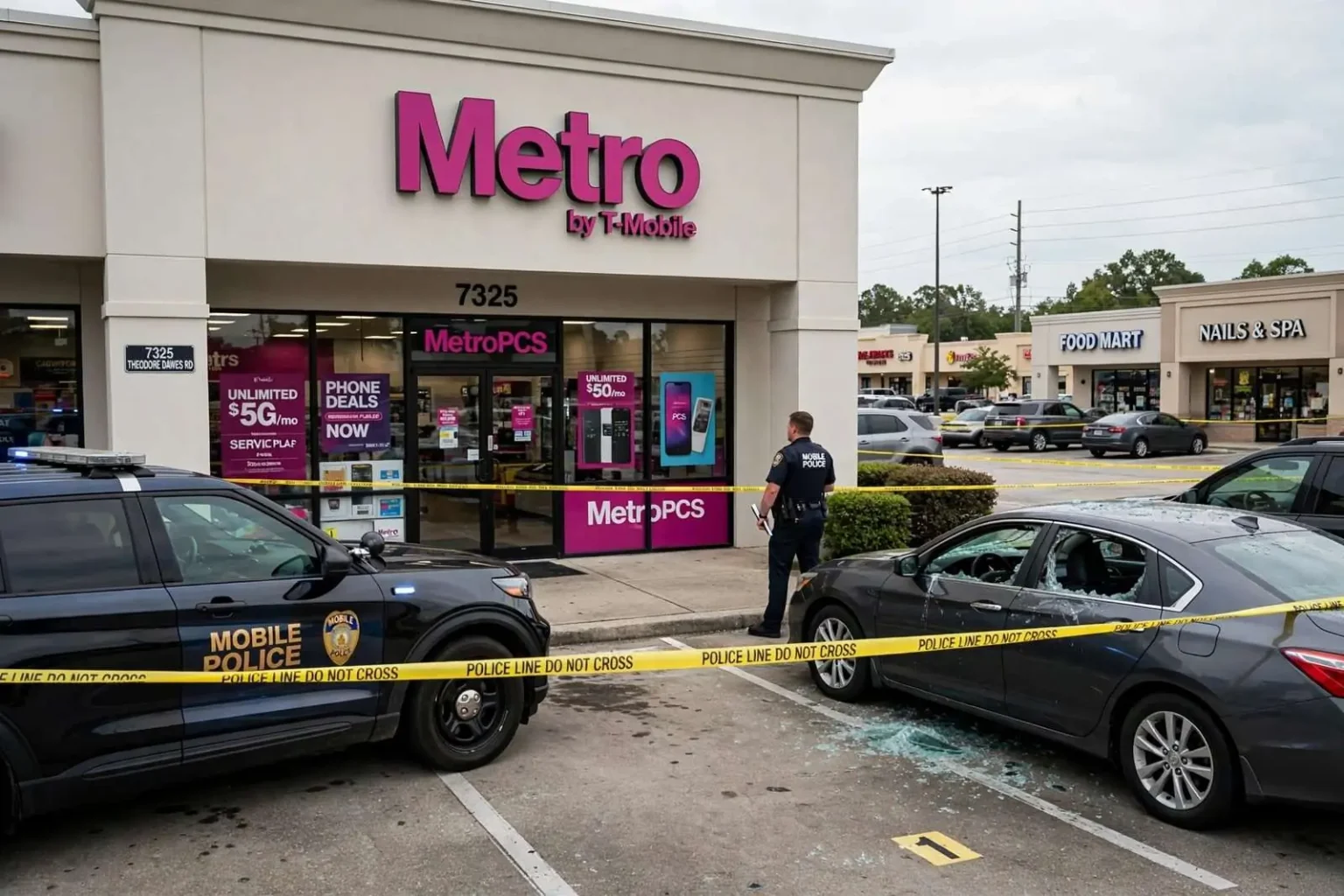
A 21-year-old woman was shot in the neck during a physical altercation outside a Metro PCS store on Theodore Dawes Road early Monday afternoon, according to Mobile police. The shooting, which sent one person to a hospital with injuries described as not life-threatening, left investigators working into the afternoon to identify the shooter.
Officers were called to the store at 7325 Theodore Dawes Road around 1:11 p.m. after reports of shots fired in the area. By the time units arrived, the woman had already been taken to a hospital by private vehicle — a common pattern in daytime shootings, when bystanders or companions rush victims to emergency care rather than waiting for an ambulance.
Police said that during an altercation, the suspect fired into the victim’s vehicle, striking the woman in the neck. Corporal Ryan Blakely provided those details as the investigation remained active Monday afternoon. Her injuries were described as not life-threatening, and no arrest had been announced.
The shooting occurred near a shopping center in the heart of Theodore, one of Mobile County’s largest communities south of the city. The stretch of Theodore Dawes Road around the store is a busy commercial corridor, and the daylight timing — early Monday afternoon — means any exchange of gunfire drew attention from drivers, shoppers and neighboring businesses.
What police say happened
According to the account police provided, the episode began as a physical altercation involving the victim’s vehicle outside the phone store. At some point during that confrontation, the suspect fired into the vehicle, and a round struck the 21-year-old in the neck. Investigators had not released information about what preceded the altercation, whether the parties knew each other, or whether the shooter acted alone.
The decision of the victim’s companions to transport her to a hospital immediately likely shortened the time between injury and treatment. For neck wounds, rapid care matters: injuries in that region of the body can involve blood vessels and the airway, and trauma teams evaluate such patients quickly even when wounds appear stable. Police characterized her injuries as not life-threatening, suggesting she arrived in condition to be treated and stabilized.
With the shooter unidentified and at large, detectives spent the afternoon canvassing the shopping center area. Daylight shootings in commercial corridors typically generate witnesses — customers in nearby stores, drivers stopped at nearby intersections and employees on break — and investigators depend on those accounts to piece together a timeline and a description of the suspect.
How investigators build a case
In the hours after a shooting like this one, Mobile police detectives work several tracks at once. Witness canvassing comes first, with officers and investigators returning to the businesses around the Metro PCS store to ask for accounts and any camera footage. Commercial corridors are typically dense with surveillance — storefront cameras, parking lot systems and dash cameras — and footage from the 1:11 p.m. window can establish the sequence of events before, during and after the gunfire.
Detectives will also examine the vehicle that was fired into, both for physical evidence and for what it reveals about the confrontation. Shell casings, if recovered, can be matched to a weapon if one is later found, and the trajectory of rounds through a vehicle helps corroborate witness accounts of where the shooter stood.
The victim’s own account, once her condition allows an interview, will be central. Police had not released her name or details about her condition beyond the initial assessment, and investigators had not said whether the altercation was connected to an earlier dispute. No arrest had been announced as of Monday afternoon, and police typically ask anyone with information to come forward as the case develops.
Theodore and its commercial corridor
The shooting took place in Theodore, the unincorporated community south of Mobile that ranks among the county’s largest population centers. Theodore Dawes Road serves as one of its main commercial arteries, lined with strip malls, restaurants, convenience stores and service businesses — including the Metro PCS store where Monday’s altercation began. The corridor’s volume of daily traffic makes it familiar to nearly everyone in the community, and it is precisely that activity which turns a midday shooting into a scene investigators mine for witnesses.
Communities like Theodore fall under the jurisdiction of the Mobile County Sheriff’s Office for some services, but the Mobile Police Department handled this response and investigation, providing the details released Monday afternoon. The distinction matters for residents following the case: updates would come from the department’s public information channels, and anyone with information about the shooting would be directed to its investigators.
Daylight violence in a busy retail corridor also reverberates through the businesses nearby. Store employees who heard or saw the altercation become witnesses, and managers typically review their camera systems within hours of an incident to preserve footage before it is overwritten. That quick cooperation between businesses and investigators often determines whether a case like this one moves forward or stalls.
The medical picture in a neck wound
Neck injuries occupy a special category in trauma care, which is why the victim’s private-vehicle transport and rapid hospital arrival were significant. Wounds to the neck can threaten major blood vessels, the spinal cord and the airway, and emergency teams evaluate them with imaging and observation even when the patient is awake and talking. An assessment that the injuries were not life-threatening indicates that the bullet’s path spared those critical structures — an outcome that, in neck shootings, is far from guaranteed.
Survivors of such wounds often face a recovery measured in weeks or months, with follow-up care depending on what the round damaged. Police did not release details about her treatment or expected recovery, noting only that her injuries were not life-threatening — the key fact for a community waiting to learn whether a midday gunfire incident had turned fatal.
The fact that it did not — that a 21-year-old woman shot in the neck in the middle of a Monday afternoon is expected to survive — is the narrow good news in the case. The open question that remained as investigators worked Monday was who fired the shot, and why.
How the community can help
With no arrest announced and the shooter unidentified, police investigations of this kind rely heavily on the public. Witnesses to the altercation, drivers who passed the Metro PCS store around 1:11 p.m., and anyone with camera footage from the shopping center area are the sources detectives need. Mobile-area residents with information are typically urged to contact the department directly, and anonymous tips remain an accepted route for those hesitant to come forward openly.
The investigation remained active Monday afternoon, with police continuing to work to identify the shooter. Updates on any arrest, or on the victim’s condition, would come from the department as the case develops. In the meantime, the scene on Theodore Dawes Road returned to its ordinary rhythm — customers in and out of the store, traffic moving along the corridor — while the details of what happened outside it remained with the investigators working the case.
For now, the known facts are the ones police released: a 21-year-old woman, an altercation outside a business on Theodore Dawes Road, gunfire into her vehicle, a neck wound that is not life-threatening, and a suspect still being sought. Anything beyond that, investigators said, is what their work this week is for.
Altercations that turn to gunfire
The pattern police described — an argument escalating into a physical fight, then gunfire into a vehicle — is among the most common scenarios in nonfatal shootings, and it is the scenario prevention programs most want to interrupt. Police departments across the country note that many shootings begin not as planned attacks but as disputes that escalated in minutes, which is why de-escalation messaging and conflict mediation programs feature in community safety work alongside enforcement.
For investigators, an altercation-based shooting presents a different evidentiary picture than a random attack. The parties were in contact before the shot was fired, meaning there are interactions to reconstruct: who was present, what was said, whether others intervened or filmed the confrontation. Phone videos, though not official evidence until collected, often circulate quickly after daytime incidents in commercial areas, and detectives sometimes receive them directly from witnesses.
Charges in such cases, once a suspect is identified, depend on the full picture — the shooter’s actions, the victim’s condition and Alabama’s statutes covering assault and gunfire into an occupied vehicle, the latter a serious felony on its own. None of that legal stage has been reached yet; as of Monday afternoon, the task was simpler and harder: find out who pulled the trigger.
What comes next in the case
The investigation’s next visible steps depend on evidence flow. If surveillance footage and witness accounts produce a suspect description, police may release it publicly and ask for help locating the person. If the case develops more slowly, it moves into the quieter phase of detective work — interviews, records checks and lab analysis — that can take days or weeks before an arrest is announced.
The victim’s cooperation will likely be part of that process once she recovers sufficiently to speak with detectives. Her account of the altercation, the people involved and the moments before the shot was fired could fill the gaps that physical evidence alone cannot close.
Police did not announce a timeline for updates Monday. The department’s standard practice in active cases is to release information when it can be confirmed, and officials cautioned that details could change as the investigation continues. What was confirmed Monday — the time, the location, the account of gunfire into the victim’s vehicle and the victim’s survivable injuries — forms the foundation that everything else in the case will be built on.