
Woman Testifies in Pensacola Trial of Man Accused of Carjacking and Rape
A woman testified in the trial of Joshua Edwards, accused of carjacking and raping her in Pensacola. The ordeal spanned from Florida to Elberta, Alabama.
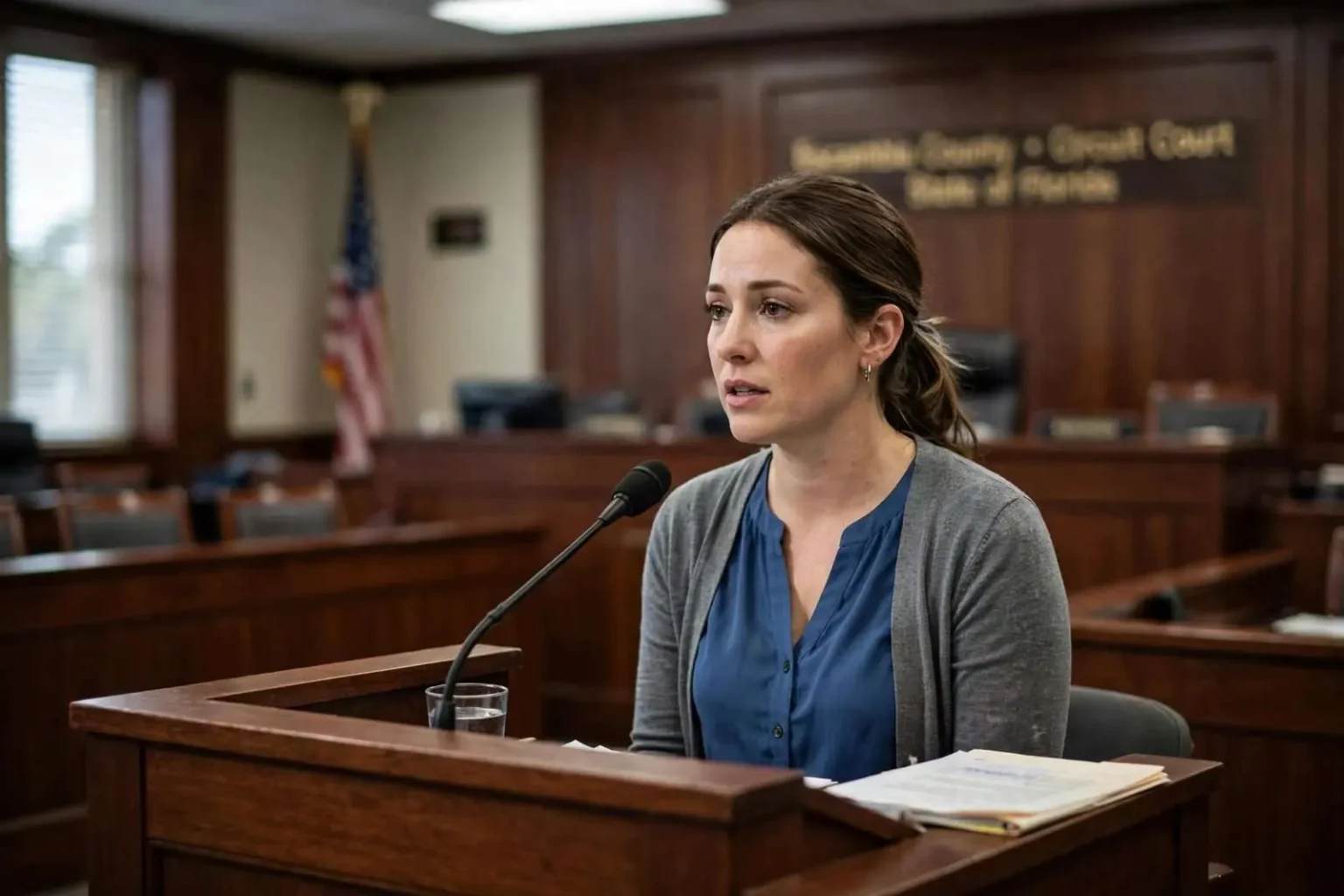
A woman took the stand Thursday in the trial of a man accused of carjacking her and raping her twice in an ordeal that began in Pensacola and ended across the state line in Alabama last year. Testifying in an Escambia County courtroom, she walked jurors through the early morning of March 19, 2019, hour by hour, describing how a routine stop for gas became a nightlong ordeal that spanned two states.
According to testimony, the woman was pumping gas at a Circle K on New Warrington Road early that morning when Joshua Edwards allegedly pulled a gun and forced her to drive him to Elberta, Alabama, a small Baldwin County town roughly 30 miles from the Pensacola neighborhood where the encounter began. The route runs west along the coast, across Perdido Bay and through some of the most rural stretches of southwest Baldwin County, ending far from the streetlights and traffic of the city where the trip started.
“I was afraid when we got to the dark wooded area,” the woman testified. When asked why, she said, “Because at that point he was trying to, well, he raped me.”
A night of attempted escapes
The woman told jurors that Edwards had just been released from prison and that he is an alleged member of the Aryan Brotherhood. She said she tried several times to escape during the ordeal, which stretched across the darkened roads between Pensacola and the Alabama line.
According to testimony, one of those attempts came when the woman crashed her blue Mazda 3 into a tree near Bayou Grande, the tidal waterway that separates Pensacola from the naval air station side of the bay. The crash did not end the ordeal. “He said he was going to shoot me and drive my car into the lake,” she testified, describing what Edwards told her after the wreck.
The woman testified that Edwards raped her again along Fenceline Road before walking with her to a house where he allegedly carjacked another woman. Fenceline Road runs through the rural area near the state line, and by the time the two women reached the house, the ordeal had covered miles of dark two-lane roads on both sides of the Florida-Alabama border.
A second victim and a 911 call
At the house, the testimony shifted to a second victim. “I’m looking at her trying to mouth to her to go get help,” the rape victim said, describing the moments inside the home when she silently urged the other woman to summon assistance while Edwards was present.
Edwards then drove away, leaving the two women behind. The other victim’s mother, Mary Staples, brought the rape victim inside her house and called 911, setting in motion the law enforcement response that followed. The call brought deputies and police into a case that crossed jurisdictions, tied together by a stolen car, a stolen weapon and two women who did not know each other before that morning.
For the jurors hearing the case, the testimony drew a line from the brightest street in the story to the darkest: a well-lit gas station pump on New Warrington Road, the black water of Bayou Grande beside a wrecked sedan, a rutted stretch of Fenceline Road, and finally the front door of a house where help was finally reached. The woman told jurors she remembered each leg of that route, and prosecutors used that memory to walk the panel through the charges one scene at a time.
How the case reached trial
The trial unfolding in Pensacola is the product of the kind of multi-jurisdiction investigation that cases like this require. A crime that begins at a gas station inside the Pensacola city limits, crosses Escambia County and ends in Baldwin County, Alabama, involves police departments, two sheriff’s offices and, ultimately, prosecutors in Florida, where the charges were brought. Investigators in such cases typically work from the victims’ accounts, the recovery of the vehicles involved, physical evidence collected along the route and the timeline reconstructed from the 911 call.
For the woman on the stand Thursday, testimony meant recounting the events in front of the man accused of them, a dynamic that victims’ advocates describe as one of the hardest parts of the criminal justice process. Florida law allows certain support measures for testifying victims, but the core experience — answering questions, in detail, about the worst night of a person’s life while the defendant sits nearby — remains central to a jury trial.
The charges in a case of this kind typically include carjacking, which under Florida law is a first-degree felony when committed with a firearm, along with sexual battery counts tied to each assault. A firearm allegation can substantially increase any sentence, and prosecutors generally present the sequence of events — the gun, the forced drive, the repeated assaults, the second carjacking — as a single continuing course of conduct.
What the testimony established
Thursday’s testimony gave jurors the geographic spine of the case: the Circle K on New Warrington Road where the woman was taken, the crash near Bayou Grande, the assault along Fenceline Road and the house where the second victim was encountered. Each location maps onto a stretch of road that investigators documented, and each stop in the sequence matched a detail the woman had given in earlier statements.
The testimony also established the timeline that ties the two carjackings together. The ordeal began in the early morning darkness and ended after sunrise, when the 911 call from the house brought help to the two women. The blue Mazda 3, wrecked near Bayou Grande, and the car taken from the second victim became the physical trail that connected the scenes.
Defense attorneys in such trials typically focus on identification, consent of witnesses to earlier statements, or gaps in the physical evidence, and cross-examination of a victim who has lived through a kidnapping and assault is often the longest and most difficult portion of the trial. Prosecutors, for their part, lean on the consistency of the account and the corroboration provided by the physical trail across two states.
Support for victims in the courtroom
Trials like this one also highlight the support network that surrounds victims of violent crime in Northwest Florida. Victim advocates with the State Attorney’s Office guide witnesses through the process, from pretrial interviews to the witness stand, and rape crisis counselors in the Pensacola area provide counseling that often continues long after a verdict. Advocates note that the delay between an arrest and a trial — measured in months, and sometimes years — adds its own strain, as victims wait while motions, continuities and scheduling conflicts move a case through the docket.
The woman’s decision to testify, and the accounts she gave of trying repeatedly to escape, form the human core of the case. Jurors heard not just the sequence of events but the fear and calculation behind each attempted escape — the crash near Bayou Grande, the attempts to get away on foot, the silent signals to the second victim inside the house. Those details, prosecutors argue, show a woman who resisted at every turn in circumstances where resistance carried a lethal risk.
The broader picture
Elberta, the destination Edwards allegedly demanded, is a farming community of fewer than 2,000 people in southern Baldwin County, an area of fields, pine stands and two-lane roads where dark wooded stretches like the one the woman described are easy to find after midnight. The distance between a busy Pensacola gas station and those quiet roads is what made the case so jarring for residents on both sides of Perdido Bay, and it explains why investigators from two states found themselves working the same trail of stolen vehicles.
Carjackings themselves are rare compared with ordinary auto theft, but their combination of armed robbery, kidnapping and assault makes them among the most serious charges a defendant can face, and sentences in Florida routinely run to decades when a firearm is used. The addition of sexual battery counts, and of a second carjacking with its own victim, multiplies the exposure Edwards faces if convicted on all charges.
Cases that cross the Florida-Alabama line are a regular feature of the Panhandle’s court system, a consequence of a border that cuts through closely connected communities. Residents of Baldwin County, Alabama, shop, work and travel daily through Escambia County, Florida, and vice versa, which means a carjacking that begins at a Pensacola gas station can end less than an hour away in a small Alabama town. Law enforcement agencies on both sides of the line maintain long-standing agreements for pursuing suspects, sharing evidence and returning victims and witnesses across the border when a case requires it.
The trial was continuing after Thursday’s testimony, with the woman’s account expected to anchor the state’s case as prosecutors presented the remainder of their evidence. The second victim and her mother, whose 911 call ended the ordeal, were also part of the chain of witnesses connecting the night’s events to the charges Edwards faces. A verdict in the case will resolve an episode that began with a gun at a gas pump and ended with two strangers bound together by a call for help.