Zoogma Brings Live Electronic-Rock to Soul Kitchen in Mobile (July 20, 2012)
Zoogma brought its wired, beat-driven live show to Soul Kitchen on Dauphin Street in downtown Mobile on Friday, July 20, 2012. The Oxford,...
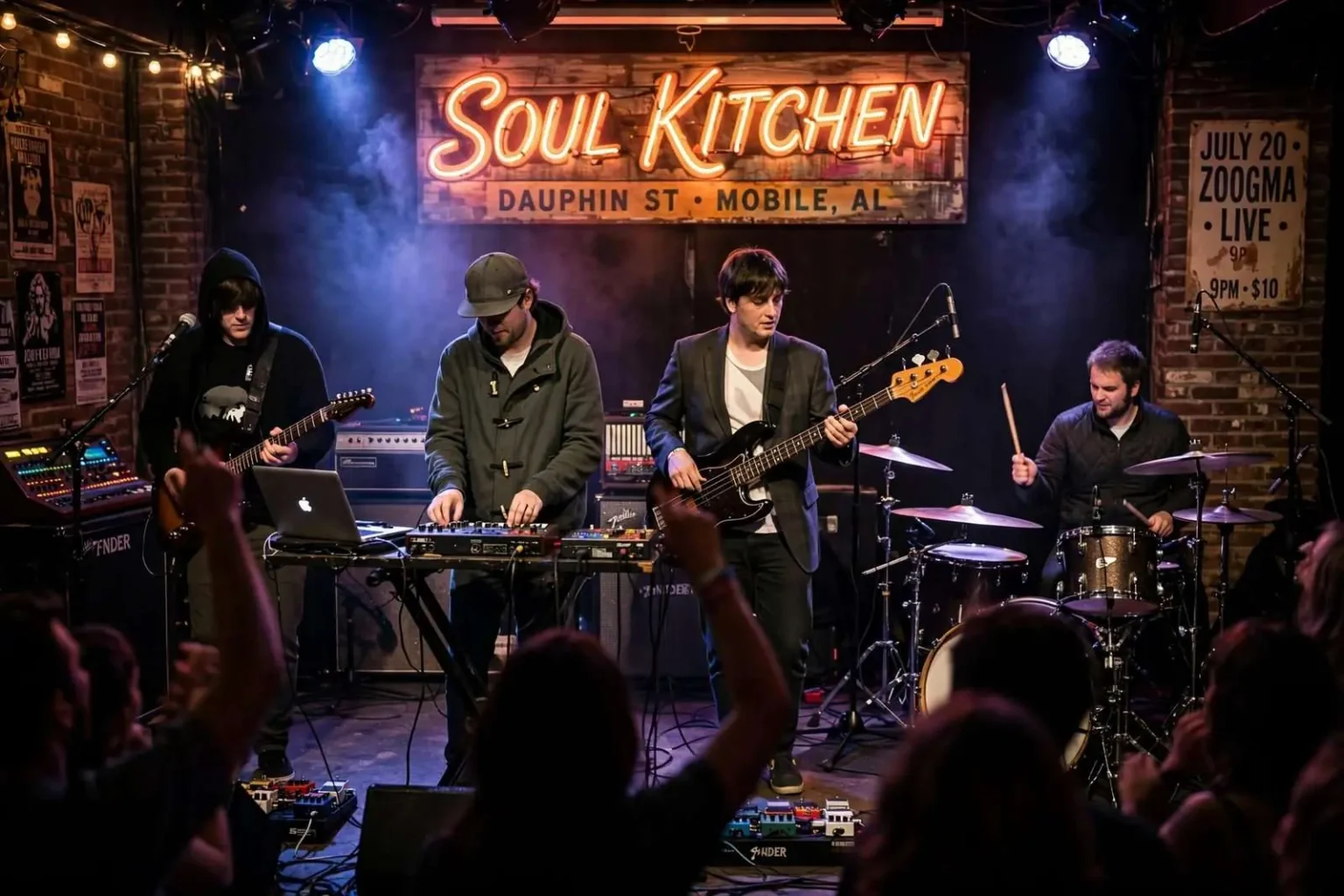
Zoogma brought its wired, beat-driven live show to Soul Kitchen on Dauphin Street in downtown Mobile on Friday, July 20, 2012, arriving in the middle of a summer that had the Oxford, Mississippi-bred quartet crisscrossing the country’s festival grounds. For the fans who packed the room, the date offered a chance to see one of the Southeast’s rising electronic-rock acts in a room built for exactly that kind of band — loud, tight, and aimed squarely at the dance floor.
The group’s formula is unusual and deliberately so: Zoogma blends the precision of a DJ with the punch of a four-piece rock group. Where a laptop act plays back its arrangements, this band performs its electronic music with guitars, drums, and live improvisation, pairing carefully crafted grooves with the kind of risk-taking that only musicians playing in real time can generate. Songs that begin as constructed tracks open up mid-performance, stretch, recombine, and snap back into their grooves with the tightness of a band that rehearses the way jam audiences expect and the way festival crowds require.
The result pulls from electronica, rock and hip-hop into something built for a moving crowd. Glitchy electronic textures ride on top of live drum grooves; guitar lines answer the synthesizers; the low end is mixed to do what the low end does in a club. It is dance music made by people who play instruments, and the distinction shapes both how the band sounds and how it tours.
From Oxford, Mississippi to the festival circuit
Zoogma came together in Oxford, the north Mississippi college town that has long punched above its weight in music, and by 2012 the band had built its reputation the way regional acts do — constant touring, relentless sets, and a live show that converted first-time listeners show by show. The quartet’s members honed their hybrid sound in a college-town scene that sat within easy range of Memphis, Oxford’s musical neighbor, and of the festival culture spreading across the Southeast in the early 2010s.
The band had released its debut album, Recreational Vehicles, ahead of a busy 2012 festival run that included Hangout, Electric Forest, Camp Bisco and a string of other dates across the country. Those three festivals mark the map of what Zoogma was becoming: Hangout on the beach at Gulf Shores, the region’s flagship event, where the band played for a home-state-adjacent crowd; Electric Forest in the Michigan woods, one of the electronic and jam scene’s signature gatherings; and Camp Bisco in upstate New York, a long-running electronic music festival with a reputation for acts that could deliver live energy.
A slot at any one of those festivals is a milestone for a young band. Holding them together on a single summer calendar meant Zoogma had moved from regional opening act to national touring act in a few years’ time, with the club dates in between — like the Soul Kitchen show — serving as the connective tissue of the tour and the place where the band could play a full headlining set.
The Soul Kitchen room
Soul Kitchen, a mainstay of Mobile’s live-music calendar, was among the downtown venues that gave touring acts a stage within walking distance of LoDa’s bars and restaurants. The room on Dauphin Street had built its booking identity around exactly this kind of act: nationally touring bands with young followings, playing in a space close enough to the street that the crowd could move between the show and the district’s nightlife without ever getting in a car.
For a Friday night in July, the pairing of band and venue made sense in every direction. Mobile’s downtown entertainment district runs along Dauphin Street — “LoDa,” the lower Dauphin corridor — where blocks of bars, restaurants and music rooms sit within a few minutes’ walk of one another. A touring band that lands a Friday there draws not only its own fans but the passersby the district supplies, and the room’s regulars had learned over the years that a summer Friday at Soul Kitchen was a reliable bet.
By 2012, Soul Kitchen had been part of the city’s live-music fabric long enough to have shepherded local audiences through the rise of the era’s touring scene — jam bands, indie acts, electronic-leaning groups, and Southern rockers alike. Its stage and sound system could accommodate a band like Zoogma, whose live show depends as much on bass weight and electronic texture as on guitars, and whose audience expects a room they can dance in.
The live electronic moment of 2012
Zoogma’s July visit placed the band squarely in the middle of a shift that was remaking live music in the early 2010s. Electronic dance music was surging nationally, but a parallel current — bands that played electronic music with real instruments — was building its own audience, particularly across the Southeast and the festival circuit. Acts in this lane traded the spectacle of the DJ booth for the drama of a live rhythm section, and crowds responded to the difference: no two shows the same, improvisation as a feature rather than a risk, and the communal energy of a rock show driving music built for dancing.
The festival circuit rewarded that hybrid. Hangout, on the white sand of Gulf Shores, had established itself as one of the country’s destination festivals, and its booking blended mainstream headliners with up-and-coming acts of exactly Zoogma’s profile. Electric Forest and Camp Bisco drew the electronic and jam audiences that formed the band’s core following. A band’s summer schedule said a great deal about its trajectory, and Zoogma’s 2012 calendar put it in the company of the scene’s rising names.
Recreational Vehicles gave those crowds something to arrive prepared for. A debut album functions as a calling card for a touring act — the recorded evidence that the live show’s energy translates to songcraft — and the record preceded the band into markets like Mobile, where fans arrived knowing the material and newcomers heard it for the first time from the stage.
Mobile’s music geography
Downtown Mobile in 2012 was in the midst of a decade-long reinvention as an entertainment district, and live music was central to it. The LoDa corridor’s clubs and venues gave the city a walkable night out — a quality larger cities cultivate deliberately — and Soul Kitchen anchored the music side of that offering. Touring acts routing between New Orleans, the Florida panhandle, and the festival grounds of the Southeast found Mobile a natural stop, and local audiences had grown accustomed to seeing national-caliber talent without leaving the city.
For fans of electronic music in particular, a date like Zoogma’s filled a gap. The genre’s national tours leaned toward major markets, and Mobile’s answer was rooms like Soul Kitchen booking the touring middle class — bands with festival credentials, growing followings, and a live show worth a Friday night. The July 20, 2012 show captured that arrangement at work: an Oxford, Mississippi quartet on the way up, a Mobile room that knew how to host them, and a downtown district that turned the whole stretch of Dauphin Street into the evening’s venue.
Inside the band’s sound
Describing Zoogma to someone who has not seen the band usually starts with that hybrid identity. The group writes and performs music that is electronic at its core — programmed textures, glitch effects, bass lines with club music’s weight — but every element runs through the hands and feet of four musicians. Drums are played, not sequenced. Guitar and bass react to the synthesizers in real time. The arrangements are composed, but the transitions between them are improvised nightly, which is why followers of the band talk about individual shows rather than a standard setlist.
The hip-hop influence in the band’s sound shows up in its rhythmic approach: grooves that sit in the pocket, beat patterns borrowed from hip-hop production, and a sense of space that lets the low end do the talking. The rock influence shows up in dynamics — the quiet-loud architecture of a rock set, the moments where the band pulls back before pushing forward again. And the electronic influence is the palette itself, the textures and effects that give the music its club-ready sheen even though it is being produced live on stage.
For a Friday-night crowd, the practical effect is a show that never asks anyone to sit down. Dance-floor audiences respond to the steady drum attack; rock audiences respond to the live performance; and the improvisational passages reward the listeners who track the band closely enough to know what is being invented in front of them.
Oxford’s role in the band’s story
Oxford, Mississippi, has a way of producing musicians who sound like nowhere else. The town’s musical identity runs through the University of Mississippi, through the Memphis influence an hour north, and through the literary and artistic culture that has made the town a way station for creative types for generations. Bands that form there tend to be musically literate and stylistically restless, and Zoogma’s fusion of electronic production values with instrumental rock fits the pattern.
The town also gave the band a college audience within walking distance, the kind of base that sustains a young act through the lean years of regional touring. By the time the band reached Soul Kitchen in July 2012, it had played the Southeast’s clubs and college towns enough times to arrive with a following, and Mobile’s proximity to that circuit — a few hours’ drive from the band’s home territory — made the date a natural stop on the summer’s route.
The festival summer as a career marker
For touring bands, a festival-heavy summer is both a payoff and a platform. The payoff is playing to crowds measured in thousands rather than hundreds; the platform is the exposure that converts festival audiences into club audiences who buy tickets the next time the band passes through. Zoogma’s 2012 run — Hangout, Electric Forest, Camp Bisco, and the string of other dates across the country — delivered both, and the club shows in between, like the Mobile date, were where that new audience could be met at close range.
The structure of that summer also reflects how the Southeast’s music economy had matured by 2012. Gulf Shores’ Hangout festival gave the region a destination event that drew national crowds to Alabama’s beaches; Electric Forest and Camp Bisco pulled the same audiences north in successive months; and the club circuit tied it all together for fans who followed the scene. A band routing through those nodes could build a national following out of a regional base, and Zoogma’s presence on that map was the evidence that it was doing exactly that.
The July 20, 2012 show at Soul Kitchen sits at the center of that story — a Friday night in Mobile, a Mississippi quartet at the height of its festival summer, and a room full of listeners getting the live version of a band whose record had already told them what to expect.