$129 Million Navy Barge Disposal Project Lands at Port of Mobile, Fueling Regional Shipbuilding Boom
A $129 million Navy Surface Ship Support Barge disposal project has arrived at the Port of Mobile, part of a broader wave of shipbuilding and industrial growth across the region.
A $129 million U.S. Navy project has arrived at the Port of Mobile, bringing what officials say is a three-year infusion of jobs and economic activity that could open the door to additional Navy work in the future.
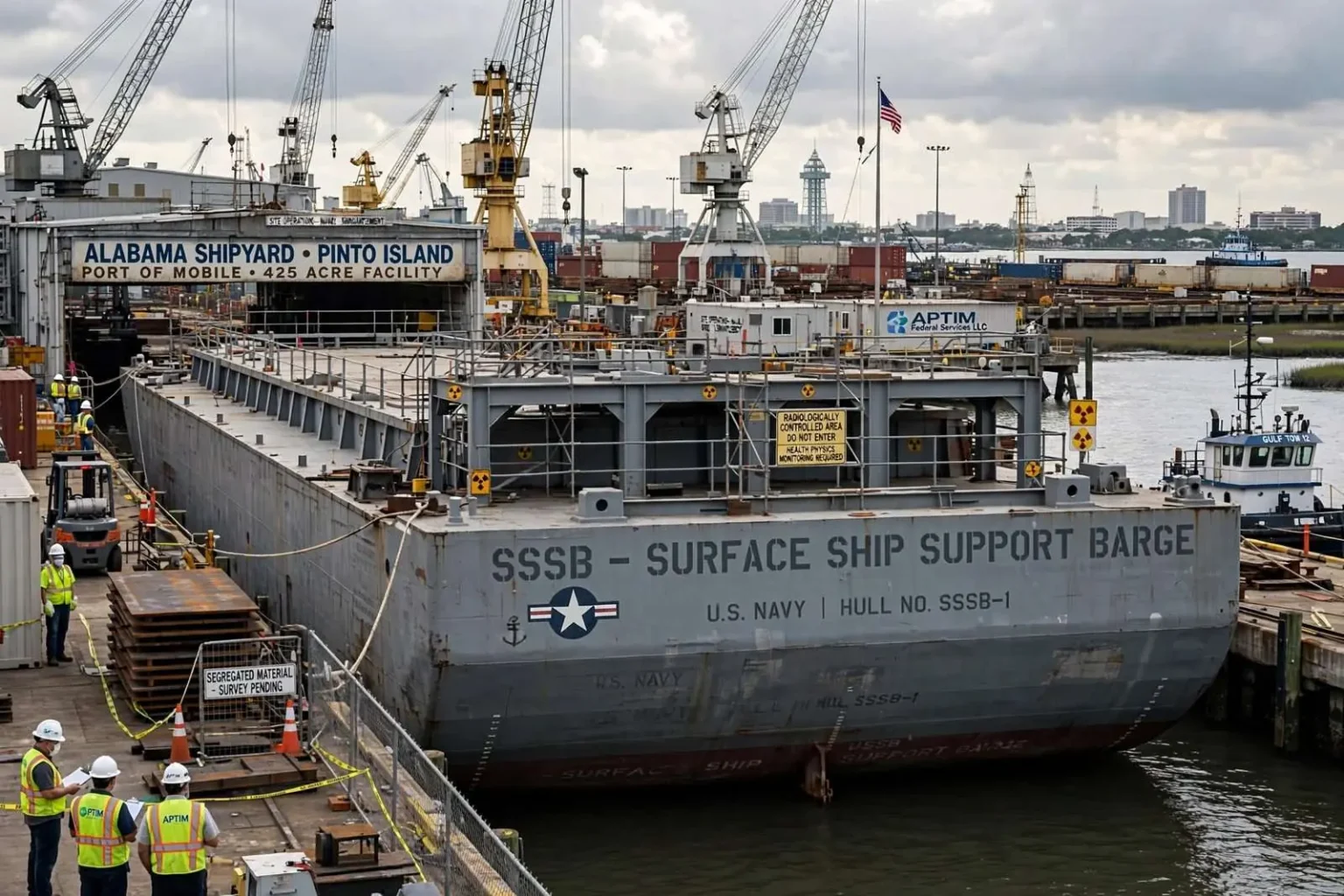
Last week, APTIM Federal Services LLC delivered a Surface Ship Support Barge to the port for a dismantlement and disposal project, set to take place at the 425-acre Alabama Shipyard facility on Pinto Island.
“The SSSB brings with it an exciting opportunity for the city of Mobile’s economy by paving the way for tremendous job growth now and through future work in the dismantlement of Navy ships with highly-skilled personnel,” Mobile Mayor Sandy Stimpson said.
Before arriving in Mobile, the barge had been in the Navy’s possession at the Newport News Shipyard in Virginia. APTIM took possession of the vessel in the James River, where it was moved into dry dock and prepared for a dry tow. From there, the barge made its way to Mobile over a 13-day journey down the East Coast and around into the Gulf of Mexico.
The dry-tow itself was a logistics exercise of the kind few ports can absorb. Moving a vessel of that size from the James River, down the Atlantic seaboard, around Florida and up into the Gulf required tugs, escort arrangements, weather windows and berthing coordination across multiple port authorities — and the fact that Mobile was the destination says a great deal about the infrastructure now standing on Pinto Island. The 425-acre Alabama Shipyard site gives the project something increasingly scarce on the American coast: room. Dismantlement work demands laydown space for segregated materials, wharf capacity for a vessel of this scale, and industrial services — cranes, trucking, rail — that the Port of Mobile has spent the last decade expanding.
The SSSB is a radiologically controlled dockside refueling facility that was converted from a Navy tanker.
Vessels of this class occupy a niche between ship and shore facility. Converted from an oiler hull, the barge was fitted out as a floating platform where nuclear-powered warships could dock for refueling and radiological work without tying up a fixed pier at a nuclear shipyard. Its radiologically controlled spaces — compartments where reactor components were handled — are precisely what make its disposal a specialized undertaking rather than ordinary scrapping, and why the work must proceed under strict Nuclear Regulatory Commission and Navy radiological controls, with health physics monitoring, contamination surveys and documented release criteria for every ton of material that leaves the site.
A National Disposal Mission With a Mobile Address
Officials say the disposal project will rely on local hiring and training, local materials and supplies, and local trucking and hotel services, while also making use of shipyard, port and rail infrastructure and recycling non-impacted steel from the vessel.
That sourcing model matters as much as the headline number. A three-year, $129 million project spent largely on local labor ripples through the regional economy in wages, supplier contracts and service work — the trucking runs, hotel nights, industrial gases and scrap logistics that a dismantlement project consumes continuously. Mobile’s maritime workforce, built over generations of shipbuilding, port operations and offshore work, includes many of the specific trades the job demands: welders, riggers, crane operators, shipfitters and radiation safety technicians. Training programs will add to that base, and the skills involved — particularly radiological work — are transferable to whatever Navy work follows.
Alan Weakley, president of the APTIM business unit overseeing the disposal, said the project marks a significant step in the Naval Sea Systems Command’s broader effort to safely and cost-effectively reduce the number of inactive nuclear reactors in both vessels and shore facilities.
“APTIM is proud of our contribution to safely and efficiently dispose of this once strategic asset. We are also proud of our partnership with Alabama Shipyard and their impressive safety record,” Weakley said. “APTIM has been a part of the fabric of Mobile for many years with our Port Modernization team here.”
APTIM’s presence in the city predates this project. The firm’s Port Modernization work — the long-running capital program that rebuilt and expanded the Port of Mobile’s terminals, container yards and intermodal connections — made the company a familiar contractor on the waterfront, and the disposal contract extends that relationship from construction to heavy industrial dismantlement. That continuity is part of what persuaded federal program managers that Mobile could absorb a project of this sensitivity.
The reactor backlog driving the work
The Naval Sea Systems Command — NAVSEA, the Navy’s shipbuilding and maintenance command — has carried a backlog of defueled, reactor-bearing vessels and facilities for decades. Nuclear-powered ships cannot be scrapped the way conventional hulls are: reactor plants retain activation and contamination long after a ship leaves service, and their disposal historically concentrated at government yards with nuclear certifications, most famously on the West Coast. Mobile’s arrival in that world marks a geographic shift — Gulf Coast yards stepping into disposal work that for generations lived almost entirely at the Navy’s established nuclear facilities.
The timing compounds the significance. Mobile’s shipbuilding sector has been on a run of federal investment, with Austal USA’s expansion into steel shipbuilding adding submarine modules and Navy auxiliaries to a yard long known for aluminum littoral combat ships. The Alabama Shipyard’s Pinto Island site — a working yard with decades of repair history on the city’s waterfront — now joins that industrial base with work no other Gulf port is performing. Each federal dollar that lands in Mobile’s maritime sector tends to attract more, because the workforce, the suppliers and the certifications that one project builds become the qualifications the next contract requires.
What It Means for Mobile
For the city, the project lands at a moment when its port economy is already expanding. The Port of Mobile has grown into one of the busiest deepwater ports on the Gulf, anchored by container terminals, bulk and breakbulk piers, and a rail network that pushes freight inland to the Midwest. The Alabama State Port Authority’s terminals and the private terminals around Mobile Bay share the same labor pool and supplier ecosystem that a three-year dismantlement project will draw on — which is why local officials describe the SSSB less as an isolated contract than as another layer of the city’s industrial identity.
Mayor Stimpson’s emphasis on “future work in the dismantlement of Navy ships” points to the prize behind this one. Federal disposal programs are multi-year, multi-vessel affairs; a facility that proves it can execute radiological dismantlement safely, on schedule and within regulatory expectations becomes a candidate for the vessels that follow. The Navy’s inactive fleet and shore facilities hold a continuing supply of reactor plants awaiting disposal, and every contract awarded outside the traditional nuclear yards widens the map of where such work can go.
The recycling component also gives the project an environmental dimension that local officials have highlighted. Non-impacted steel from the vessel — material surveyed and released from radiological controls — re-enters the scrap stream, and the segregation discipline required to document every batch builds practices that recycling-heavy industries in the region can draw on. Ports along the Gulf have long handled scrapping of merchant vessels; adding federal radiological work raises the standard and, with it, the value of the workforce that learns it.
A three-year clock
Three years of steady work — high-skill, safety-critical, and concentrated on one site — is the kind of economic activity that changes a yard’s trajectory. Apprentices trained on this project will carry certifications that outlast it; suppliers who qualify for radiological work gain a credential competitors lack; and the safety record that APTIM praised in its Alabama Shipyard partner becomes the calling card the site presents to the next program office. Mobile’s maritime community has watched federal investment arrive in waves over the past decade — port modernization first, then shipbuilding expansion — and the SSSB extends that sequence into a sector the city has never touched: the retirement of the Navy’s nuclear fleet.
The barge’s journey itself illustrated the reach of the regional logistics network. Thirteen days from the James River to Mobile Bay meant coordination with tow operators, port agents and dockyards along the entire eastern seaboard and the Florida straits, and the arrival at the Alabama State Docks put the vessel within minutes of the rail lines, heavy-haul routes and industrial suppliers that the dismantlement will draw on daily. Cities that compete for such projects are, in effect, competing on that combination: wharf depth, yard space, labor, and the road and rail connections that move material in and recycled steel out. Mobile’s decade of infrastructure spending positioned it to answer that competition, and the SSSB contract is the clearest evidence yet that the answer was heard.
For residents, the visible signs will be modest compared with the sums involved — trucks on the causeway routes, workers at the Pinto Island gates, a vessel along the wharf where tankers and cargo ships usually moor. The measurable signs will accumulate in payroll, contracts and the training pipeline feeding them. And the strategic sign, the one local officials care most about, is already legible in the project’s arrival: the Navy chose Mobile for work it once reserved for a handful of certified yards, and if the three years go as promised, more such choices are likely to follow.