Austal USA Sale Talks Advance as Parent Company Extends Hanwha Review, Keeps Wildcat Bid Alive
Austal Ltd. says it has extended Hanwha's due diligence on Austal USA and opened commercial negotiations, while continuing talks with Florida-based Wildcat Infrastructure. Both non-binding offers for the Mobile shipyard exceed $1 billion.
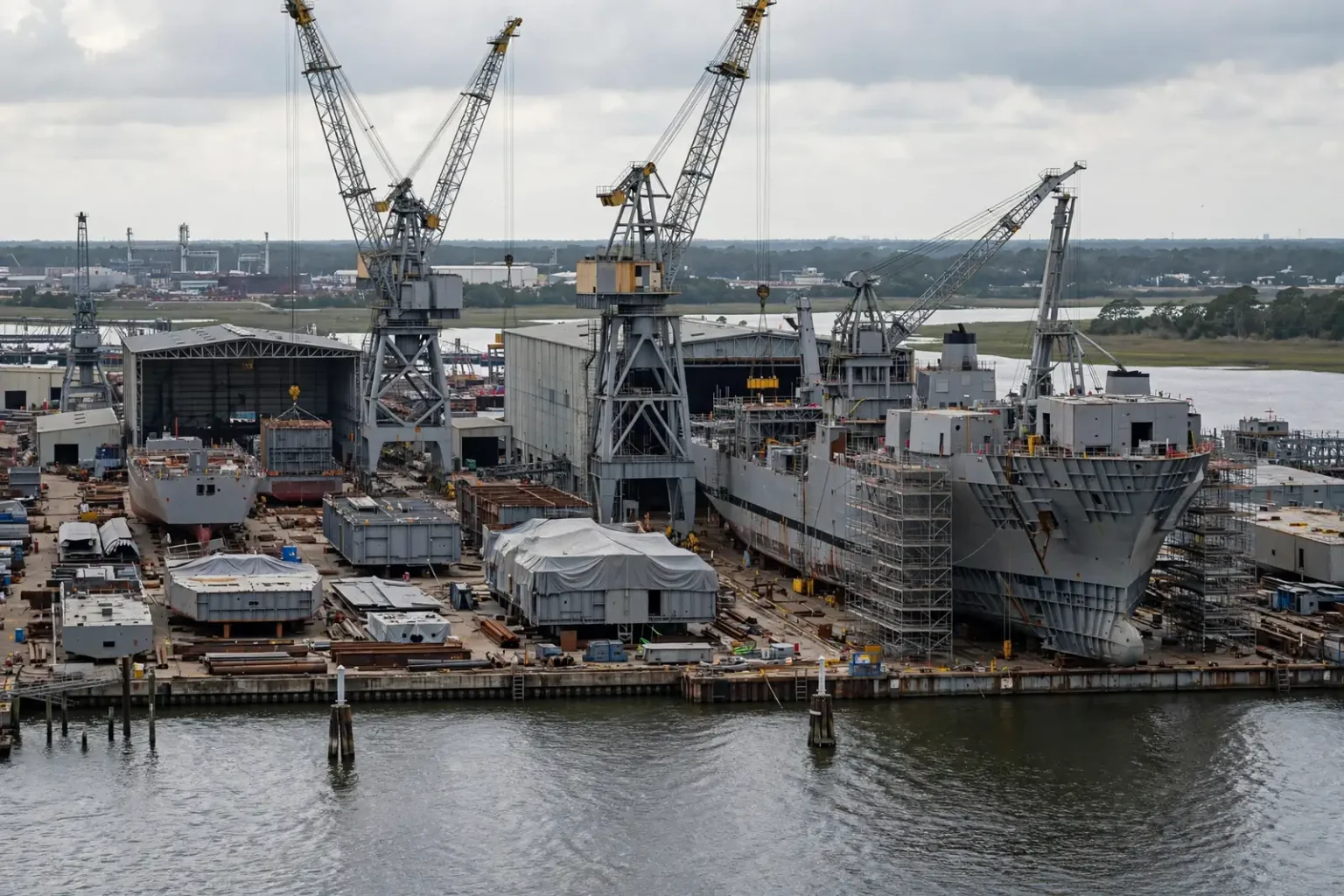
MOBILE, Ala. — Talks over a possible Austal USA sale, involving the Mobile shipyard that employs more than 3,000 people on the Mobile River, are moving forward, according to its Australian parent company, Austal Ltd. The company told investors this week that it has given South Korean conglomerate Hanwha more time to complete its review of the business and has opened commercial negotiations, while it continues talks with a second bidder, Florida-based Wildcat Infrastructure.
Austal Ltd. provided the brief update Wednesday, addressing two potential billion-dollar offers for its Mobile-based subsidiary. Neither offer is binding, and any deal would require government approvals.
What Austal Ltd. said
In a statement released Tuesday, Austal Ltd. said it had extended the due diligence period for Hanwha “to enable it to submit a formal proposal to acquire the business entities and operations of Austal USA.”
“In addition, commercial negotiations between Hanwha and Austal have commenced regarding details of a potential transaction and Austal is seeking professional advice on the various taxation implications of a transaction,” the statement said. “Regarding due diligence, while the substantive issues in the data room have been closed out, and the original parameters of the transaction have not changed, a tail of lower materiality data requests remains outstanding.”
The company said it “also remains in on-going dialogue with Wildcat Infrastructure LLC in relation to their non-binding indication of interest.”
Two bidders, two very different profiles
Hanwha
The first offer came in early August, when Hanwha Defense USA Inc., a subsidiary of the South Korean conglomerate, pitched an “indicative, non-binding and conditional offer” to buy Austal USA for $1.05 billion to $1.2 billion.
Austal Ltd.’s board allowed Hanwha to conduct a four-week due diligence review of Austal USA’s operations. Later in August, a delegation of Alabama officials traveled to South Korea to visit Hanwha facilities.
Hanwha has experience in military shipbuilding, and its interest appears to line up with a push by the Trump administration to tap foreign shipbuilding know-how to speed up American military ship production. A memorandum from President Donald Trump has opened a path for foreign shipbuilders to win U.S. defense contracts, but to take advantage of it they must build or buy a shipyard in the United States.
Hanwha already owns one American yard. It purchased the Philly Shipyard in Philadelphia in a deal completed in late 2024. Winning new business for that yard has reportedly been difficult, in part because it is not economically competitive with shipyards in South Korea or China.
The company’s shipbuilding arm, Hanwha Ocean, is one of South Korea’s largest shipbuilders. Formerly known as Daewoo Shipbuilding & Marine Engineering, it was acquired by the Hanwha Group in 2023 and builds commercial ships as well as naval vessels and submarines for the South Korean navy.
Wildcat Infrastructure
In early September, Wildcat Infrastructure, a Florida-based investment company, made a similarly non-binding proposal, saying it was willing to pay $1.25 billion to $1.35 billion for Austal USA — a higher range than Hanwha’s.
Wildcat only recently launched a defense business. A Wildcat executive has said its offer represents “American capital,” and the company has said it would keep the Austal name.
Since the two offers surfaced, speculation has varied over which would be more likely to win the required government approvals. Sales of defense contractors, particularly to foreign buyers, typically face federal review, including national security scrutiny.
How Austal USA came to Mobile
Austal USA began in Mobile in 1999 as a joint venture between the Australian shipbuilder and a local partner, and it later became a wholly owned subsidiary of Austal Ltd. The yard grew from building aluminum ferries and commercial vessels into a major Navy contractor, winning work on the littoral combat ship program and the expeditionary fast transport program in the 2000s and early 2010s.
In 2022 it won a Coast Guard contract to build the service’s Offshore Patrol Cutters, a program that pushed the company deeper into steel shipbuilding and led to new construction halls on its riverfront campus. Its work on submarine modules has added yet another line of business tied to the Navy’s highest-priority programs.
That growth has made the shipyard a central part of Mobile’s industrial economy, alongside the Airbus assembly lines at the Mobile Aeroplex at Brookley and the Port of Mobile.
Why Austal USA matters to Mobile
Austal USA is one of the largest private employers in the Mobile area. The company employs more than 3,000 people at its yard and has expansion projects underway that it says will raise its workforce to 5,000 or more.
The shipyard launches a variety of U.S. Navy and Coast Guard vessels into the Mobile River. It has built the Navy’s Independence-variant littoral combat ships and Spearhead-class expeditionary fast transports, and in recent years it has expanded into steel shipbuilding. The yard also builds modules that go into the Navy’s Columbia-class and Virginia-class nuclear-powered submarines.
Modular and distributed shipbuilding
The stakes extend beyond Mobile. Austal USA is heavily involved in two approaches the Navy is counting on to build more ships, faster:
- Modular shipbuilding, in which vessels are built in large sections that are later joined together.
- Distributed shipbuilding, in which multiple shipyards contribute modules to a single finished vessel.
The approaches promise to increase the number of ships built each year, but they also add logistical complexity. Among the risks: problems at smaller yards can ripple into delays at larger ones.
Analysts examining the Navy’s push toward distributed shipbuilding have noted that modular manufacturing is creating new opportunities for Austal’s Mobile yard. The shipyard has a reputation for quality work but has stumbled with management turnover, underbid contracts and a federal investigation, and it is now up for sale by its Australian parent.
The Navy’s top officer has praised the yard. Adm. Daryl Caudle, the chief of naval operations, cited Austal USA in January as a pioneering example of a “paradigm shift” he said other shipyards needed to make.
A tight labor market on the Gulf Coast
Like other American shipbuilders, Austal USA faces the challenge of hiring and keeping the workers it needs for projected growth. Competition for skilled tradespeople along the Gulf Coast is fierce, with Ingalls Shipbuilding, Austal USA and Bollinger Mississippi Shipbuilding all within commuting distance of one another.
Any change in ownership could affect how the company invests in its workforce and facilities, though neither bidder has publicly detailed specific plans for the Mobile yard beyond Wildcat’s statement that it would keep the Austal name.
The approval question
Any purchase of a major U.S. defense shipyard is likely to draw close federal scrutiny. Foreign acquisitions of American businesses with national security significance can be reviewed by the Committee on Foreign Investment in the United States, an interagency panel that examines whether a deal poses security risks and can recommend conditions or blocking a transaction. Defense contractors that handle classified work must also maintain security arrangements approved by the Defense Department.
Austal USA itself has long operated as the American subsidiary of a foreign parent, so foreign ownership of the Mobile yard is not new. Still, a sale to either bidder would change who controls one of the Navy’s key suppliers, and approval decisions could weigh factors ranging from security safeguards to the buyer’s plans for the workforce and facilities.
What happens next
Austal Ltd.’s update suggests the Hanwha process is furthest along. The extended due diligence period is meant to let Hanwha submit a formal proposal, and commercial negotiations over the details of a potential deal have begun. Austal Ltd. is also weighing the tax implications of a sale.
At the same time, the parent company is keeping talks open with Wildcat. Neither bidder has made a binding offer, and Austal Ltd. has not said when it expects to make a decision. Any agreement would still need approval from the relevant governments before it could close.
For now, work continues at the Mobile shipyard, where Austal USA’s Navy and Coast Guard programs and its submarine module work remain underway.