18-year-old seriously hurt in head-on crash with tractor-trailer in Washington County, Florida
An 18-year-old from Wellington was seriously injured in a head-on crash with a tractor-trailer on State Road 20 in Washington County, Florida.
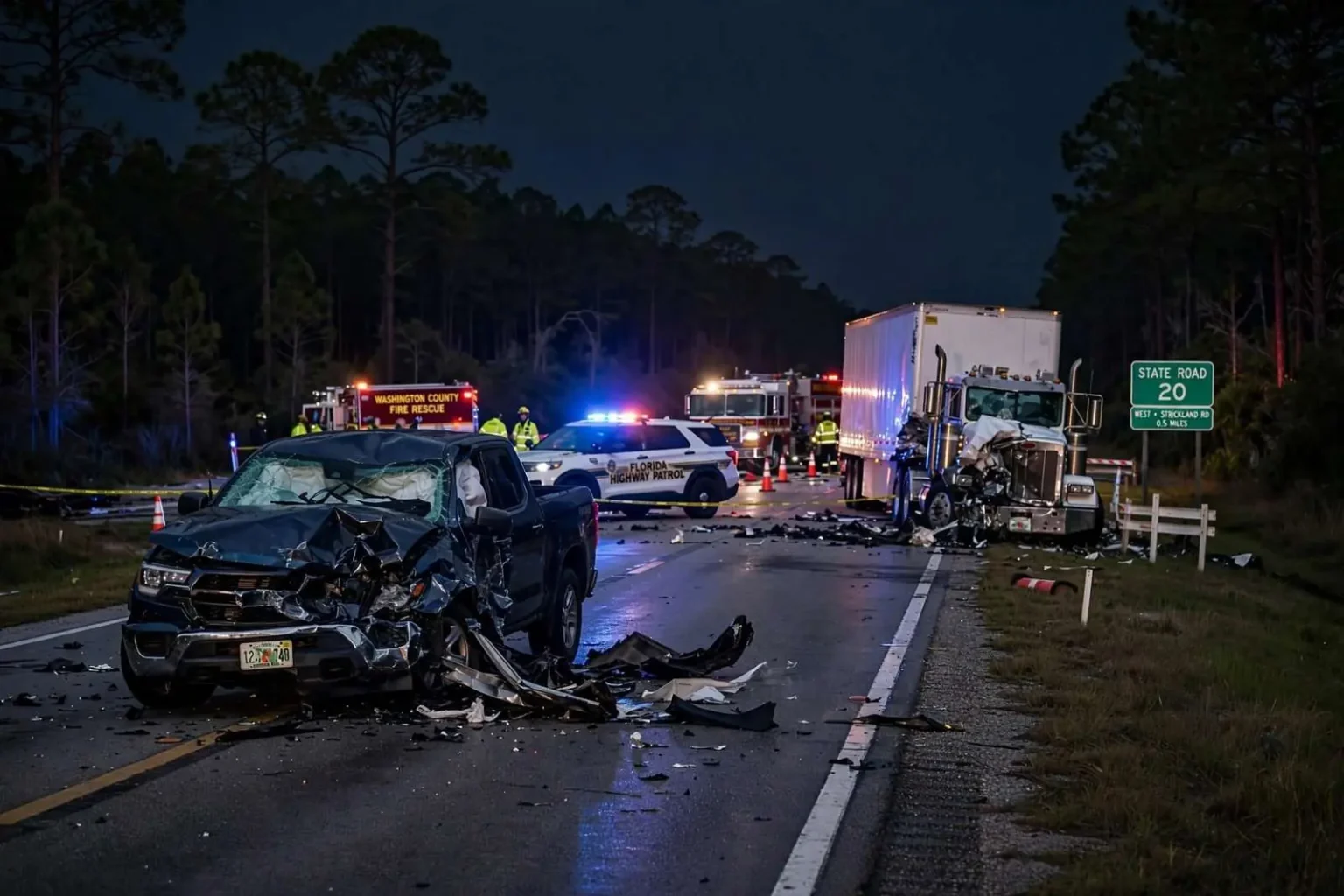
WASHINGTON COUNTY, Fla. — An 18-year-old is dealing with serious injuries after his pickup truck collided with a tractor-trailer on State Road 20 early Tuesday morning, according to the Florida Highway Patrol.
The head-on crash happened on State Road 20 just west of Strickland Road around 12:40 a.m. Oct. 11. Troopers said the 18-year-old from Wellington was traveling west on State Road 20 in a pickup truck when he crossed the centerline into the eastbound lane. The pickup came into the path of the tractor-trailer and collided head-on.
According to the Highway Patrol’s account, the pickup truck came to rest in the eastbound lane facing west, while the tractor-trailer came to a controlled stop in the eastbound lane facing east. The 38-year-old female driver of the tractor-trailer, from Montgomery, Alabama, sustained minor injuries, the release said.
The timing of the crash — in the middle of the night on a rural highway — framed the response. With traffic nearly nonexistent at that hour and visibility limited to what headlights provide, the wreck was discovered and reported as emergency crews responded to a scene that, in daylight, would have presented its own challenges on a two-lane road.
A rural stretch of State Road 20
State Road 20 is one of the principal east-west corridors of the Florida Panhandle, running from the Panhandle’s coastal communities near Niceville through rural Washington County toward the Tallahassee area. In the stretch west of Strickland Road, the highway crosses sparsely populated country — pine flatwoods, scattered farms, and small unincorporated communities — with long sight lines interrupted by curves and the occasional intersection.
Washington County, with the town of Chipley as its county seat, sits along the Interstate 10 corridor between Pensacola and Tallahassee, and its residents routinely drive two-lane state roads like SR 20 for commuting, school, and errands. Traffic volumes are modest compared with the interstate, but the road carries a steady mix of passenger vehicles, logging trucks, and commercial traffic, including the tractor-trailers that move goods between the Panhandle’s ports, distribution centers, and inland markets.
Centerline crossings are a persistent hazard on roads of this type. Federal and state highway safety data consistently show that head-on collisions, though a small share of total crashes, account for a disproportionate share of serious injuries and deaths, because the closing speed of two vehicles traveling in opposite directions multiplies the force of impact. On a two-lane road, the margin between a routine drive and a catastrophic head-on collision can be a moment of distraction, fatigue, or a wrong pedal input.
The overnight factor
Safety researchers have long identified the hours around midnight as among the most dangerous on rural highways. Driver fatigue peaks in those hours, and the visual cues that help drivers judge their lane position are reduced to the roadway’s painted lines and the glare of oncoming headlights. Crossings of the centerline at that hour, when they occur, are often severe for exactly the reason this crash illustrates: the oncoming vehicle has no room and no time to get out of the way.
The presence of a tractor-trailer as the oncoming vehicle made the physics worse. A loaded commercial truck cannot maneuver out of the path of a wrong-way vehicle in the fractions of a second available, and the mass difference between a pickup truck and a semi means the smaller vehicle absorbs most of the collision energy. Commercial drivers are trained to brake, maintain their lane, and steer away when possible, but head-on encounters of this kind leave little for even an experienced truck driver to do.
How the investigation proceeds
The Florida Highway Patrol’s traffic homicide and crash investigation units handle serious-injury wrecks with the same attention given to fatal crashes, reconstructing the sequence of events from physical evidence: skid marks and gouges on the pavement, the final rest positions of both vehicles, damage patterns, and the roadway itself. Investigators will also have examined whether impairment, fatigue, distraction, or a medical event played any role, though the patrol’s initial release did not attribute a cause.
That evidence-gathering takes time. A preliminary narrative — who was traveling where, and in what direction — can be released within days, while conclusions about contributing factors generally wait until the reconstruction is complete and any necessary laboratory work is finished. Charges, if any are warranted, follow the completed investigation rather than the initial report.
For the two drivers, the aftermath follows separate paths. The 18-year-old pickup driver’s serious injuries made him the crash’s principal casualty, and treatment for injuries of that severity typically means transport to a trauma center and an extended recovery. The tractor-trailer driver’s minor injuries illustrate the disparity in outcomes that mass difference produces; she was evaluated and, per the release, sustained non-serious harm.
Commercial carriers involved in serious crashes also face their own post-crash requirements. Motor carriers must document the wreck, preserve driver logs and records that show hours of service, and cooperate with any federal or state review of the trip. Those records exist precisely so that when a commercial vehicle is involved in a crash of this severity, investigators can account for the driver’s schedule, the truck’s condition, and the load it carried.
Head-on crashes and the push for safer roads
Crashes like this one are part of the case that highway safety advocates make for infrastructure improvements on rural two-lane roads. Relatively inexpensive countermeasures — centerline rumble strips, rumble stripes with added shoulder width, high-visibility pavement markings, and signage at known problem curves — have been shown to reduce centerline crossings sharply. Florida’s Department of Transportation has installed rumble strips along many of its rural corridors for that reason, and SR 20 has been among the roads targeted for safety reviews over the years.
On a larger scale, safety engineers distinguish between preventing the error and forgiving it. Prevention measures try to keep the vehicle in its lane; forgiveness measures — median barriers, wider clear zones, breakaway poles — reduce the harm when the error happens anyway. On a rural two-lane highway, most of the practical benefit comes from prevention, which is why centerline treatments are the standard recommendation where head-on crash history accumulates.
The hour of the crash also feeds the broader discussion about fatigue. Safety campaigns directed at young drivers emphasize the risks of driving in the late-night hours, and the combination of an 18-year-old driver, a rural highway, and a post-midnight timeline is the kind of profile that appears repeatedly in serious crash statistics across the country.
Emergency response in rural counties
A serious crash in the middle of the night in Washington County draws on the resources of a rural emergency network: volunteer and career fire-rescue units, county EMS, and the responding troopers, coordinated through dispatchers who must locate a scene that callers may only be able to describe approximately. Air ambulance services play a regular role in the Panhandle’s serious rural crashes, where the distance to the nearest trauma-capable hospital makes flight transport the difference in minutes that matters for survival.
Rural counties across the Panhandle train for exactly this kind of incident. The combination of a commercial truck and a pinned passenger vehicle requires specialized extrication equipment and the knowledge to stabilize a heavy vehicle while cutting into a smaller one, and mutual-aid agreements let neighboring counties send resources when a single department cannot cover the scene alone.
Closing a stretch of State Road 20 for the investigation also has real consequences in a rural county. With few parallel routes, a shutdown of the main east-west highway diverts traffic onto farm roads and through small communities until the scene is cleared and the roadway reopened.
What the initial report tells residents
The Florida Highway Patrol’s release, in cases like this, is a starting point rather than a final word. It establishes the basic narrative — the time, the location, the directions of travel, the rest positions of the vehicles, and the nature of the injuries — while the deeper questions of cause and fault await the completed investigation. Local residents reading the report should expect updates only if the patrol identifies a contributing factor significant enough to note publicly.
For drivers who travel State Road 20 regularly, the crash is a reminder of the conditions that define Panhandle rural driving: long, dark stretches with modest traffic, oncoming trucks whose closing speed leaves no recovery time, and the narrow painted line that is all that separates the lanes. Safety officials’ advice in the wake of serious rural crashes is consistent — leave the fatigue hours to the rest stops, watch the centerline, and assume the oncoming vehicle will stay where it belongs until proven otherwise.
The investigation remains ongoing, and the patrol’s findings will determine whether any citations or charges result from the Oct. 11 wreck west of Strickland Road. In the meantime, both drivers’ injuries — serious for the young man from Wellington, minor for the Montgomery truck driver — stand as the human measure of a collision that, in the end, was over in seconds on an empty stretch of rural highway.
Officers and troopers responding to wrong-way and centerline crashes also document everything visible at the scene — roadway lighting, weather, signage, and sight distances — so that the completed file reflects not just what happened inside the vehicles, but the conditions on the highway itself. That record serves families, insurers, and any court proceedings that follow, and it feeds the data that highway engineers use when deciding where the next round of safety improvements should go.