2014 South Alabama Film Fest announces lineup
The 2014 South Alabama Film Fest returns Sept. 12-14 with feature films, documentaries and a shorts block screening at venues across downtown Mobile.
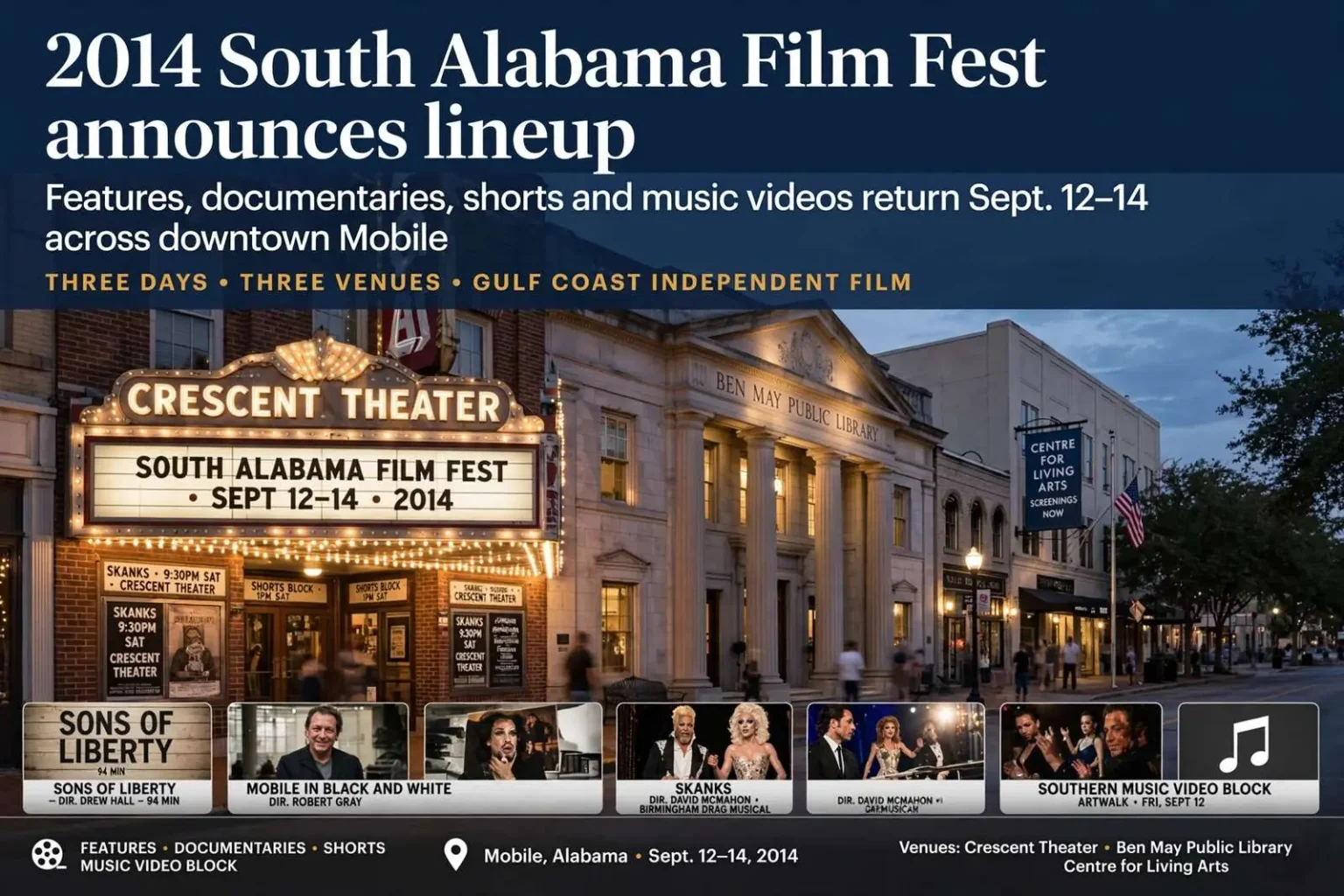
The South Alabama Film Fest returns Sept. 12-14 with a 2014 lineup of feature films, documentaries and shorts screening at venues across downtown Mobile.
The festival has grown into one of the Gulf Coast’s showcase events for independent film, mixing works with direct Alabama ties — from films shot in the state to documentaries about its communities — alongside national and international independents that rarely screen in the region. Over three days, downtown Mobile’s museums, libraries and historic theaters become screening rooms, and the festival’s footprint doubles as a walking tour of the city’s cultural district.
The 2014 edition leans into that mix, with a feature program spanning an action thriller, two demanding documentaries, and a portrait of Birmingham’s drag theatre scene, plus a shorts program and a music video block timed to the city’s Friday night ArtWalk.
Features and documentaries
Among the feature presentations: Sons of Liberty — Director Drew Hall; 94 min; Bernheim Hall at Ben May Public Library; Sat., 9/13. A special operations unit races to stop a radical mercenary group from building a micro nuclear device.
The festival’s action entry is also its most Alabama-rooted production: Drew Hall shot the thriller in the state, and its screening in Bernheim Hall — the grand room inside the Ben May Public Library downtown — gives the film a stately setting. The premise is pure ticking-clock cinema: an elite special operations unit racing to keep a micro nuclear device out of the hands of mercenaries, a genre story told with the pace and production scale that festival audiences don’t always expect from independent fare.
Mobile in Black and White — Director Robert Gray; 92 min; Centre for Living Arts; Sat., 9/13. A documentary examining how racism persists in the structures of a supposedly post-racial world, built from local residents’ and experts’ perspectives.
Gray’s documentary is the lineup’s most locally pointed work — a film about American racism that builds its argument from the voices of its own community. Structured around interviews with Mobile residents and subject-matter experts, it examines how racial disparities persist in institutions and everyday life decades after formal segregation ended. The title’s framing — a country that describes itself as beyond race while remaining divided in practice — sets up the kind of conversation-starting screening that festivals do best, and the Centre for Living Arts’ gallery setting provides space for the discussion that follows.
The Road to Livingston — Director Erik Mauck; 86 min; Centre for Living Arts; Sat., 9/13. Delia Meyer fights for the innocence of her brother, convicted of triple murder in 1999 and now on death row.
The second of the festival’s heavyweight documentaries follows a family’s decades-long fight with the criminal justice system. Mauck’s film centers Delia Meyer, whose brother was convicted of a 1999 triple murder and sentenced to death, as she works to prove his innocence — a story that sits at the intersection of the wrongful-conviction genre and the intimate family drama, and one that invites audiences to consider how capital cases are investigated, tried and appealed.
Skanks — Director David McMahon; 85 min; Crescent Theater; Sat., 9/13 at 9:30 p.m. A documentary following an original drag musical mounted by a Birmingham community theatre.
The late-night slot belongs to the festival’s most exuberant film. McMahon’s documentary goes behind the scenes of a Birmingham community theatre as it stages an original drag musical — a story about reinvention, performance and community that gives the festival its Friday-night-energy anchor. The Crescent Theater, the compact downtown cinema beloved by Mobile’s film community, is a fitting room for it.
Shorts, music videos and more
A Shorts Block (60 min) screens at the Crescent Theater at 1 p.m. Saturday, followed by Last Stop, Flamingo, the Homespun series, Stomping Ground and Josephine Decker’s Thou Wast Mild and Lovely.
The Saturday afternoon shorts program packs a festival’s worth of filmmaking into a single hour — an economical sampler for audiences who want the full range of independent work, from comedy to drama to experiment. Short blocks are also where festivals showcase emerging directors, and this year’s block carries a notable headliner: Josephine Decker’s Thou Wast Mild and Lovely, a work from a director whose boundary-pushing style would soon make her one of the most talked-about names in American independent cinema. Sharing the program are Last Stop, Flamingo, the Homespun series and Stomping Ground — a lineup that moves from Gulf Coast flavor to stranger territory.
The 1 p.m. timing makes the block an easy addition to a festival Saturday: audiences can catch the shorts at the Crescent and still make the evening’s features across downtown.
The Southern Music Video Block
A Southern Music Video Block debuts at 6 p.m. Friday, Sept. 12, during ArtWalk in the CLA Art Park, featuring videos from Alabama artists including The Breton Sound, The Glass Jars and The Honorable South.
The newest addition to the festival’s programming is also its most public. Rather than a ticketed screening inside a theater, the music video block unspools outdoors in the CLA Art Park, timed to Mobile’s ArtWalk — the monthly Friday evening when downtown galleries and studios open their doors and the streets fill with browsers. The format turns the festival’s opening night into a street-level event, with videos projected for passersby as part of the ArtWalk circuit.
The lineup spotlights Alabama’s independent music scene. The Breton Sound, The Glass Jars and The Honorable South represent a cross-section of the state’s rock and soul acts, and the video block gives their visual work a festival platform. For the bands, it is exposure to an arts crowd; for the festival, it is a bridge between Mobile’s film and music communities — two scenes that share audiences, venues and volunteers.
ArtWalk itself has become one of downtown Mobile’s signature traditions, drawing crowds into the historic Lower Dauphin district on Friday evenings. Screening the video block inside it positions the film festival within the city’s broader cultural calendar and reaches an audience that might not otherwise buy a festival pass.
Three venues, one weekend
Screenings span multiple downtown venues, including the Crescent Theater, Ben May Public Library and the Centre for Living Arts.
The venue map is a tour of downtown Mobile’s cultural infrastructure. The Crescent Theater on Dauphin Street is the city’s arthouse institution — a small, single-screen cinema with a devoted following. The Ben May Public Library, the main branch of the Mobile Public Library system, offers Bernheim Hall, a spacious and elegant auditorium steps from Government Street. And the Centre for Living Arts, adjacent to the Saenger Theatre, provides gallery space whose flexibility suits documentaries and post-screening conversation alike.
Distributing screenings across the three sites keeps the festival walkable — every venue is within a few blocks — and spreads the event’s energy through the downtown core, bringing festival crowds past restaurants and bars during the screenings and between them.
Festival organizers encourage filmgoers to consult the full schedule and trailers ahead of the weekend.
With features, documentaries, shorts and music videos spread across three venues and three days, planning pays off. The festival’s schedule and online trailers let audiences sample the lineup in advance — useful in a program where a documentary about the death penalty and a late-night drag musical share billing. Passes and individual tickets are handled through the festival’s usual outlets, and the weekend’s compact scale means committed filmgoers can realistically see nearly everything.
The Sept. 12-14 run marks another chapter for a festival that has become part of Mobile’s cultural identity — a weekend when the Port City turns out for independent film, from its own backyard and far beyond it.
Mobile’s festival moment
The South Alabama Film Fest arrives at a time when Mobile’s downtown cultural calendar has grown crowded in the best way. The city that hosts Mardi Gras — America’s original Carnival celebration — has spent recent years building a quieter set of traditions: ArtWalk on Friday nights, the SouthSounds music festival, museum exhibitions and a steady stream of live theater. The film festival slots into that ecosystem as the anchor event for the city’s film community, drawing filmmakers and audiences who often return for the other events.
That cultural growth has practical underpinnings. Downtown Mobile’s reinvention over the past two decades — restored theaters, new restaurants and bars, residential lofts in historic buildings — has created an audience for walkable, evening-oriented events. A festival that spreads across three downtown venues and stages its opening night in the street is designed for exactly that kind of city.
The festival also serves Alabama’s growing film production community. The state has attracted productions in recent years, and homegrown directors like Drew Hall represent a cohort of Alabama filmmakers who shoot, crew and cast locally. Screenings like the Sons of Liberty premiere give those filmmakers a hometown audience and give local crew members and actors a chance to see their work on a big screen.
Documentary as civic conversation
Two of the 2014 features — Mobile in Black and White and The Road to Livingston — use the documentary form to examine institutions: race in American cities, and the machinery of capital punishment. Festivals have long been the natural home for such films, which commercial theaters rarely book and television treats episodically. A festival screening gathers the interested audience in one room and, in the best cases, sends it out arguing.
Mobile in Black and White carries particular weight screening in its own subject city. Documentaries about a community’s racial landscape hit differently when the community is in the seats — the interview subjects are neighbors, the statistics are local, and the conversation afterward is not hypothetical. The Centre for Living Arts screening positions the film for exactly that kind of engagement.
The Road to Livingston brings a different institutional lens: the story of a death row conviction and the sister fighting it. Wrongful-conviction documentaries have reshaped public understanding of the criminal justice system over the past two decades, and Mauck’s film joins that tradition with a case rooted in the region. Between the two films, the festival’s documentary slate covers territory that Mobile audiences rarely get on a local screen.
The lighter side of the program — the drag musical documentary Skanks, the shorts block, the music videos — balances the weekend, ensuring the festival remains an entertainment as well as a forum. That range, from micro nuclear-device thrillers to gallery-wall conversations about race, is the festival’s identity: a weekend when downtown Mobile screens nearly everything, and audiences pick their own path through it.