2020 Senior Bowl in Mobile features unusual North and South rosters
The 2020 Senior Bowl in Mobile features unusual North and South rosters, with Ohio State and Oregon on the South and Auburn and Miami on the North.
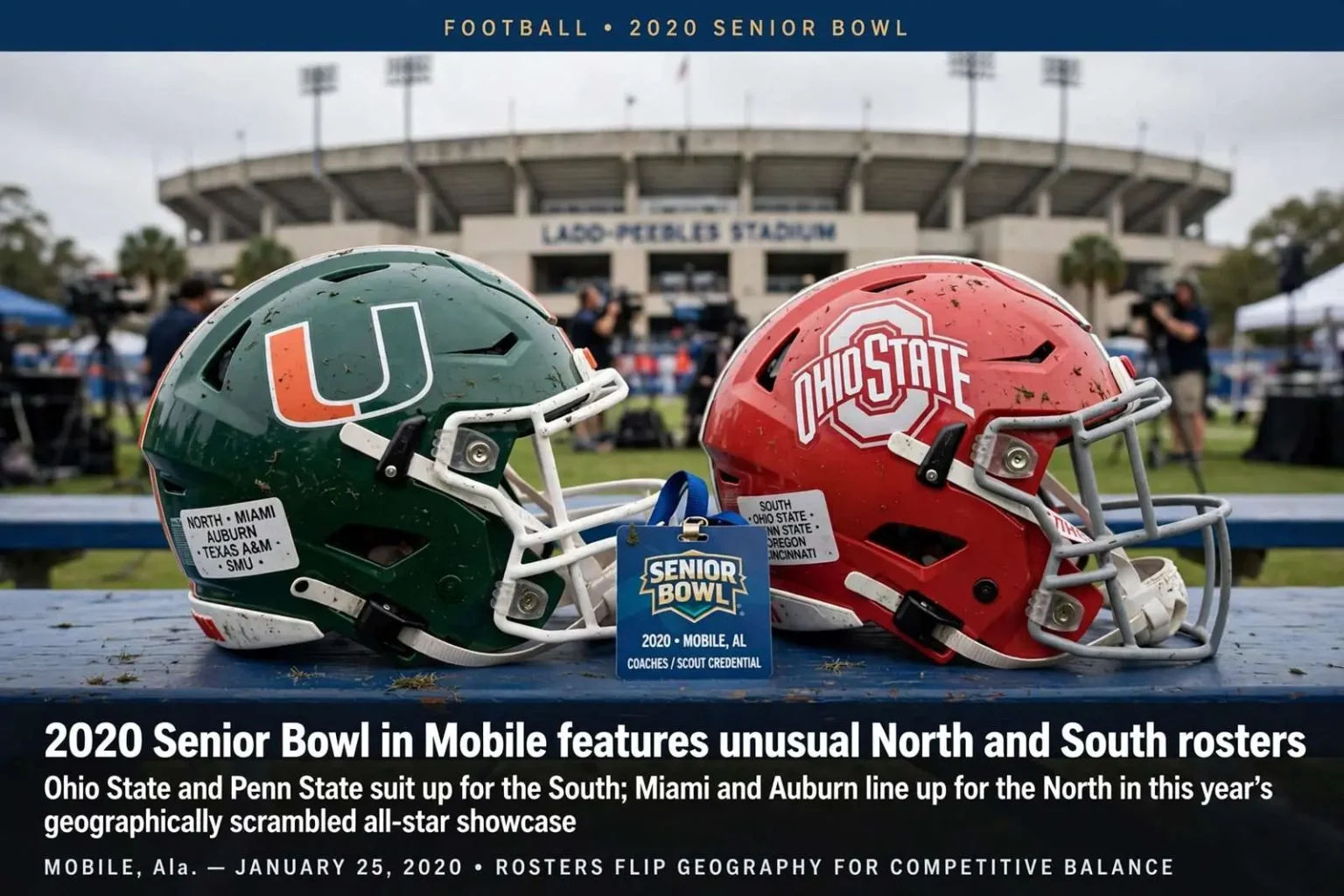
MOBILE, Ala. — Fans at Saturday’s Senior Bowl might do a double take at the roster assignments. With schools from Florida, Georgia and Texas lining up for the North and programs like Ohio State, Penn State and Oregon suiting up for the South, the 2020 game’s geographic split is anything but tidy. The traditional mental map — northern schools in one locker room, southern schools in the other — has been quietly discarded in favor of something more practical, and anyone scanning the rosters on game day at Mobile’s Ladd-Peebles Stadium will see the evidence everywhere they look.
The Senior Bowl, played annually in Mobile, routinely takes liberties with geography to balance players by position. But this year’s rosters stretch that tradition further than usual. Players from Ohio State, Penn State, Oregon, Cincinnati, Colorado and Pittsburgh landed on the South squad, while Miami, Georgia Southern, Auburn, Texas A&M, Baylor, SMU and TCU were slotted for the North. For longtime attendees who remember when the split roughly tracked the Mason-Dixon line, the assignments read like a roster swap — the Buckeyes and Nittany Lions representing the South, the Hurricanes and Tigers representing the North.
Why the geography bends
The reason is competitive balance, and it has been the organizing principle of roster construction for years. The two squads need comparable numbers at every position — equal quarterbacks, equal offensive linemen, equal cornerbacks — so that practices are evenly matched and the game itself functions as a fair showcase. Draft boards do not respect geography, and neither do the pools of talent at each position in a given year. If a particular season produces an abundance of quarterbacks from southern schools, some of them have to head north, whatever the map says.
That balance matters because of what the week is actually for. The Senior Bowl is the nation’s premier senior all-star game, a week of practices in front of hundreds of NFL scouts, coaches and front-office personnel that culminates in Saturday’s game. Every practice rep is evaluated, and the game itself is the final audition before the scouting combine and the draft. If one squad were loaded at a position while the other ran thin, the week’s evaluations would be distorted — players would face mismatches rather than fair measurements.
The by-product is the odd spectacle that greets fans scanning the 2020 rosters. A handful of programs placed athletes on both teams. Oregon, Ohio State and Auburn each have players on the North and South sides, setting up the odd spectacle of teammates facing off. For the schools involved, it is a point of pride — a measure of how much draftable talent a program produced that its seniors can populate both squads of a showcase game.
Teammates on opposite sidelines
The most striking of those matchups comes from Oklahoma, which placed defensive tackle Neville Gallimore on one squad and quarterback Jalen Hurts on the other, setting up the possibility of Gallimore chasing down his Sooner teammate in live game action. Teammates spend a season working together in practice; they rarely get to line up against each other in pads until the NFL does the scheduling for them. Should the assignment come up Saturday, the two will know each other’s tendencies as well as anyone on the field — and both will have something to prove to the scouts watching.
Hurts is a familiar figure for the Mobile crowd for reasons beyond the Senior Bowl. The quarterback starred at Alabama before transferring to Oklahoma for his final college season, meaning much of the Alabama audience watched him win games in person before he ever arrived back in Mobile in a Sooners context. His path — three seasons leading the Crimson Tide, a graduate transfer, and a Big 12 title — made him one of the most discussed quarterbacks in this draft cycle, and Senior Bowl week is where his evaluation against other senior quarterbacks begins in earnest.
The position he plays is the most scrutinized one on the field all week. Quarterbacks at the Senior Bowl work with professional coaching staffs, in professional terminology, in front of the exact people who will decide where they are drafted.
Herbert and the quarterbacks at Wednesday’s practice
South squad quarterback Justin Herbert of Oregon was among the players going through drills at Wednesday’s practice in Mobile ahead of Saturday’s game. Practice week is where the Senior Bowl’s real business happens. The Wednesday sessions, in particular, sit in the middle of the week’s schedule — long enough after arrival for the install to be in place, close enough to Saturday for the intensity to show. Scouts line the fences at Ladd-Peebles Stadium with stopwatches and tablets, and every throw, drop and footwork rep is logged against the player’s name.
For Herbert, the week carries particular weight. Oregon’s offense asks its quarterback to make professional-style reads and throws, but the Senior Bowl offers the first sustained look at him running an NFL playbook under NFL coaches, against defensive linemen and defensive backs who will be his professional peers. Practices give evaluators the context a college highlight reel cannot: how quickly a quarterback processes, how he communicates at the line of scrimmage, how he responds to a coverage surprise. The Wednesday drills are where those answers start to accumulate.
His presence on the South roster — an Oregon Duck on the South squad, in a game whose South squad once meant SEC and ACC territory — is the roster-bending tradition in miniature. Herbert’s assignment north or south was never going to follow latitude; it followed the arithmetic of the quarterback pool and the need to balance both squads’ passing games. The result is a Southern showcase with a Pacific Northwest quarterback under center, which is exactly the kind of detail that makes longtime Senior Bowl watchers chuckle at the program.
A Mobile tradition with a national reach
The Senior Bowl has been part of Mobile’s identity for generations, drawing the sport’s attention to the Gulf Coast every January or February in the quiet stretch between the college season and the combine. The week’s economic footprint is real — hotels, restaurants and the downtown entertainment district fill with team personnel, agents and media — but the deeper significance is reputational. For one week, Mobile is the center of the football world’s scouting calendar, and the city has built traditions around it that survive coaching staffs and roster quirks alike.
The game’s format has evolved with the sport. Professional coaching staffs take over the two squads each year, installing condensed playbooks over the practice week and giving seniors their first taste of NFL operational tempo. Players arrive days before the sessions begin, go through measurements and medical checks, and then split into the North and South squads for the week’s work — wherever geography has placed them.
That placement has grown looser over the years precisely because the stakes have grown higher. The Senior Bowl’s invitation list has become one of the most reliable predictors of draft-day outcomes, with hundreds of participants going on to be drafted each year and many others earning NFL roster spots as undrafted free agents on the strength of their week in Mobile. With that much riding on the week, the organizers’ priority is maximizing the quality of every rep — which is how the map ends up redrawn in the service of balance.
The 2020 rosters, then, are less an anomaly than a snapshot of the game’s operating philosophy. Position balance beats geography. Fair measurements beat tradition. And if that means Ohio State and Penn State play for the South while Auburn and Miami play for the North — with Oklahoma teammates potentially colliding in the middle of it — the program simply prints the rosters as assigned and lets the football sort out the rest on Saturday.
What the week decides
For the players, the Senior Bowl is less a game than a job interview with pads on. Seniors arrive from programs of every size — the national powers whose seasons end in the playoff and the mid-major standouts whose talent outgrew their conference — and the week in Mobile is the one setting where they are measured on equal footing. A dominant practice against first-round-caliber competition can move a player up draft boards as surely as a season of statistics, and the game on Saturday is the culminating rep of that audition.
The roster-bending that defines the 2020 squads serves that purpose directly. Balance across both teams means every defensive lineman faces comparable offensive talent, every quarterback throws to comparable receiving corps, and no player’s evaluation is inflated or deflated by the luck of an assignment. It is the same logic that governs the combine and pro days, translated to a team setting — and it explains why organizers have grown comfortable sending Auburn to the North and Ohio State to the South without so much as a footnote in the program.
For the scouts in attendance, the week’s value compounds across positions. Practices feature one-on-one drills — receivers against cornerbacks, linemen against linemen — that isolate individual matchups in ways game film cannot. The scrimmage periods in the middle of the week tend to draw the largest crowds of evaluators, because that is where the game’s rosters stop being an abstraction and become the actual assignments players will carry into Saturday.
Mobile’s week in the football spotlight
Around the stadium, the week follows its own rhythm. Downtown Mobile hosts the media availabilities, the team meetings and the steady foot traffic of a sport’s middlemen — agents, trainers, analysts — and the city’s restaurants and bars absorb a professional football convention for seven days. Local fans, meanwhile, get access that is rare in professional sports: practice sessions that are open to the public, autograph opportunities, and a chance to watch future NFL players at close range before their names appear on Sundays.
That accessibility is part of why the odd rosters draw such attention locally. Mobile fans follow the game closely, many with allegiances to Auburn, Alabama and the region’s other programs, and scanning a squad list that puts the Tigers on the North and the Buckeyes on the South is exactly the kind of detail that gets discussed in the stands and on the radio all week. The game’s organizers have long understood that the local audience treats Senior Bowl week as a civic event, not just a football game — and the quirks of the rosters are part of the conversation every year.
By Saturday, the geography question will have faded into the background where it belongs. The squads will line up as assigned, the quarterbacks — Herbert on the South, Hurts on the North, with a class of passers spread between them — will take their snaps, and somewhere in the fourth quarter Neville Gallimore may find himself with a clear path to his Oklahoma teammate. If it happens, Mobile will have hosted one of the week’s signature moments, produced by the same roster arithmetic that made fans do a double take in the first place.