Bluegrass Band Shadowgrass Closes Two-Night Run at Mobile’s Merry Widow Tonight
Young jam-minded bluegrass band Shadowgrass plays the second night of its two-night run at the Merry Widow in downtown Mobile tonight, Oct. 7, touring behind its third album, “All That Will Do.”
MOBILE, Ala. — Bluegrass band Shadowgrass wraps up a two-night stand at the Merry Widow in downtown Mobile tonight, Wednesday, Oct. 7, bringing a young, adventurous take on one of America’s most enduring musical traditions to the venue at 51 S. Conception St. Tickets for the show range from $25 to $40.
The five-piece group opened its Mobile run Tuesday night, and the second show offers another chance for fans — whether they come for the high-lonesome harmonies of traditional bluegrass or the stretched-out improvisation of the jam scene — to hear what the band has been building for the past decade.
A sound born in the Bluegrass State
Bluegrass has proved to be one of the country’s most timeless styles. The genre takes its name from Kentucky, the Bluegrass State, by way of Bill Monroe, the Kentucky-born mandolinist widely known as the “Father of Bluegrass,” and his band, the Blue Grass Boys.
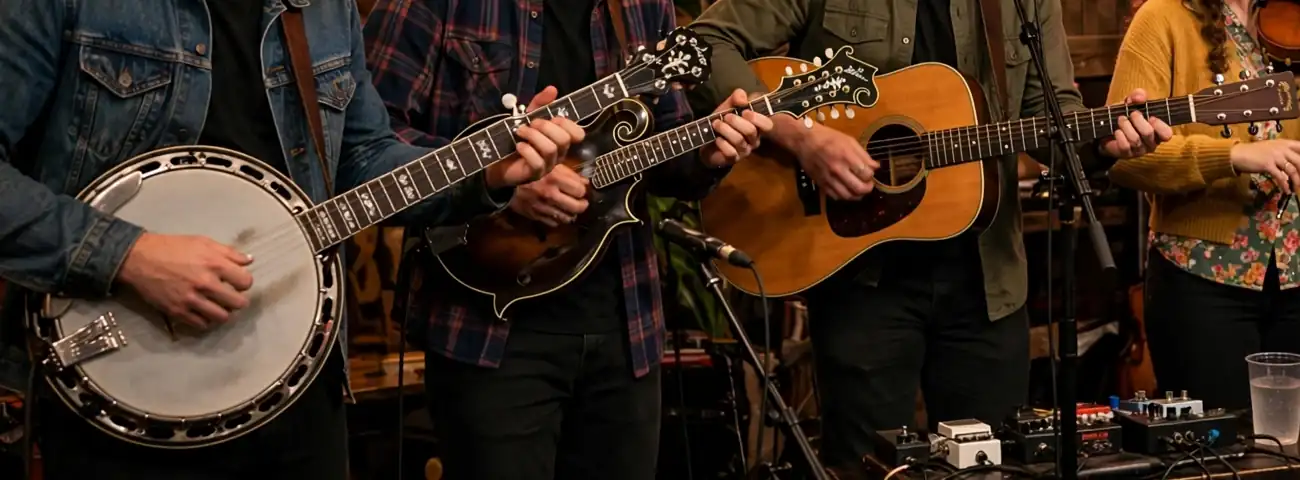
Built on acoustic instruments — typically banjo, mandolin, fiddle, guitar and upright bass — and tight, stacked vocal harmonies, the music grew out of the old-time string band traditions of the rural South and Appalachia. Monroe’s band, especially the lineup of the mid-1940s that featured banjo great Earl Scruggs and guitarist Lester Flatt, helped define the fast, driving sound that came to be known as bluegrass. Through radio, recordings and appearances on the Grand Ole Opry, that sound moved out of the backwoods and eventually onto stages around the world.
For decades, many musicians kept the form close to its original shape. But bluegrass has always had a restless streak. Beginning in the late 1960s and 1970s, “newgrass” bands began folding in rock, jazz and folk influences, and later the jam-band scene embraced bluegrass instrumentation and its culture of virtuosic soloing. Today, “jamgrass” is a thriving corner of the festival circuit, and it is from that lineage of innovation that Shadowgrass emerged.
Started as kids at a fiddlers’ convention
Shadowgrass first began to take shape 10 years ago at a jam session during the Grayson County Fiddlers’ Convention in Elk Creek, Virginia. The players were strikingly young: banjo player Clay Russell was 9, mandolinist Luke Morris was 13 and guitarist Kyser George was 14.
Even then, the three had an obvious musical chemistry, and that connection became the foundation of the band.
The setting was fitting. Southwest Virginia, along the Blue Ridge, is one of the country’s great strongholds of old-time and bluegrass music, and its fiddlers’ conventions are legendary gathering places where musicians of every age trade tunes in parking lots and campgrounds late into the night. For many young pickers, those informal jams serve as a kind of apprenticeship, where they learn the repertoire, the etiquette and the art of playing with others.
Meet the band
Since that first jam, the group has grown into a full five-piece lineup:
- Clay Russell — banjo
- Luke Morris — mandolin
- Kyser George — guitar
- Madison Morris — fiddle and vocals
- Evan Campbell — bass
Now all in their 20s, the members have used a blend of traditional and nontraditional approaches to craft a sound that feels like a fresh addition to bluegrass’s long American legacy.
“All That Will Do” and a jazz-fusion mindset
Shadowgrass is on the road in support of its latest release, “All That Will Do,” the band’s third album. The record plays like a joyride down a winding back-country road, with every measure a possible turn into a new rhythm or a new emotion.
On the surface, the instrumentation and song forms are rooted in tradition. But the band’s approach to bluegrass has more in common with the mindset of jazz fusion, where familiar structures become launching pads for exploration. Expecting the unexpected is one of the album’s greatest strengths.
That same quality lets the band carry its style equally well from the studio to the stage. Songs that are tightly arranged on record can open up in front of an audience, which is a big part of why bluegrass with a jam sensibility has become such a draw for live-music fans.
Why two nights?
Booking a two-night run is something of a statement, and for Shadowgrass it is a natural fit. Jam-oriented acts often vary their set lists from show to show, so a second night can mean different songs, different arrangements and new improvisational detours. With the band’s twin passions for bluegrass and jam music, fans of both camps have good reason to make it to both performances.
For anyone who missed Tuesday’s opener, tonight is the final opportunity to catch the band during this Mobile visit.
About the Merry Widow
The Merry Widow sits on South Conception Street in the heart of downtown Mobile, a short walk from the bars, restaurants and live-music spots along Dauphin Street. The venue has become a regular stop for touring bands of many genres, and its location makes it easy to pair a show with dinner or drinks in the entertainment district.
Downtown Mobile’s music scene has long drawn on the city’s deep Gulf Coast roots, mixing rock, blues, jazz, country and Americana, and acoustic acts like Shadowgrass fit comfortably into that mix.
If you go
- What: Shadowgrass, night two of a two-night run
- When: Tonight, Wednesday, Oct. 7 (the run opened Tuesday, Oct. 6)
- Where: The Merry Widow, 51 S. Conception St., Mobile
- Tickets: $25–$40
- Latest album: “All That Will Do”
Fans are encouraged to check with the venue for door times, ticket availability and any age restrictions before heading downtown.
Whether you consider yourself a bluegrass purist or a dedicated jammer, Shadowgrass offers a reminder that a decades-old tradition still has plenty of room to grow — and that sometimes the grass really is greener when a band is willing to wander off the beaten path.