Westbound I-10 Drivers in Daphne Will Lose Straight Shot to the Causeway Under ALDOT Island Plan, Worrying Spanish Fort
ALDOT will build a traffic island at the westbound I-10 exit to U.S. 98 in Daphne, ending the straight route onto the Causeway and requiring a left or right turn. Spanish Fort residents and city leaders fear more traffic on U.S. 31.
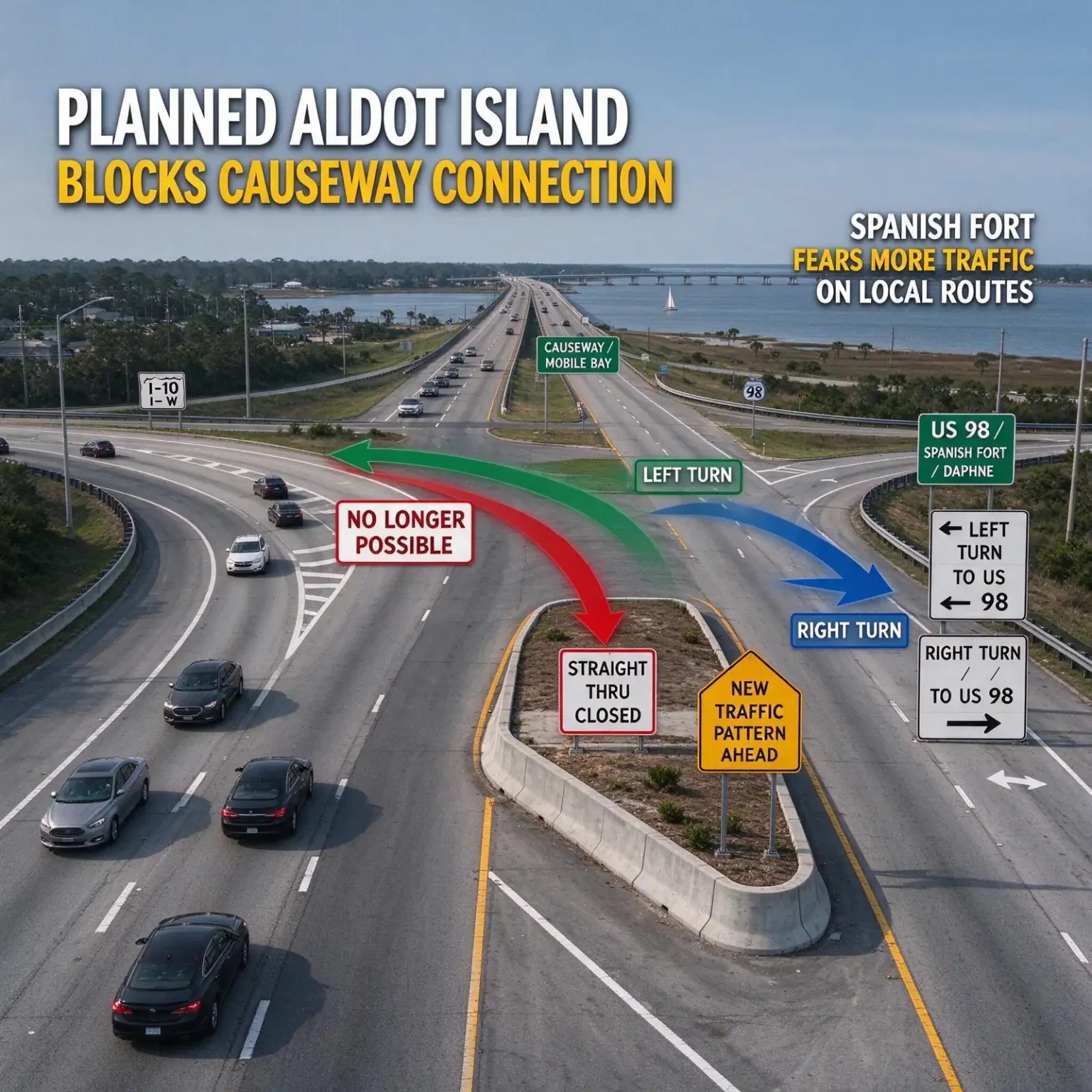
Drivers who leave Interstate 10 westbound at the U.S. 98 exit in Daphne and roll straight across onto the Causeway will eventually have to change their habits. The Alabama Department of Transportation plans to install a raised island at the bottom of the ramp that will block that through movement, so drivers coming off the interstate there will have to turn either left or right onto U.S. 98.
The change is part of the Mobile River Bridge and Bayway project, and ALDOT has said the decision to add the island is final. The plan is drawing objections from residents of neighboring Spanish Fort, and city leaders there say they share some of those worries.
What Will Change at the Exit
Today, westbound I-10 drivers taking the exit in Daphne can continue directly across U.S. 98 and onto the Causeway bypass, the connection that feeds U.S. 90/98 across the north end of Mobile Bay toward Mobile. Once the island is in place, that straight-through option will no longer exist.
- Left turn: Drivers will be able to turn left onto U.S. 98.
- Right turn: Drivers will be able to turn right onto U.S. 98.
- Straight ahead: The direct path from the ramp onto the Causeway bypass will be closed by the island.
ALDOT’s Reasoning
ALDOT did not grant an interview about the plan. In a written response, the department said the change is meant to improve the flow of traffic on U.S. 90/98 and to help local commuters by removing a signal phase from the intersection.
A signal phase is the portion of a traffic light’s cycle given to a particular movement. When a signal has to serve an extra movement, such as cars crossing straight from a ramp, every other direction waits longer for its turn. Eliminating one of those phases can free up more green time for the remaining movements, which can shorten waits and reduce backups for the traffic that stays on the main road.
The department acknowledged that a new configuration will take some getting used to for drivers. It said it expects the improvements to relieve congestion and better handle both present-day traffic and the volumes projected for the future.
Spanish Fort’s Concerns
Fear of more traffic on U.S. 31
The main worry in Spanish Fort is where the redirected traffic will go. A resident who has been raising the issue questioned why the state would remove a direct link from the interstate to the Causeway that already exists. He said he fears that forcing drivers to turn right will push more motorists who are trying to avoid tolls onto U.S. 31 through Spanish Fort.
He shared the plan with his neighbors in the Spanish Fort Estates subdivision through a social media post, which drew strongly negative responses. Several commenters pointed out that the Causeway bypass was meant to keep out-of-town traffic from clogging their city. The resident said everyone he has talked to has reacted the same way, with no one understanding or supporting a plan that would send more cars past their neighborhood and onto U.S. 31.
City leaders share the worry
Spanish Fort city leaders said the city is not fond of the changes either. They noted, however, that the plan comes out of traffic studies and engineering analysis that ALDOT has been working through for years. City officials said they are concerned about additional traffic heading north through the center of Spanish Fort.
A Plan Years in the Making
Though many residents are only now hearing about it, the island is not a new idea. It appears in a 2022 presentation on the bridge project. Some Spanish Fort residents spotted it only recently while looking over ALDOT’s separate proposal for U.S. 31.
That U.S. 31 plan has its own critics. The resident leading the opposition to the island said he dislikes that project too, because it would take away the ability to turn left out of his neighborhood. He said he hopes ALDOT will reconsider both changes.
The separate U.S. 31 proposal
ALDOT is currently collecting public comment on a plan to widen and rework U.S. 31 in Spanish Fort, in an area stretching from U.S. 90 north toward School Road. The proposal would widen parts of the road from four lanes to six, add turn lanes, upgrade and realign signals, add sidewalks and convert several entrances to right-in, right-out access, which allows only right turns into and out of a driveway or side street. The deadline to submit comments on that plan is Dec. 10.
How the Bridge Project Fits In
The Mobile River Bridge and Bayway project is a major interstate project that calls for a new bridge over the Mobile River and a new, higher I-10 Bayway across Mobile Bay, built to relieve chronic congestion at the George Wallace Tunnel and on the existing Bayway. The new crossing will carry tolls, while toll-free routes, including the Causeway, will remain available.
That toll structure is at the heart of the Spanish Fort concerns. Drivers who want to avoid paying tolls can use the Causeway, and the routes they take to reach it on the Eastern Shore will shape how much traffic passes through Daphne and Spanish Fort.
Recent ALDOT camera data from the Bayway shows how heavily local drivers rely on the corridor. Vehicles with Alabama plates account for just over half of all Bayway traffic, and about 63.5% of vehicles during the weekday morning rush between 7 a.m. and 9 a.m.
Timeline
- 2022: The island appears in a presentation on the bridge project.
- Dec. 10, 2026: Deadline for public comments on ALDOT’s separate U.S. 31 proposal in Spanish Fort.
- 2027: ALDOT expects to release more information about the construction schedule.
- Later phase of the bridge project: Installation of the island at the Daphne exit.
- 2031: Projected completion of the Mobile River Bridge.
What Drivers Can Expect
Nothing is changing at the Daphne exit yet. The island will be installed during a later stage of the bridge project, and ALDOT has said it will share more construction scheduling details in 2027. Until then, westbound I-10 drivers can continue to use the direct connection to the Causeway as they do now.
Residents who want to weigh in on the U.S. 31 changes in Spanish Fort can submit comments to ALDOT before the Dec. 10 deadline. ALDOT has indicated that the decision on the Daphne island itself is settled.