Overnight Lane Closures on Westbound I-10 Past the Wallace Tunnel to Last Into March 2027
Westbound I-10 in downtown Mobile will lose one, then two right lanes on weeknights from 9 p.m. to 4 a.m. through March 29, 2027, for restriping and barrier wall work.
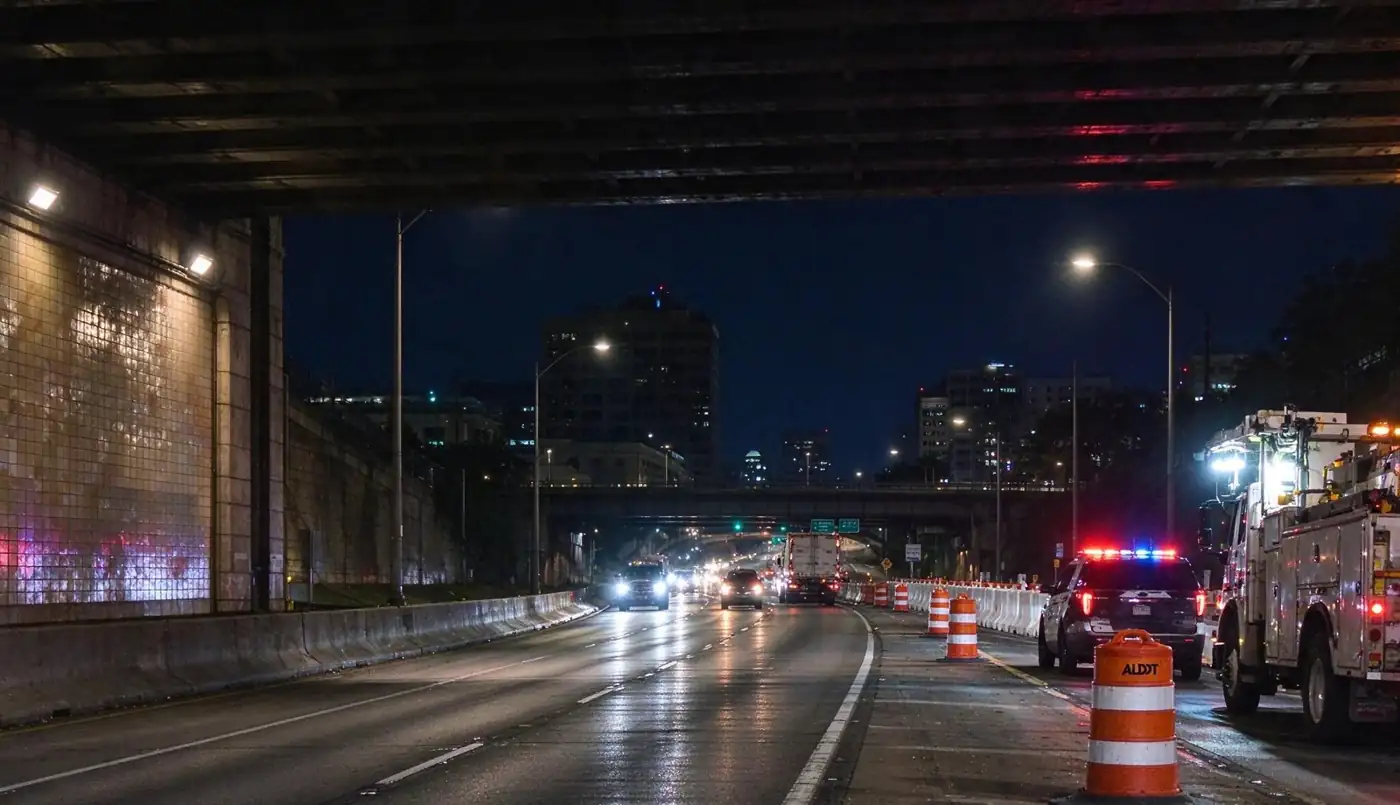
MOBILE, Ala. — Drivers heading west on Interstate 10 through downtown Mobile late at night should expect fewer open lanes on weeknights for the next several months, as crews working on the Mobile River Bridge and Bayway project shift to restriping and temporary barrier wall installation.
The Alabama Department of Transportation has put in place a series of overnight lane closures on westbound I-10 just west of the George C. Wallace Tunnel. The work is scheduled to run nightly on weekdays from 9 p.m. to 4 a.m., with completion anticipated by March 29, 2027.
Closure Details at a Glance
- Direction: Westbound I-10
- Where: Starting about 1,000 feet past the tunnel’s western portal and continuing through the area of the Water Street on-ramp
- Lane setup: The right lane closes first, and the closure widens to the two right lanes near the Virginia Street overpass
- When: Weeknights, 9 p.m. to 4 a.m.
- Teardown: Crews begin removing traffic control devices at 3:30 a.m.
- Normal lanes restored: 4 a.m. daily
- Expected finish: March 29, 2027
- Purpose: Restriping plus installation of temporary barrier walls, tied to the Mobile River Bridge and Bayway project
How the Closure Will Work
The closures follow a staged pattern. Westbound drivers emerging from the tunnel area will first encounter a single closed lane on the right side of the interstate. Closer to the Virginia Street overpass, that closure expands so that the two right-hand lanes are blocked, leaving traffic to merge into the remaining open lanes on the left.
The closed section continues through the stretch where the Water Street on-ramp feeds traffic onto westbound I-10, so drivers entering from downtown at that ramp should be prepared for reduced lanes and slower merging during work hours.
To keep the morning commute clear, crews start pulling cones, barrels and other traffic control devices at 3:30 a.m. ALDOT says the roadway is scheduled to be back to its usual layout by 4 a.m. every morning, ahead of the early rush of commuters and commercial traffic.
Law enforcement vehicles will be posted at the entry points to the work zone to help slow traffic and protect the crews working on the road.
Why the Work Is Needed
Restriping and temporary barrier walls are standard steps in a major highway project. As construction progresses, lanes often have to be shifted so crews have room to work safely next to live traffic. New pavement markings guide drivers through the revised lane layout, while temporary concrete barrier walls separate the travel lanes from the work area, shielding both workers and motorists.
This kind of preparatory work is typically done overnight on busy urban interstates because traffic volumes are at their lowest, which limits delays for the majority of drivers.
Part of the Mobile River Bridge and Bayway Project
The lane closures are tied to the Mobile River Bridge and Bayway project, a roughly $3.2 billion undertaking that began construction in October and is expected to take about five years to complete. Plans call for a new six-lane cable-stayed bridge over the Mobile River, along with restriping the existing I-10 Bayway across Mobile Bay to carry six lanes.
The project is aimed at relieving the long-standing traffic bottleneck at the Wallace Tunnel, where I-10 dips beneath the Mobile River and narrows to two lanes in each direction. The tunnel has been a persistent choke point for local commuters, tourists traveling along the Gulf Coast, and freight moving through one of the busiest corridors in the region.
With a project of this size underway in the middle of a working downtown, drivers can expect a series of lane shifts, closures and detours over the life of the work. ALDOT typically announces closures in advance and updates them as the schedule changes.
Tips for Driving Through the Work Zone
ALDOT is asking motorists to obey signage and all traffic control devices, slow down, and stay alert for workers and heavy equipment. A few additional precautions can help drivers get through safely:
- Merge early: When signs warn of a lane closure ahead, move over as soon as it is safe rather than waiting until the last moment.
- Obey work zone speed limits: Reduced speeds are posted for a reason, and fines for speeding in Alabama work zones can be higher when workers are present.
- Leave extra space: Sudden slowdowns are common near lane reductions, so allow more following distance than usual.
- Put the phone down: Distracted driving is especially dangerous when lanes narrow and workers are only a few feet away.
- Watch for police vehicles: Officers will be stationed at the work zone entrances; give them room and follow their directions.
- Consider timing: Drivers with flexibility may want to avoid the westbound stretch between 9 p.m. and 4 a.m. on weeknights.
Wallace Tunnel Rules and Alternate Routes
The George C. Wallace Tunnel, which opened in the early 1970s, carries I-10 beneath the Mobile River between downtown Mobile and the Causeway area. Because of its age and design, the tunnel has long been a pinch point, and certain vehicles are not allowed to use it at all. Trucks hauling hazardous materials are prohibited from the tunnel and must take the signed truck route across the Cochrane-Africatown USA Bridge on U.S. 90/98 instead.
That same bridge route can also serve as an alternative for some drivers who would rather avoid the downtown interstate during closure hours. Motorists traveling between the Eastern Shore and points north or west of downtown may find it a reasonable option, though it adds distance for many trips and passes through surface streets on the Mobile side.
Remember the Move Over Law
With police vehicles stationed at the entries to the work zone, drivers should also keep Alabama’s Move Over law in mind. The law requires motorists approaching a stopped emergency vehicle, tow truck or certain other service vehicles with flashing lights to move over a lane when it is safe to do so, or to slow down significantly if they cannot change lanes. The rule is designed to protect officers and roadside workers who are just feet away from passing traffic.
Work zones are among the most dangerous places on the highway for both crews and motorists. National safety data consistently show that most people killed in work zone crashes are drivers and passengers, not workers, which is why slowing down and staying attentive benefits everyone traveling through.
Schedules May Shift
ALDOT notes that closure dates and times can change because of weather or the needs of the construction work. Rain, in particular, can delay striping, since pavement markings need dry conditions to be applied properly.
For up-to-the-minute information on road conditions, closures and incidents, ALDOT recommends that drivers download the ALGO Traffic app, the department’s traveler information tool, which provides real-time traffic updates across the state.
Bottom Line for Drivers
Through late March 2027, westbound I-10 drivers leaving the Wallace Tunnel area on weeknights between 9 p.m. and 4 a.m. should plan for one and then two closed right lanes near the Virginia Street overpass and the Water Street on-ramp. Lanes are scheduled to reopen fully by 4 a.m. each morning, leaving the daytime commute unaffected.