More Foley Storefronts Can Now Tap City Facade Grants of Up to $25,000 After Council Widens Eligible Area
The Foley City Council on Nov. 16 extended its Facade Improvement Incentive Grant Program to the Extended Downtown District. Matching grants reimburse up to 50% of exterior work, capped at $25,000.
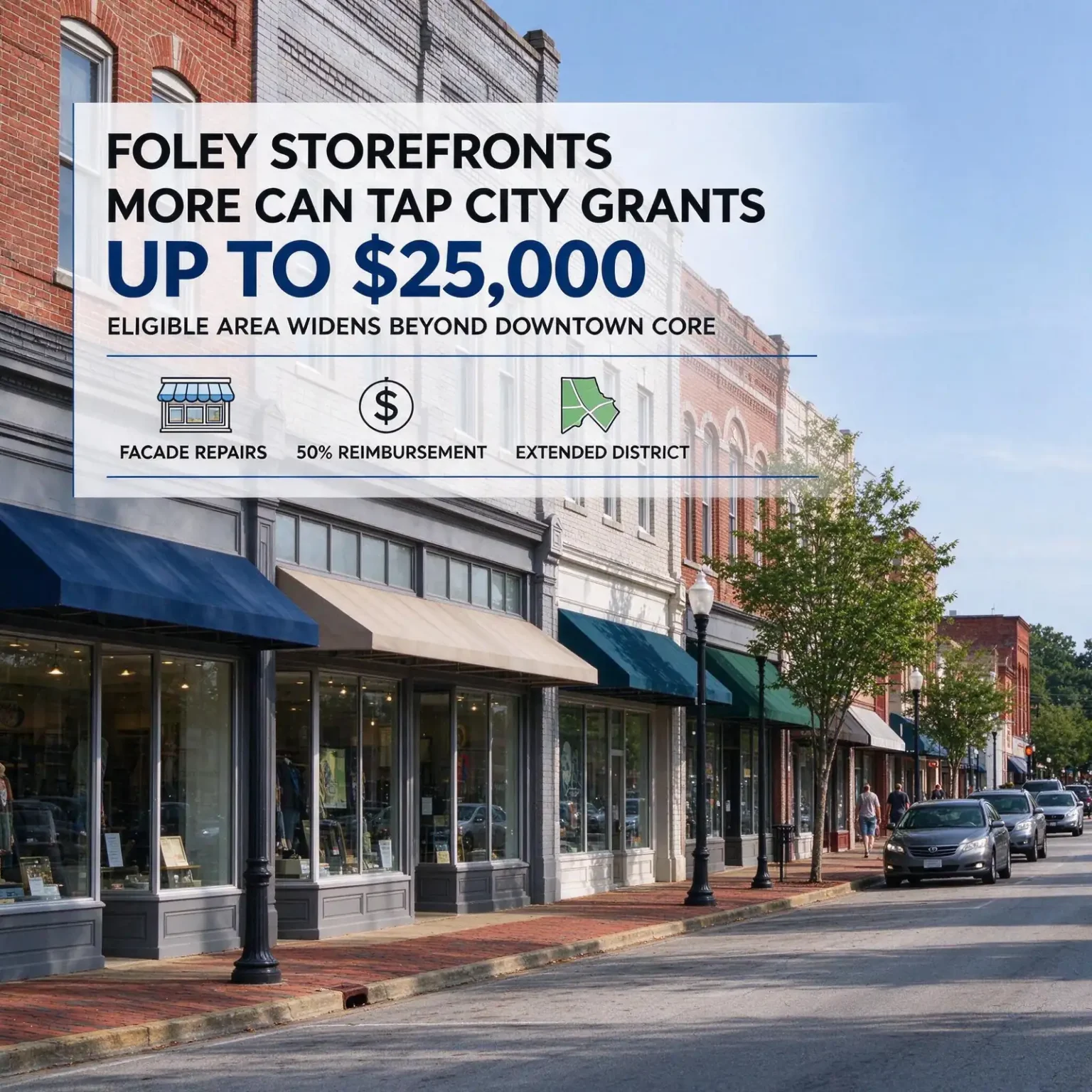
FOLEY, Ala. — Business owners on the blocks surrounding downtown Foley can now apply for city money to help fix up their storefronts. On Monday, Nov. 16, the Foley City Council voted to extend its Facade Improvement Incentive Grant Program into the Extended Downtown District, a zone that wraps around the existing Foley Downtown Overlay District.
Until now, only buildings within the city’s three core downtown designations could qualify. The change opens the program to additional commercial properties just beyond those lines.
Who Was Eligible Before, and Who Is Eligible Now
Before the council’s vote, the facade grants were available only to properties in:
- The Local Downtown Historic District
- The National Register Historic District
- The Foley Downtown Overlay District
With the amendment, the Extended Downtown District joins that list. The added area covers the properties immediately around the overlay district, where many of the businesses that visitors pass on their way into the heart of downtown are located.
The city’s planning department explained the reasoning in simple terms: in its view, downtown does not end at the boundary line of the overlay district, so the program should not end there either. Planning officials said the businesses on the surrounding blocks help shape the first impression people form of Foley.
How the Grant Works
The program is designed to support downtown revitalization and historic preservation by helping pay for improvements to the outside of buildings. It operates as a reimbursement, not an up-front payment, so applicants complete the work first and are paid back afterward.
Who can apply
- Property owners and business tenants may apply.
- The project must involve an existing building on commercially zoned property within the grant area, including qualifying mixed-use buildings.
- Tenants need written permission from the property owner before they apply.
- The building must have received its certificate of occupancy at least 12 months before the application is submitted, which keeps the focus on established buildings rather than new construction.
How much money is available
- Awards start at $1,000.
- Applicants must put up a dollar-for-dollar cash match.
- The city reimburses up to 50% of eligible project costs.
- The maximum award is the greater of $5,000 or $5 for each square foot of improved primary facade facing a named public street or right-of-way.
- No project can receive more than $25,000.
When the money is paid
Reimbursement comes after the work passes a final inspection and the city reviews the required documentation. Grants are handed out on a first-come, first-served basis as long as funding is available, and each building can receive one award every five years.
What the Numbers Mean in Practice
Because of the 50% reimbursement rate and the square-footage formula, the size of an award depends on both the cost of the project and the size of the storefront. A few examples based on the program’s limits show how the math works:
- A small storefront: A building with 400 square feet of improved primary facade would have a formula amount of $2,000, so the $5,000 minimum cap applies instead. If the owner spends $8,000 on eligible work, the city could reimburse up to $4,000.
- A mid-size building: A facade of 2,000 square feet produces a cap of $10,000. A $24,000 project there could earn up to $10,000 back, since half the cost would exceed the cap.
- A large building: A facade of 6,000 square feet would produce a formula amount of $30,000, but the $25,000 per-project ceiling would limit the award. The owner would need to spend at least $50,000 on eligible work to reach that maximum.
The square footage counted is the improved primary facade facing a named public right-of-way, so side or rear walls that do not face a street generally do not add to the cap.
Why Facade Grants Matter for Downtowns
Facade grant programs are a common tool in Alabama cities and across the country for encouraging private investment in older business districts. By covering part of the cost of exterior work, such as painting, signs, awnings, windows, lighting and storefront repairs, cities aim to make it easier for owners to take on projects that improve how a whole street looks and feels.
The matching requirement is a central feature of these programs. Because owners must spend at least as much as the city contributes, every grant dollar is paired with private money, and the improvements tend to be projects owners already want to undertake.
For buildings in historic districts, design standards typically guide the work so that changes respect a building’s original character. Foley’s program ties directly to that goal, since historic preservation is one of its stated purposes.
Part of a Broader Downtown Effort
The expansion is one of several recent steps Foley has taken to shape its downtown. Earlier this month the council held a work session discussion of amendments to the facade grant program and also considered downtown design guidelines, and the Nov. 16 meeting addressed a long agenda that included underground utilities, a new Senior Center and sidewalk projects.
Foley has grown rapidly in recent years as one of the fastest-growing cities in Baldwin County, with new residential neighborhoods, sports tourism venues and the OWA entertainment district drawing visitors and residents. City leaders have sought to make sure the historic downtown around Heritage Park keeps pace with that growth.
How to Apply
Property owners and tenants interested in the program should contact the City of Foley’s planning department for application materials, district maps and the program’s design requirements. Because grants are awarded on a first-come, first-served basis while funding lasts, owners planning exterior work may want to apply early and confirm eligibility before starting any project, since work must meet program rules and pass final inspection to be reimbursed.