Studio Cantrell Brings a Gallery and Full Frame Shop to Orange Beach Under One Roof
Orange Beach painter Nick Cantrell and potter Maya Blume-Cantrell have opened Studio Cantrell, a gallery, working studio and public frame shop in the former Pink Pelican building.
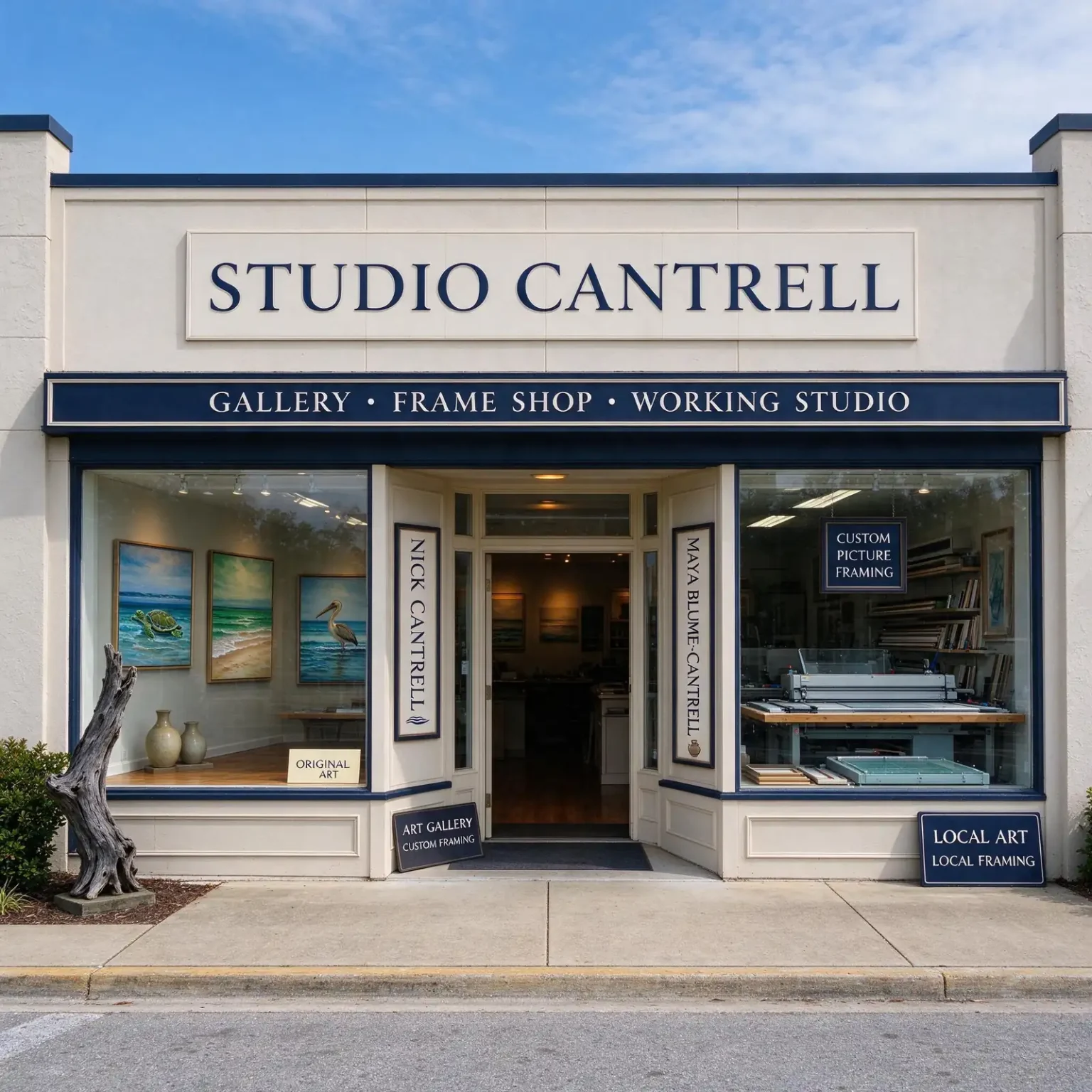
ORANGE BEACH, Ala. — After more than a decade of carrying his paintings from one outdoor art festival to the next, Orange Beach painter Nick Cantrell finally has a permanent place where the public can walk in and see his work. He and his wife, potter Maya Blume-Cantrell, have opened Studio Cantrell, a combined working studio, art gallery and public frame shop in the building that once housed the Pink Pelican gallery.
The new space gives the couple room to make, frame and sell art in one location, and it puts roughly a dozen other artists’ pieces on the walls alongside their own. For a painter who has spent 12 years earning his living entirely through shows and festivals, it marks the first time his work has had a gallery home of its own.
What Visitors Will Find
Studio Cantrell operates on three fronts at once:
- A gallery: Original work by Nick Cantrell and ceramics by Maya Blume-Cantrell are displayed for sale, along with pieces by about 12 additional artists.
- A frame shop: The business offers full custom framing to the public, run by a dedicated shop manager.
- A working studio: The building holds Nick Cantrell’s painting space plus an upgraded printer, a wood cutter, a frame assembly station and an indoor area for cutting glass.
Maya Blume-Cantrell handles the business side of the operation, balancing administrative work with her own time at the potter’s wheel.
From a Van Full of Paintings to a Storefront
Before the studio opened, the logistics of selling art were demanding. Nick Cantrell’s paintings traveled to fine art shows up and down the East Coast and along the Gulf Coast, which meant long hours on the road and a lot of physical labor setting up and tearing down booths. At home, his studio space was spread across a basement, a van and the yard, where he worked outdoors whenever the weather cooperated.
That setup made it hard to accommodate local collectors. When someone in town wanted to see a particular piece, the paintings had to be pulled out of the van and arranged in a makeshift workspace at the house, a process that could stretch to around two hours just to reach a single work a visitor might want to buy. The couple has described the gallery as a way to solve that problem and to give him a place to show work outside of the festival circuit.
Cutting glass for frames had also been an outdoor job that depended on dry weather. Moving that work inside the new building means the frame shop can run on its own schedule rather than the forecast.
The Building’s Long History With Local Art
The property has been tied to the Orange Beach art scene for decades. For more than 20 years it was home to the Prosperous Pelican, a gallery run by a local couple. After the husband died about 12 years ago, his widow offered his former upstairs office to Nick Cantrell, who at the time was beginning to build out a studio at home. He chose to stay put and expand his home workspace instead.
Years later, the building changed hands. A couple from Fairhope who had met Nick Cantrell at an art show in Key West, after noticing that his booth was tagged Orange Beach, bought the property. By then the old gallery had deteriorated and was full of artwork by other people, with no records to sort it out. The Cantrells and several of Maya Blume-Cantrell’s colleagues from the local arts center pitched in on the cleanup, and the new owners paid to remodel the space, reopening it as the Pink Pelican. The first artist they signed to represent was Nick Cantrell.
When the Pink Pelican’s owners later decided to move away, they asked him whether he wanted to take over the business. The result is Studio Cantrell.
The Painter: Wax, Color and Coastal Subjects
Nick Cantrell is known for watercolor batik paintings, a layered technique that relies on wax to lock in shapes and colors as a piece develops. His subjects come straight from the Alabama coast: sea turtles, jellyfish, brown pelicans, broken pilings and other everyday sights from the water. Because his work is so tied to the shoreline, he has generally kept his festival schedule to coastal markets.
His process works in stages. He applies a light layer of color, then hot wax, then more color, then more wax, repeating the cycle again and again. Each wax layer seals what is beneath it so the next wash of pigment cannot bleed into it. As the layers build, more and more of the surface becomes covered, so the painting is in a sense finished by gradually closing off the open areas, the reverse of a sculptor who carves material away. He experiments with different sponges, patterns, line work and dabbing techniques to get his textures, and his brushes, many of them cut and bent into unusual shapes, show the wear of that experimentation.
How batik works
Batik is a centuries-old wax-resist method most closely associated with textile traditions in Indonesia, particularly on the island of Java. Artists apply melted wax to areas they want to protect, then add dye or paint; the wax keeps color from reaching the covered areas. Repeating the process with progressively darker colors produces rich, layered images. Painters who adapt the technique to paper often work on thin rice paper with watercolor, then remove the wax at the end, which can leave a distinctive crackled or glowing look.
An unlikely route to color
Color did not come easily to him at first. He had long been a skilled drawer, but for years he struggled to work in color and held onto beliefs that limited him, including the idea that a piece was not complete without color and that he could not earn a living with black-and-white, graphite or line work. He tried colored pencils, acrylics, murals and oils along the way. Oils, he found, were difficult to sustain while moving around and raising children, because an oil studio needs daily attention.
The turning point came in 2011, when he was doing damage assessment work in upstate New York and came across a magazine featuring an artist who worked in batik watercolor. Inspired, he began experimenting with rice paper, watercolor and wax and developed his own coastal take on the method.
His path to full-time art was a winding one. He first studied building science until a health setback changed his plans. He later worked as a real estate agent until the 2008 financial crisis ended that career. After Hurricane Katrina, he volunteered to help extended family clear storm damage, and by the time Hurricane Gustav struck in 2008, he was working as a paid contractor for the Federal Emergency Management Agency.
The Potter: A Fixture at the Arts Center
Maya Blume-Cantrell found her medium in clay during college and has worked with it ever since. She holds the resident artist post in the Clay Shop of the Coastal Arts Center of Orange Beach, which sells her pottery and ceramic pieces, and she also sells under the name Maya Earth Ceramics. Her work has been exhibited in Asheville, North Carolina, at the Kress Gallery, and she has spent the past 12 years at the Orange Beach arts center after first showing locally at the Orange Beach Festival of Arts.
The two have known each other since Nick Cantrell moved to Orange Beach in the eighth grade. Both went on to study art in college and reconnected at Auburn University.
Learning the Framing Trade
Nick Cantrell had already brought most of his production in-house before the studio opened, including framing. He learned the craft from the owner of what was once the island’s lone frame shop, picking up lessons on when a simple standard frame serves a piece best and when the frame should become part of the artwork. For festival booths, a plain frame keeps the attention on the painting. For a piece headed to a specific home, the frame can be tailored to the space and the owner’s taste.
Tips for anyone getting art framed
Custom framing is about protection as much as appearance. Framers commonly suggest a few general points for anyone bringing in a piece:
- Ask about archival materials. Acid-free mats and backing help keep paper artwork from yellowing or deteriorating over time.
- Consider UV-filtering glazing. Glass or acrylic that blocks ultraviolet light can slow fading, which matters for watercolors and prints hung in sunny coastal homes.
- Think about humidity. In a climate as humid as the Gulf Coast’s, proper sealing and spacing between the artwork and the glass can help prevent moisture damage.
- Match the frame to the room and the piece. A frame can either stay quiet so the art stands out or become a design element of its own.
Giving Other Artists a Platform
One of the main goals of the new space is to share it. Opening to the public allows the couple to represent other artists and give emerging talent wall space and exposure. They have described the shop as a form of stewardship, a way to pass along the knowledge and help they received from others over the years and to help newer artists build careers of their own.
That approach reflects a broader pattern in small art communities, where established artists often serve as informal mentors, sharing practical lessons about pricing, shows, framing and the business of selling work that are rarely taught in a classroom.
Supporting Local Artists
For residents and visitors who want to support working artists on the coast, a few simple steps make a difference:
- Visit local galleries and studios, not only during peak tourist season.
- Buy original work or prints directly from artists when possible.
- Attend local art festivals and arts center events, where many coastal artists sell their work.
- Use local framers, who can often advise on how to protect art in a humid beach environment.
- Share artists’ work with friends and on social media to help them reach new buyers.
Orange Beach has long promoted the arts as part of its identity alongside its beaches and waterways, and studios like this one add a year-round option for people looking to see and buy work made by artists who live and work along the coast.
A New Chapter
For Nick Cantrell, the move from van and basement to storefront closes one chapter and opens another. The studio gives him the equipment and space to work without depending on the weather, a place to meet buyers face to face, and a way to bring other artists into the spotlight. For Maya Blume-Cantrell, it adds a business to manage alongside her ceramics. Together, the painter and the potter now share a single address for making, framing and showing art in Orange Beach.