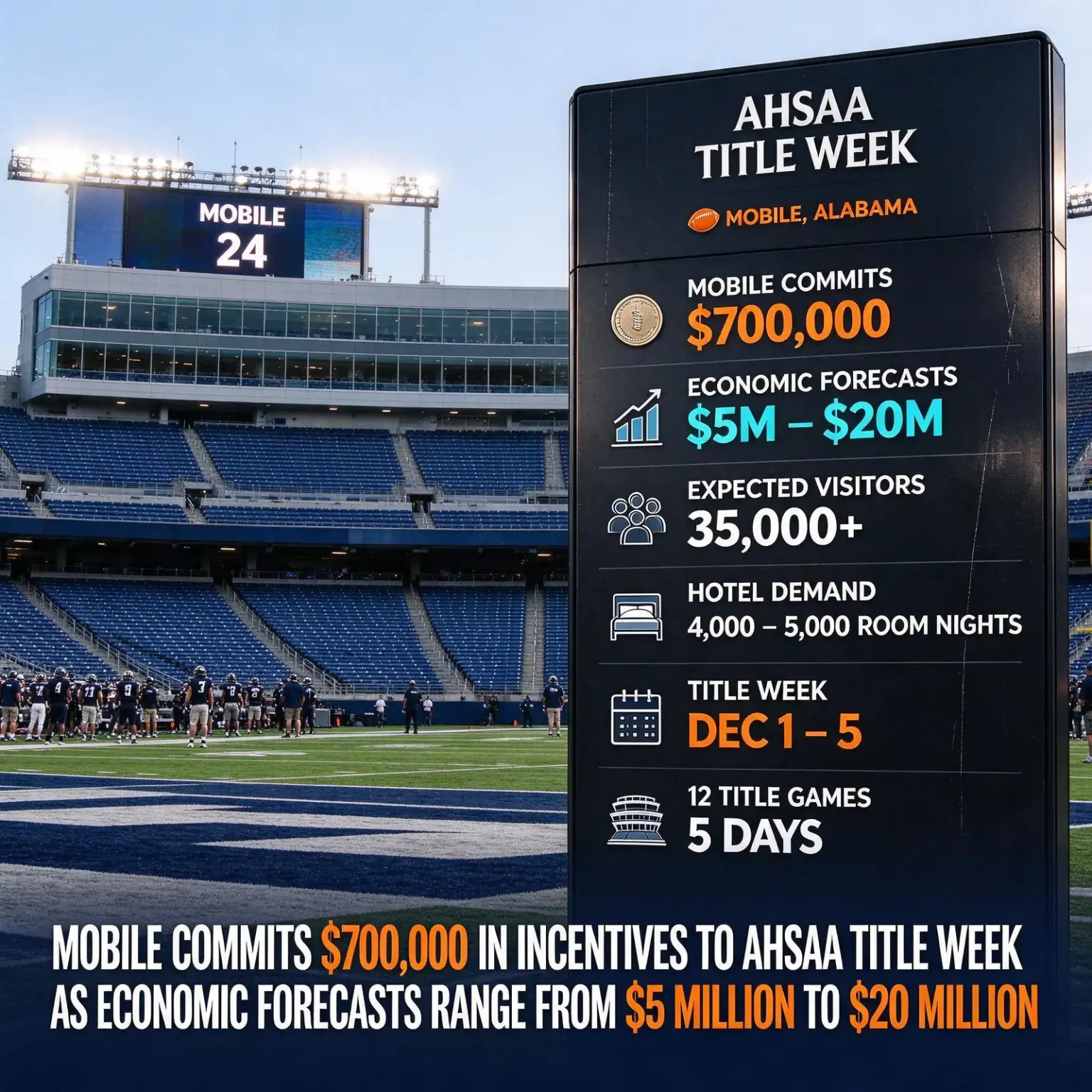
Mobile Commits $700,000 in Incentives to AHSAA Title Week as Economic Forecasts Range From $5 Million to $20 Million
Local tourism and sports officials expect the AHSAA football championships at Hancock Whitney Stadium Dec. 1-5 to draw more than 35,000 visitors, but spending forecasts vary widely depending on which teams reach the finals and how far their fans travel.
MOBILE, Ala. — When the state’s best high school football teams arrive in Mobile next month, they will bring more than helmets and marching bands. They will bring fans who need hotel rooms, meals, gas and souvenirs. Just how much money that crowd leaves behind is the open question, and the answer depends on games that have not been played yet.
For the first time, the Alabama High School Athletic Association is bringing its football state championships in Mobile, with all title games set for Hancock Whitney Stadium on the University of South Alabama campus from Dec. 1 through Dec. 5. Local leaders believe the week could set a modern record for economic impact from a sporting event in the area. Their forecasts, however, span a wide range.
The Estimates at a Glance
- Expected visitors: more than 35,000, according to the Mobile Sports Authority
- Projected visitor spending: $12 million to $20 million, per the Mobile Sports Authority
- Direct economic impact: about $5 million, per Visit Mobile
- Hotel demand: roughly 4,000 to 5,000 room nights
- Public incentives: $700,000 in combined city, county and lodging-tax support
A Bigger Event Than Before
The championship week has grown. What used to be known as the Super 7 now includes eight tackle football title games, six for public school classifications and two for private schools, plus four girls flag football championships. That makes 12 title games over five days.
Leading the push to bring the event to town was the Mobile Sports Authority, which secured the championships for 2026 and again for 2028. Its leaders have said they expect the week to rank among the largest sporting events ever held in Mobile County and in Southwest Alabama.
Measuring against 1994
Sports authority officials have pointed to a benchmark more than three decades old. In 1994, the American Bowling Congress tournament came to Mobile and was staged inside what was then the newly built Arthur R. Outlaw Mobile Convention Center. Organizers installed as many as 48 temporary lanes, and some 46,000 bowlers from around the country took part over a run of nearly four months. One estimate put the economic impact of that event at around $37 million. The authority believes the football championships could produce the largest windfall from a sporting event since then.
Why the Numbers Vary So Much
The gap between a $5 million projection and a $20 million one reflects different methods and several unknowns.
Who makes the finals
The biggest variable is geography. Ten teams from the Mobile area were still alive in the playoffs heading into the final two weeks before the championships. If several of them reach the title games, many of their fans will simply drive to the stadium and home again the same day, spending money on tickets and food but not on hotel rooms. Teams from north Alabama or the Wiregrass, by contrast, are far more likely to bring fans who stay overnight.
Tourism experts in other states have made the same point: a championship’s economic value can swing considerably based on the finalists and the distance their supporters have to cover. Overnight guests add lodging, extra meals and other spending that day-trippers do not.
Weather
Early December on the Gulf Coast is usually mild, but rain or cold can keep casual fans home, especially for games involving teams they do not follow closely.
What counts as impact
Economic impact studies can measure different things. Some focus on direct spending, the dollars visitors spend on lodging, food, transportation, shopping and entertainment. Others add indirect and induced effects, such as the wages that local businesses pay out and the purchases they make in turn. That difference alone can produce widely varying totals for the same event.
The Tourism Bureau’s View
Visit Mobile, the city’s convention and visitors bureau, has taken a more conservative approach, projecting about $5 million in direct economic impact. That figure draws partly on expected hotel demand, projected at between 4,000 and 5,000 room nights based on comparable past events.
The bureau also looked at Birmingham’s experience. The Greater Birmingham Convention and Visitors Bureau calculated that the 2025 AHSAA championships, held Dec. 3-5, accounted for $4.1 million in direct visitor spending, compared with $3.6 million a year earlier. That bureau tallies direct spending across five areas: hotels, getting around, meals and drinks, shopping, and recreation. Mobile’s version of the event runs two days longer than last year’s.
Tourism officials said the first week of December is normally a quiet stretch for local hotels, so the title games could deliver a welcome boost ahead of the holidays. Lodging demand is expected to be strongest in west Mobile and along the Interstate 65 beltline near the stadium, where much of the city’s hotel inventory is concentrated, though some teams are booking rooms downtown.
What Mobile Paid to Host
Landing the championships required public money. Three sources contributed:
- City of Mobile: $300,000, appropriated in the 2026 fiscal year budget
- Mobile County: $250,000 spread over the next two years
- Mobile County Marketing Fund: $150,000 toward this year’s event, drawn from lodging tax revenue
A city spokesperson said leaders expected the investment to pay off by drawing visitors from elsewhere in Alabama to fill local hotels. During a recent Mobile County Commission meeting, a commissioner praised the sports authority’s work in winning the event, describing it as a very big deal for the area and noting that it ranks among the largest sporting events in the Southeast.
Part of what made Mobile competitive is that Alabama’s two biggest football venues are not currently in the conversation: Auburn’s Jordan-Hare Stadium and Tuscaloosa’s Bryant-Denny Stadium. The expansion of college football’s postseason has made December dates at those stadiums difficult to schedule.
How Other States Have Fared
Mobile’s projections fall in line with what host cities across the South have seen from high school football finals.
- Mississippi: In 2024, Hattiesburg was home to the Mississippi Gridiron Classic, and estimates credited the games with an economic boost topping $8 million. Those games also produced $554,755 in local sales tax revenue and $9,540 in state lodging tax. This year’s Mississippi finals moved to Davis Wade Stadium in Starkville.
- Tennessee: The Chattanooga Tourism Co. estimated that the 2024 state championships at Finley Stadium, where the games are held annually, produced about $4 million in total economic impact, $2.3 million of it direct.
- Oklahoma: Two weeks of title games at Chad Richison Stadium on the University of Central Oklahoma campus in Edmond, north of Oklahoma City, generated roughly $7 million in spending last year.
- Florida: An economic impact study by Visit Tallahassee found that the state’s 2022 high school football finals, run by the Florida High School Athletic Association, brought $928,500 in additional spending from visitors who came from outside Leon County. The 2026 Florida finals are in Miami.
A cautionary example from Georgia
Hosting is not always profitable. The Georgia High School Association ran a deficit on its football championships last year and had to draw on reserves to cover expenses. Lower attendance, combined with the rising expense of playing at Atlanta’s Mercedes-Benz Stadium, produced a modest loss, the first in the history of the event. The lesson for host cities and associations is that a bigger venue can bring bigger bills.
The Payoff for South Alabama
Some of the potential benefit is harder to put a dollar figure on. Tourism leaders noted that the championships will put thousands of high school athletes, parents and families on the University of South Alabama campus at the very moment many are weighing college choices. They suggested that some visitors who might never have considered the university could leave thinking about it.
The timing fits the university’s growth. South Alabama’s enrollment has passed 14,000 students, and campus housing held more than 2,600 students last year, a school record, as the university continues to build out its residential experience.
University athletics leaders have expressed a similar view. They said they welcome having many of the state’s top athletes on campus, but that the real value lies in showing the university to prospective students and their parents, many of whom will be setting foot on campus for the first time.
The championships will also give a large number of fans their first look at Hancock Whitney Stadium itself. The stadium opened in 2020 and seats about 25,000, giving it a more compact, intimate feel than the state’s largest college venues.
What Visitors and Residents Should Know
- Dates: Tuesday, Dec. 1, through Saturday, Dec. 5
- Location: Hancock Whitney Stadium, University of South Alabama, west Mobile
- Traffic: Expect heavier traffic around the campus and along nearby corridors on game days, particularly when multiple games are scheduled back to back.
- Hotels: Visitors planning to stay overnight may want to book early, since demand is expected to be concentrated near the stadium and the I-65 corridor.
- Tickets: Check the AHSAA’s official ticketing channels for game times and availability once the finalists are set.
The Bottom Line
Mobile has committed $700,000 in public money, including county support spread over two years, to host a week of championship football and, with it, the chance to showcase the city and its university to fans from across Alabama. Whether the return lands closer to $5 million or $20 million will not be known until the brackets are settled and the visitors arrive. What is certain is that, for five days in December, the state’s high school football spotlight will shine on Mobile.