32 Residents Apply for Five Seats on Gulf Shores’ New School Board as District Split Takes Shape
Thirty-two residents, including a sitting county board member, are seeking seats on Gulf Shores' new school board as the city builds its own district.
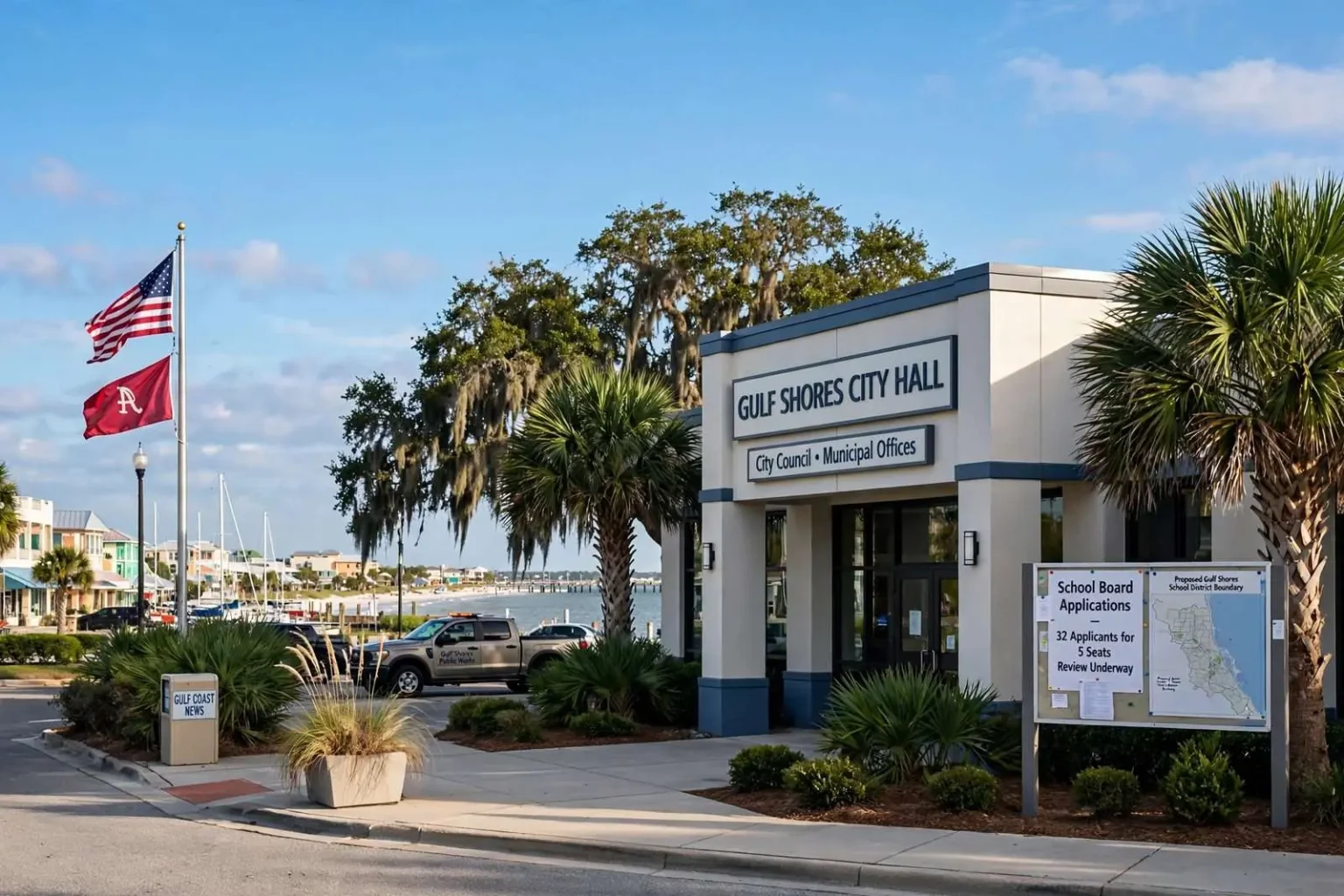
Thirty-two Gulf Shores residents have submitted paperwork hoping to land one of five seats on the city’s newly formed school board, as officials continue laying the groundwork for a system separate from Baldwin County Schools.
The applicant pool, assembled after the city council voted to create its own board of education, reflects the breadth of a coastal community preparing to take on one of the most consequential decisions a municipality in Alabama can make: dissolving its ties to a countywide school system and running its own. Teachers, business owners, parents and veterans of local civic boards were among those who filed, and the council’s task now is to winnow the list to the five members who will hire a superintendent, negotiate the split from Baldwin County and shape the new system’s first curriculum, first budget and first classrooms.
Among the applicants is Angie Swiger, who currently represents south Baldwin County’s District 5 on the Baldwin County Board of Education. That district covers Gulf Shores, Orange Beach, Fort Morgan, Ono Island and Elberta.
Swiger said that if selected for the new city board, she would step down from her county post. Her potential move has raised a legal question for the Baldwin County Board of Education, which has asked the Alabama Attorney General’s office whether a board member who lives inside the boundaries of the newly created city school system can continue serving on the county board at all.
The question is more than procedural. If the Attorney General’s office determined that a member residing within a newly formed city district is disqualified from county service, Baldwin County could face a vacancy in the very district whose schools are leaving the system — removing, at the negotiating table, the one board member whose constituency most directly depends on the outcome of the split.
Swiger, a longtime Gulf Shores resident, would live within the new district’s lines. She believes she is legally entitled to finish her term through 2020 if she is not chosen for the Gulf Shores board.
“I owe it to the citizens of my district who have elected me twice and who have entrusted me to make certain that the children and parents of Gulf Shores, as well as the children and parents of the rest of my district, have my unwavering representation,” Swiger said. “I want to be certain that all of the children in my district have proper representation at all times.”
The negotiation ahead
If appointed, Swiger would play a key role in negotiating how assets and responsibilities are divided between the city and county systems. A separation of this scale — buildings, buses, debts, employee contracts and the legal machinery of a district serving tens of thousands of students across Alabama’s largest county by area — must be settled before Gulf Shores can open its doors, and both sides will carry their own ledgers into those talks.
The city’s argument begins with what its residents have paid for. Gulf Shores taxpayers contribute to a county system whose revenue is spread countywide, and city advocates have long contended that the schools their dollars built — Gulf Shores Elementary, Middle and High School — should stay with the community that financed them. The county’s position must weigh what the loss of the Gulf Shores tax base and enrollment means for the remaining system, particularly for south Baldwin students in communities like Orange Beach and Fort Morgan who would no longer live inside the new city’s lines.
Gulf Shores has set a goal of opening its own schools in 2018, a timetable that Baldwin County Schools Superintendent Eddie Tyler has publicly questioned. “There is an aggressive timeline the city has,” Tyler said. “I don’t know how realistic that is.”
Swiger acknowledged there is significant work ahead, from dividing assets to sorting out whether students living outside the new district boundaries can finish their education in Gulf Shores schools, but said she believes the deadline is achievable. “The timetable is ambitious, but not impossible,” she said.
How the city says it can pay for it
Gulf Shores Mayor Robert Craft said the city has done the necessary groundwork to ensure the new system can be financed without straining its budget.
“There’s been a lot of noise being made about how can the city do this, how can they afford to do this,” Craft said at a recent meeting. “We’ve got that figured out. Jason, our Finance Committee chairman, went into great detail about how we’re not taking money out of the reserves, we’re not putting more money in the reserves. We’ve got the ability to cover that $2.1 million deficit between having a top-performing school and we’ve already committed to doing that,” he said, referring to Finance Committee chairman Jason Dyken.
According to Economic Development Coordinator Blake Phelps, current revenue projections would allow Gulf Shores to fund about $8,600 per student, compared to the roughly $8,900 per student currently spent by Baldwin County. By redirecting some of the $2.1 million that would otherwise go into city reserves, Phelps said Gulf Shores could match the roughly $9,500 per student spent by top-performing schools statewide, or, by committing the full $2.1 million, push spending to just over $10,000 per student to aim for the state’s highest-performing tier.
The arithmetic underlined the city’s core claim: that a resort city with a strong municipal revenue base can sustain a small school system on its own, and — more to the point — can spend more per student than the county system it is leaving. Gulf Shores’ budget rests on a tax base unlike any other in Baldwin County, with lodging taxes, business licenses and sales taxes generated by millions of visitors a year underwriting services for a resident population a fraction of the summer crowds’ size. That structure is what allows a city of its size to contemplate matching the spending levels of Alabama’s flagship systems.
Craft said the incoming board of education, once seated, would ultimately determine how those resources are used.
“The board of education and the superintendent will decide what needs to happen here to run the school,” he said. “We’ve got to give them enough money to manage the education outcome we’re looking for and add some component to allow them to build the necessary facilities where we’re not overcrowded and we’ve got a great place for our kids to go to school.”
A wave moving along the coast
Gulf Shores’ effort placed it at the front of a movement taking shape in Alabama’s beach communities. In neighboring Orange Beach, officials had already begun studying their own city school system, and across the state other municipalities have weighed separations of their own — a pattern driven by growing county systems, rising local tax bases and communities that want direct control of their schools’ direction.
For Baldwin County Schools, the stakes extend well beyond one city. The district is among the largest in Alabama, stretching from the Mobile County line to the Florida border, and the departure of Gulf Shores’ enrollment and property values would ripple through its south-end campuses. Tyler’s skepticism about the 2018 timeline is rooted in that reality: a separation negotiated hastily, in his view, risks leaving both systems — the new one and the one left behind — with unresolved obligations.
The five residents chosen for Gulf Shores’ founding board will inherit all of it: the Attorney General’s opinion, the asset negotiation, the hiring of a superintendent, and the promise made in Craft’s arithmetic that a city school system can be both financially sound and top-performing from its first year. With thirty-two applicants for five chairs, the council will have no shortage of willing hands — only the harder job of choosing which ones.
What happens next
With the applications in hand, the city council is expected to review the pool and interview candidates before naming the five founding members. The board they seat will be unlike any later edition: it will not inherit a running system but assemble one — adopting policies, establishing employment structures, securing accreditation and standing in for the city in the separation talks that will determine exactly which buildings, buses and liabilities come with the new system. Every decision those first five members make will set precedents that ordinary school boards never face.
The sequencing matters as much as the personnel. The board must exist before the negotiation can be completed, because it is the board — not the city council — that will hold the legal authority over the system’s property, personnel and purse. That is why the Attorney General’s question about Swiger’s eligibility has practical weight: the county board’s composition during the talks could shape who sits across the table from the city’s representatives, and whose interests they are bound to represent when the assets are divided.
For Gulf Shores families, the timeline defines real decisions. Students now in Baldwin County schools will spend their remaining school years under whichever system exists when they reach middle and high school, and the question of whether students living just outside the new boundaries — in Fort Morgan, Ono Island’s fringes or unincorporated pockets along the coast — can remain in Gulf Shores schools will shape enrollment counts, staffing plans and classroom sizes for years to come. The city has signaled flexibility on tuition and transfer arrangements, but nothing binding can be settled until the separation agreement is signed.
Thirty-two applicants, five chairs, a 2018 target and a county system that doubts the schedule: the pieces are now all in motion. What Gulf Shores makes of them will decide whether its experiment becomes the model Alabama’s coastal communities follow — or the cautionary tale their consultants cite.