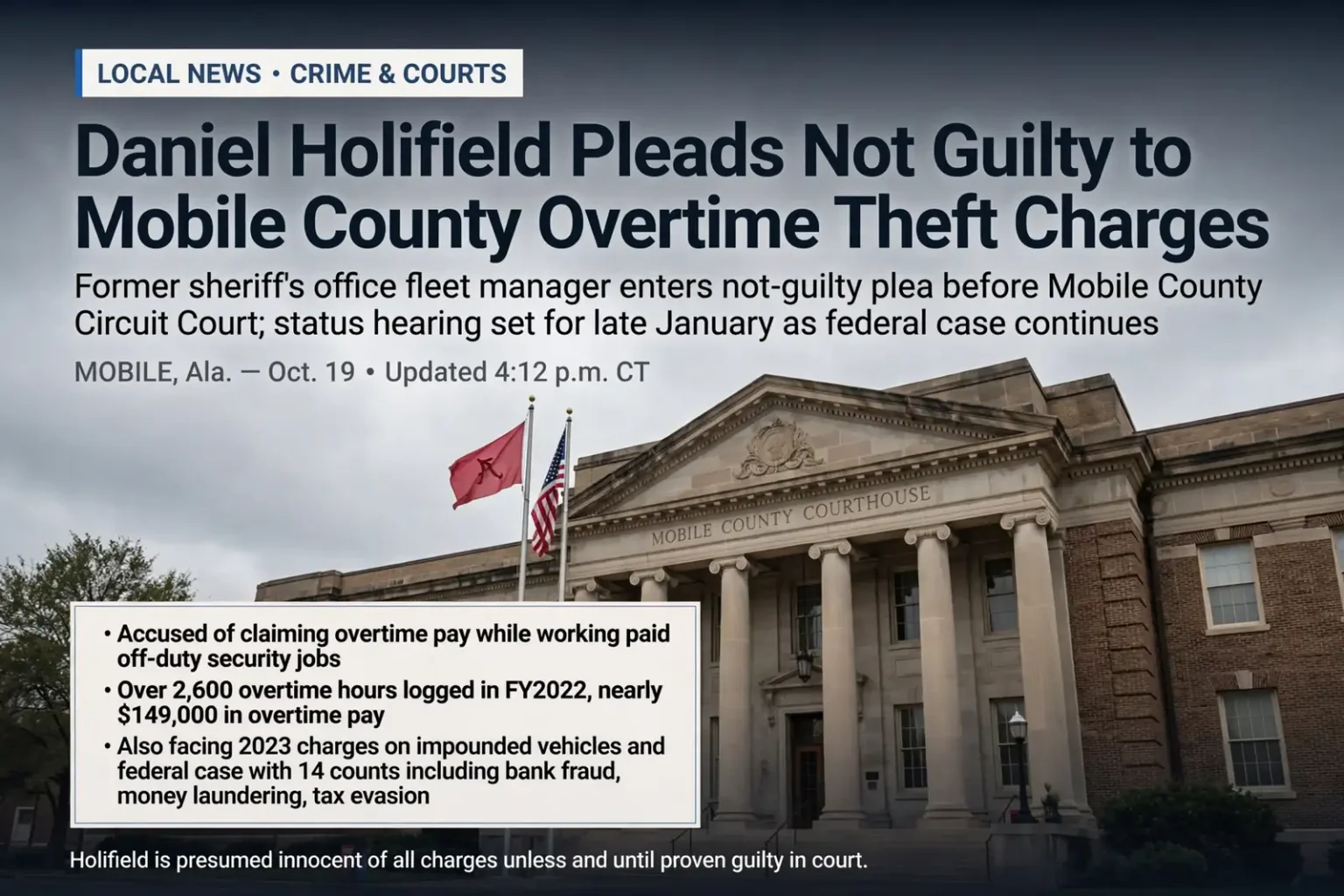
MOBILE, Ala. — Former Mobile County Sheriff’s Office fleet manager Daniel Holifield pleaded not guilty Monday to new state felony charges accusing him of stealing overtime wages and double-counting hours he worked at off-duty security jobs, and a judge pushed the case back about three months while his attorney works to resolve a separate federal prosecution.
Holifield entered his plea Oct. 19 before Mobile County Circuit Judge Ben Brooks. The new state charges center on allegations that he claimed overtime pay from the sheriff’s office for hours during which he also appeared to be working paid security jobs for outside employers. He has also been charged in state court with offenses stemming from a 2023 indictment involving impounded vehicles and county documents, and he faces a 14-count federal case that includes bank fraud, money laundering and tax evasion.
Holifield is presumed innocent of all charges unless and until he is proven guilty in court.
Holifield case reset for a January status update
Rather than setting the state case on a path toward trial, Brooks continued it for roughly three months. The judge scheduled a status hearing for late January, when prosecutors and Holifield’s defense attorney are expected to update the court on both the wage-theft allegations and the earlier charges.
Defense attorney Dennis Knizley told the court that the outcome of the federal case needs to be settled before the state charges move forward.
“There was a reset for status as there are negotiations going on presently in federal court and the federal settlement, if possible, needs to be determined before going forward in state court,” Knizley said.
Coordinating parallel state and federal cases is common when the same defendant faces charges from both sovereigns. Because a resolution in one court — such as a plea agreement and sentence — can affect how prosecutors and defense attorneys approach the other, judges often allow one case to wait while the other is resolved.
State and federal governments are considered separate sovereigns under the U.S. Constitution, which means each can bring its own charges based on its own laws, even when the cases arise from related conduct. The U.S. Supreme Court reaffirmed that principle in 2019. In practice, though, prosecutors and defense attorneys frequently try to coordinate the two tracks so that a defendant’s cases can be resolved in an orderly way.
Mobile County’s circuit court makes up Alabama’s 13th Judicial Circuit, which handles felony criminal cases in the county. In Alabama, felony charges like the ones Holifield faces generally reach circuit court by way of a grand jury indictment, in which a panel of citizens reviews evidence presented by prosecutors and decides whether there is probable cause to formally charge a person. An indictment is an accusation, not a finding of guilt.
What the overtime and wage theft charges allege
The state allegations grew out of a 2023 news investigation that identified discrepancies in Holifield’s overtime records and the hours he worked at off-duty jobs.
That review examined three months of Holifield’s timecards. According to the findings, there were instances in which Holifield appeared to be working paid security jobs for outside employers at the same time he was claiming overtime with the sheriff’s office. Some days showed as many as 21 hours of claimed work, including overlapping overtime entries.
Records showed that during fiscal year 2022 alone, Holifield logged more than 2,600 overtime hours, which translated into nearly $149,000 in overtime pay.
To put that figure in perspective, a standard full-time schedule of 40 hours a week works out to about 2,080 hours in a year. More than 2,600 overtime hours would amount to substantially more than a second full-time job’s worth of extra time on top of a regular schedule.
The new charges allege theft of overtime wages and “double-clocking” — a term used to describe being paid by two employers for the same block of time. Off-duty or “extra duty” security work is a common and legal practice for law enforcement employees in many agencies, but agencies typically have policies requiring that such work not overlap with on-duty or overtime hours paid by the public employer.
Earlier charges involving impounded vehicles and county documents
The wage case is not the first state case against Holifield. In early 2023, he was indicted on charges involving vehicles that were reportedly stolen from impound and county documents that were allegedly forged.
As the sheriff’s office fleet manager, Holifield’s job involved oversight of agency vehicles. The 2023 indictment accused him of offenses connected to impounded vehicles and county paperwork. Those charges remain pending, and the late-January status hearing is expected to address them along with the new wage-theft charges.
Holifield has not been convicted of any of the state charges.
Federal case: plea negotiations underway
Separately, Holifield faces a 14-count federal case. The charges include bank fraud, money laundering and tax evasion.
In August, Holifield notified the federal court that he is cooperating with U.S. Department of Justice investigators and intends to plead guilty to three of the 14 counts — one count each of bank fraud, money laundering and tax evasion.
On Oct. 13, U.S. Magistrate Judge P. Bradley Murray allowed the federal case to continue for another month while a possible plea agreement is finalized. The federal case is being handled in the U.S. District Court for the Southern District of Alabama, which sits in Mobile.
A notice of intent to plead guilty is not itself a conviction. In the federal system, a guilty plea becomes final only after a judge holds a change-of-plea hearing, questions the defendant to make sure the plea is knowing and voluntary, confirms there is a factual basis for it and formally accepts it. Sentencing typically comes later, after the U.S. Probation Office prepares a presentence report.
Federal magistrate judges like Murray handle many pretrial matters in criminal cases, including scheduling, detention questions and requests to extend deadlines. Felony guilty pleas and sentencings are typically handled by a district judge, although a magistrate judge may conduct a plea hearing with the defendant’s consent and recommend that the district judge accept the plea.
Holifield’s statement that he is cooperating with investigators is also significant in the federal system. When a defendant provides what prosecutors consider substantial assistance in an investigation, the government may ask the sentencing judge to take that cooperation into account. Whether such a request is made, and how much weight a judge gives it, depends on the circumstances and is decided at sentencing.
How the state and federal cases move forward
For readers following the case, here is how the process generally works from this point:
- Arraignment: At an arraignment, a defendant is formally told of the charges and enters a plea. Holifield’s not-guilty plea on Oct. 19 means the state must prove the charges if the case goes to trial.
- Status hearing: A status hearing is a check-in with the judge. The parties report on the progress of the case — such as plea talks, discovery or scheduling — and the judge decides what comes next. No verdict is reached at a status hearing.
- Federal plea proceedings: If a federal plea agreement is finalized, Holifield would appear in federal court to formally enter guilty pleas to the agreed-upon counts, and the court would later set a sentencing date.
- Return to state court: Once the federal case is resolved, the state case could move toward its own resolution, whether through a negotiated plea, dismissal of some counts or a trial.
Nothing in the current schedule guarantees any particular outcome in either court. Plea negotiations can succeed or fail, and a judge is not required to accept a plea agreement.
Why the case matters to Mobile County taxpayers
The Mobile County Sheriff’s Office is funded largely through county tax dollars, and overtime pay for its employees is part of the public payroll. Allegations that an employee collected overtime for hours not actually worked for the agency go directly to how public money is spent and how payroll is monitored.
Cases like this one often lead public agencies to review their timekeeping systems, overtime approval processes and policies on outside employment. Common safeguards include supervisor sign-off on overtime, electronic timekeeping, caps on total weekly hours and requirements that employees disclose and receive approval for off-duty jobs.
The size of the overtime totals reported in Holifield’s case — more than 2,600 hours and nearly $149,000 in a single fiscal year — has drawn attention because of how far they exceed what a typical employee could plausibly work alongside a regular schedule.
What comes next for Holifield
The next scheduled step in the state case is the late-January status hearing before Judge Brooks. In federal court, the case was continued for about a month after the Oct. 13 order while the parties work toward a possible plea agreement.
Until a court accepts a plea or a jury returns a verdict, Holifield remains presumed innocent of every charge against him in both the state and federal cases.