43 Years Later, Grand Bay Murder Victim Still Unidentified, Case Unsolved
More than 40 years after a woman's body was found in a creek south of Grand Bay, she remains unidentified and her killer has never been caught.
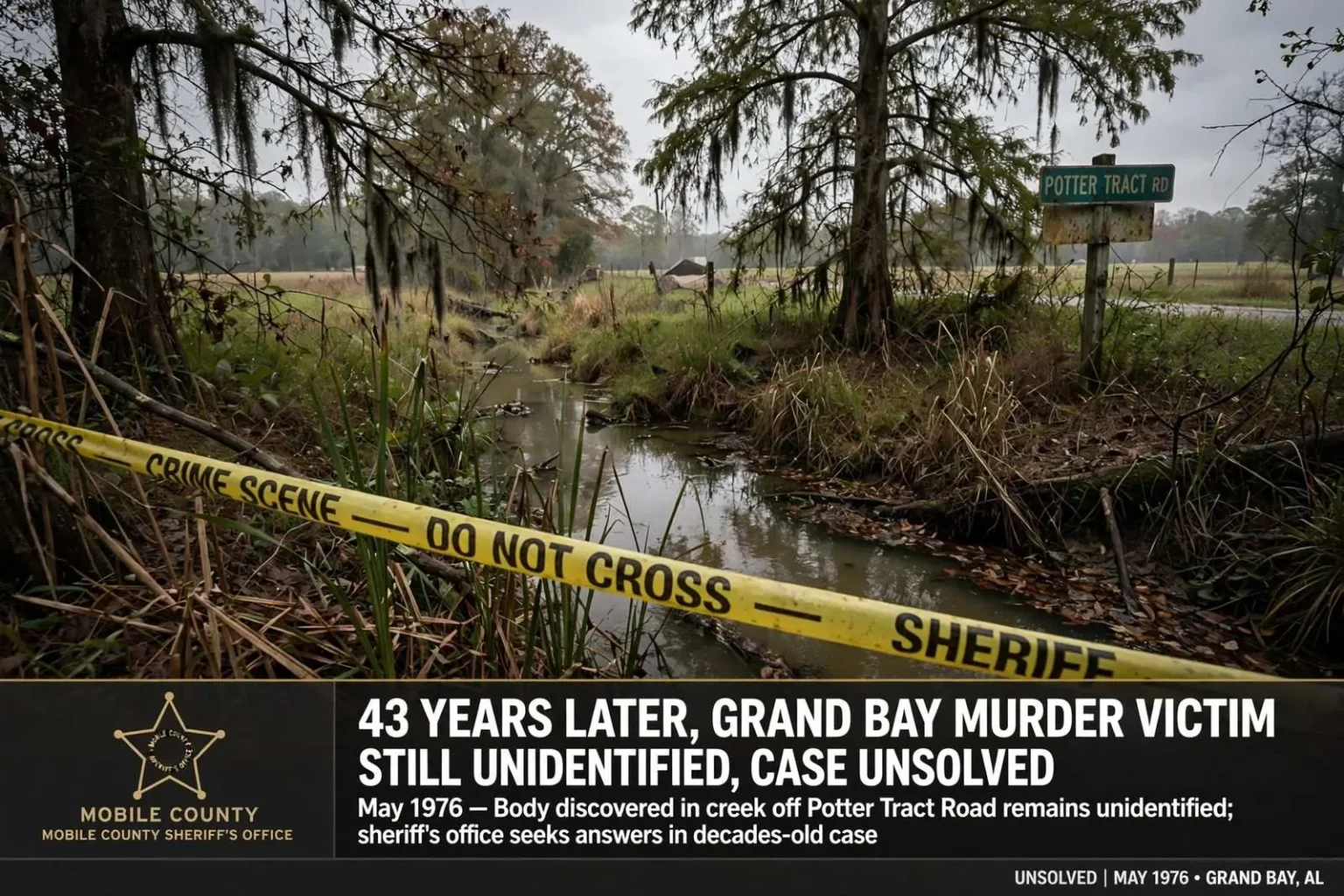
More than four decades after her body was pulled from a creek south of Grand Bay, a murder victim remains unidentified and her killer has never been caught. The case, one of the oldest unsolved homicides on the books in Mobile County, began in May 1976 when two boys fishing in a creek off Potter Tract Road discovered a woman’s body floating face down in the water.
What investigators found was disturbing in ways that went beyond the shooting itself. The woman had been shot in the back of the head. Her dentures had been removed, and her hands had been cut off — mutilations that investigators over the years have interpreted as deliberate acts, whether to prevent identification or to degrade the victim. She appeared to be in her 50s or early 60s. Nearly fifty years later, she has never been identified, and no one has ever been arrested in her death.
A suspect emerged nearly 20 years after the murder, when a similar crime was discovered nearby, but the break never turned into an arrest, and the case remains open. Investigators with the Mobile County Sheriff’s Office continue to seek answers in the cold case, which stands as one of the most haunting unsolved deaths in southwest Alabama.
Grand Bay then and now
Grand Bay is a small unincorporated community in the southwestern corner of Mobile County, hard against the Mississippi state line. In 1976, it was a quiet farming and fishing area — a place of tomato fields, small churches, and scattered homes along country roads, far removed from the city of Mobile some 20 miles to the northeast. Potter Tract Road ran through that rural landscape, and the creek where the body was found was the kind of place local children went to fish on spring afternoons, which is exactly what the two boys were doing when they made their discovery.
The area has grown since then but remains largely rural, and the community’s character has changed little in the decades since the killing. For longtime residents, the unidentified woman has become part of local memory — an unsolved mystery that has passed from one generation to the next. Cases like hers have a way of lingering in small communities, where people wonder whether the victim was a local woman whose disappearance was never connected to the body in the creek, or a stranger passing through the area on the highways that run near the state line.
Mobile County in the mid-1970s had no reliable system for tracking missing persons across jurisdictional lines, and identification of unknown bodies depended heavily on fingerprints, personal effects, and someone coming forward to report a missing relative. The removal of the woman’s dentures — which could have carried identifying marks or dental work records — and her hands, which would have carried fingerprints, cut off nearly every traditional avenue investigators had for learning who she was.
The investigation’s early obstacles
Detectives in 1976 faced the full weight of those obstacles. Without fingerprints or dental records, they could not check the identification databases that existed at the time. Without identification, they could not trace the victim’s last days, interview her acquaintances, or establish a timeline that might point to a killer. Investigators were left to canvass the Grand Bay area, publicize a description of the woman, and hope that someone would recognize her from the details that remained — her approximate age, her appearance, and the clothing she was found in.
No one ever did, or at least no identification ever followed. The description — a woman in her 50s or early 60s — suggests someone whose disappearance family members or neighbors would likely have noticed. That no missing-person report ever connected to her has always been one of the case’s central puzzles. It has left open the possibilities that she was from outside the area entirely, that she was estranged from family who would not have reported her missing, or that she may have lived on the margins of a community without close ties to anyone who would come forward.
The forensic science of the era offered little help. DNA analysis did not exist as an investigative tool in 1976, and techniques for estimating age and reconstructing the lives of unidentified remains were rudimentary by modern standards. The case file grew dusty as years passed, as happens with so many cold cases, kept alive largely by the persistence of the investigators who inherited it.
The suspect who emerged two decades later
Nearly 20 years after the murder, the case saw its most significant development. After a similar crime was discovered nearby, a suspect emerged in connection with the Grand Bay killing. The details of that later crime and the identity of the suspect have never been fully laid out publicly, but the discovery gave investigators renewed hope that the 1976 murder could finally be solved.
That hope was never realized in the form of an arrest. Whether the suspect died before charges could be brought, whether the evidence connecting him to the 1976 killing proved insufficient, or whether the investigation reached some other dead end, the case slipped back into the cold column where it has remained ever since. What the development did establish, in the view of investigators, was that the mutilation and execution-style shooting may not have been an isolated act of violence, and that whoever killed the woman may have been responsible for other crimes in the area.
Serial offenders in rural border counties were a documented problem in that era. The stretch of the Gulf Coast spanning south Mississippi, southwest Alabama, and the western Florida Panhandle saw a series of Predators operating along the interstate corridors during the 1970s and 1980s, and investigators from multiple counties have spent decades comparing notes on unsolved cases from that period. Whether the Grand Bay victim was killed by someone passing through or by someone who lived nearby has never been determined.
Modern tools that could still crack the case
The science that failed investigators in 1976 has been transformed in the decades since, and the Mobile County Sheriff’s Office cold case efforts have kept pace in ways that offer genuine hope. DNA analysis, which did not exist when the woman was found, can now produce a genetic profile from even small or degraded biological samples preserved from old crime scenes. In recent years, forensic genetic genealogy — the technique of matching crime-scene DNA against public genealogy databases to identify relatives and build family trees — has solved dozens of decades-old unidentified remains cases across the country, many of them involving victims found under circumstances similar to the Grand Bay case.
Even the mutilations that once blocked identification are less absolute a barrier than they once seemed. If any biological material from the victim was preserved in evidence, modern testing could yield a DNA profile that could be compared against databases of missing-persons reports and relatives of the long-missing. Dental records, even from the era, can sometimes still be matched if a family member ever recalls a specific dentist or a specific set of dentures.
The Sheriff’s Office has periodically publicized the case over the years, and investigators have encouraged anyone with information — including people who remember the 1976 discovery, or who had a female relative in her 50s or 60s who went missing or was estranged from family in that era — to come forward. Cold case units across Alabama have repeatedly found that memories locked away for decades can hold the detail that breaks a case open, and tips that once seemed insignificant can take on new meaning when matched against modern forensic findings.
A victim waiting nearly fifty years for a name
For now, the woman in the creek off Potter Tract Road remains a case number, an approximate age, and a set of circumstances that have haunted the Grand Bay area for nearly half a century. She was shot in the back of the head, stripped of the identifiers that might have returned her name to her family, and left in a place where only chance — two boys with fishing lines — brought her to light at all.
The unanswered questions remain as stark as ever. Who was she? Where was she from? Who took her life, and why go to such lengths to make sure she could never be identified? Until someone comes forward, or until preserved evidence finally yields a genetic match, the case remains open — a promise, implicit in every cold case unit’s work, that the file will never simply be closed and forgotten.
Anyone with information about the case is urged to contact the Mobile County Sheriff’s Office. Investigators have consistently said that even the smallest detail — a memory of a missing neighbor, a rumor passed among family members decades ago, a name that never quite fit — could be the piece that finally gives the woman her name back and her killer a court date nearly fifty years after the fact.