60 Minutes to Spotlight the Clotilda as $1 Million Preservation Push Begins in Africatown
CBS' 60 Minutes turns its lens on the Clotilda as Alabama commits $1 million to Phase 3 preservation work and Africatown's Heritage House takes shape.
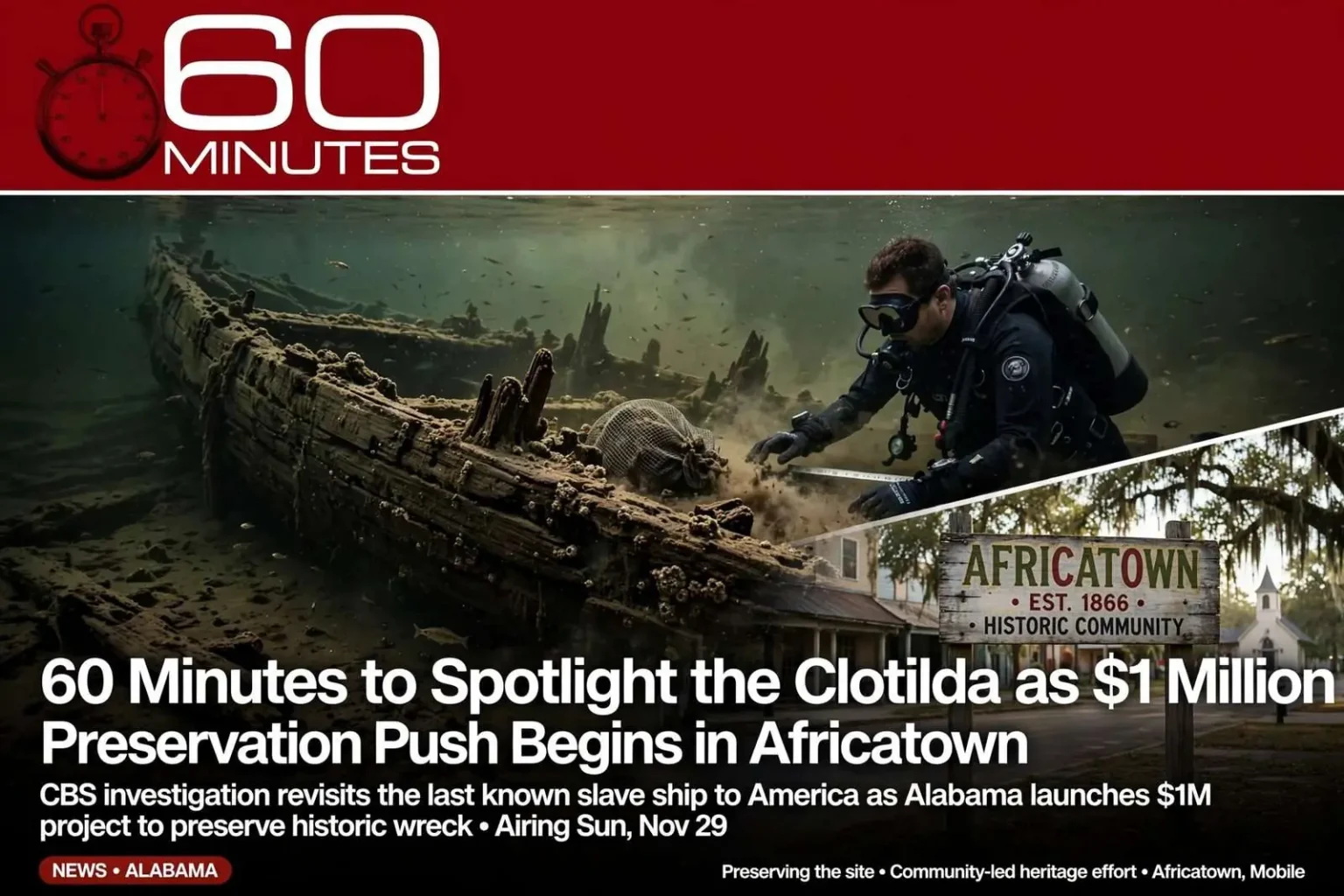
National attention returns to one of Mobile’s most storied historic sites this weekend, as the CBS newsmagazine “60 Minutes” prepares to air a segment on the schooner Clotilda — the vessel that carried the last known group of enslaved Africans to America in 1860, in defiance of federal law. The episode is scheduled for Sunday, Nov. 29, and will revisit both the illegal voyage and the remarkable community its survivors built afterward.
The Clotilda’s story remains one of the most consequential chapters in the history of the Gulf Coast. On the eve of the Civil War, more than half a century after the United States had outlawed the transatlantic slave trade, the ship slipped into Mobile Bay under cover of darkness carrying 110 African captives. After the captives were smuggled ashore, the ship’s owners scuttled the Clotilda upriver from Mobile to hide evidence of their crime, burning and sinking the vessel in the waters north of the city.
Many of those who survived the crossing eventually settled north of the city limits in what became Africatown, a community founded and sustained by African-born Americans. Unlike most Black communities in the Jim Crow South, Africatown was built by people who had been born free in their homeland, forcibly carried across the Atlantic, and then determined to reconstruct as much of their shared life as they could on Alabama soil. Residents maintained African languages, traditions and family structures well into the 20th century, and descendants of the original families remain in the area today.
The national broadcast adds a fresh layer of visibility to a story that locals have carried for more than 160 years, and it arrives at a moment when the physical evidence of that story is finally being studied, protected and interpreted on a scale never attempted before.
State Funding Launches New Phase of Work on the Wreck
The segment arrives as preservation work enters an ambitious new stage. According to a July release from the Alabama Historical Commission, the state has appropriated $1 million to launch Phase 3 of the effort to protect the wreck, which was located and confirmed in recent years in the Mobile River. The appropriation marks the most significant public investment yet in securing the remains of the vessel, and it converts years of archaeological research into a funded, structured program of work.
The new phase includes targeted artifact excavation supported by industrial dive operations, a demanding undertaking in the Mobile River’s dark, current-swept, sediment-heavy water. Divers and archaeologists will work to recover and document artifacts in a way that preserves both the objects themselves and the context in which they lie on the riverbed, information that historians consider essential to reconstructing the ship’s final hours and the conditions aboard.
An environmental study will examine sediment around the site, water movement and the species living near the wreck, all of which shape how quickly the remaining wood degrades and what protective measures can realistically work. Shipworms and fresh- and saltwater mixing in the Mobile-Tensaw system pose ongoing threats to submerged timber, making that biological and hydrological picture a precondition for any long-term plan.
A structural assessment will gauge how much the timbers have deteriorated and shape a long-term preservation plan, while an engineering study will evaluate riverbed integrity and site protection ahead of a possible on-site memorial. Taken together, the studies are intended to answer the fundamental question that has hung over the site since its confirmation: can the Clotilda be preserved where it lies, and if so, how the public might someday safely experience it.
The fragility of the remains has been documented before. A May 2019 report described the wreck as fragile, noting that its owners tried to destroy it to conceal their human trafficking crimes — and that local lore holds it was dynamited sometime in the mid-20th century, either during a salvage attempt or to finish the job of erasing it. Those decades of deliberate destruction, followed by more than a century underwater in an active industrial river, explain why researchers describe the surviving hull with such caution and why every phase of work has moved through careful assessment before any excavation.
For the Africatown community, the state’s commitment carries a meaning that goes beyond archaeology. Community leaders have long argued that the wreck is not merely an artifact but a grave site and a monument, physical proof of the founding narrative that outsiders doubted for generations. The $1 million appropriation is widely seen as a formal acknowledgment, at the state level, that the story preserved in Africatown’s churches, classrooms and family histories is anchored in verifiable physical evidence.
Heritage House Takes Shape Downtown and in Africatown
Preservation leaders are also working to tell the story on land. Mobile County, the city of Mobile, the Alabama Historical Commission, the History Museum of Mobile and the Africatown Advisory Council are partnering to create and curate the Africatown Heritage House, which will recount the Clotilda saga and display artifacts connected to it. The Heritage House is designed as a community-anchored institution, giving the neighborhood itself a central role in how the story is presented rather than leaving interpretation to distant institutions.
The partnership model matters to residents who have watched Africatown’s story be told by others for decades. Placing the Africatown Advisory Council alongside county government, city government, the state’s preservation agency and the History Museum of Mobile puts descendants and neighborhood representatives in the room where decisions about exhibits, language and emphasis are actually made.
Momentum for the exhibition project got a financial boost shortly before airtime: on Nov. 10, the Alabama Power Foundation presented a grant to the History Museum of Mobile to support development of “Clotilda: The Exhibition.” The exhibition is expected to serve as the interpretive heart of the Heritage House, pairing recovered artifacts with the documented history of the voyage, the people who endured it, and the community they built in the years after emancipation.
The project also fits into a broader effort to revive and stabilize the Africatown neighborhood itself, which has faced decades of industrial encroachment, population loss and infrastructure strain despite its singular place in American history. Residents and civic leaders have framed heritage tourism, done carefully and with community control, as one path toward investment that honors the area’s history rather than exploiting it.
A Story Mobile Has Carried for Generations
The “60 Minutes” segment will introduce a national audience to a narrative that has long been central to how Mobile understands itself, even as it remained under-taught in classrooms for much of the 20th century. The voyage of the Clotilda unfolded on the eve of the Civil War, when the importation of enslaved people had been a federal crime for more than 50 years, making the voyage not only a moral atrocity but an open act of defiance of United States law.
The wreck’s identification in recent years closed one of the great open questions in American archaeology. For more than 150 years, the ship’s final resting place was the subject of persistent local lore, with generations of Mobilians passing down accounts of where the vessel had been burned and sunk. Modern research, archaeological survey and documentary work eventually converged on the correct stretch of the Mobile River, and the confirmation transformed rumor into documented history.
That confirmation changed what is possible for Africatown. Physical evidence allows educators to teach the story with artifacts rather than anecdotes, allows preservation agencies to seek funding based on documented significance, and allows the community’s account of its own founding to stand confirmed by scientists, divers and historians from outside the neighborhood who reached the same conclusion residents had long insisted was true.
The timing of the broadcast, the state appropriation and the Heritage House planning has created a rare alignment of attention and resources. National media exposure tends to bring visitation, scholarship and philanthropic interest, and local leaders have emphasized the need to channel that attention into lasting benefit for the community rather than a single news cycle.
What Comes Next for the Clotilda Site
Phase 3 work will unfold over an extended period, with excavation, environmental monitoring and structural and engineering assessments each producing findings that shape the next decisions. Officials have stressed that any public access to the site itself remains a longer-term question, dependent on the results of the engineering study and on what protective measures prove feasible in an active working river.
In the meantime, the Heritage House and “Clotilda: The Exhibition” are expected to carry the interpretive load, offering visitors a place to encounter the full story on land while the wreck itself remains protected in place. The combination, a preserved site in the river and a curated exhibition in Africatown, mirrors approaches used at other nationally significant underwater sites, where fragile remains stay undisturbed and interpretation happens nearby.
With the national broadcast, state funding and museum plans converging, Africatown’s long fight to preserve the physical evidence of its founding story is entering its most visible chapter yet. For the descendants of the ship’s survivors, and for Mobile as a whole, the coming years will determine how a story that survived against every deliberate attempt to erase it is finally presented to the world.