68-Year-Old Man Dies After Mobile Fire-Rescue Pulls Him From Donald Street House Fire
Mobile Fire-Rescue says a 68-year-old man died after being pulled from a kitchen fire at a Donald Street home late Friday night.
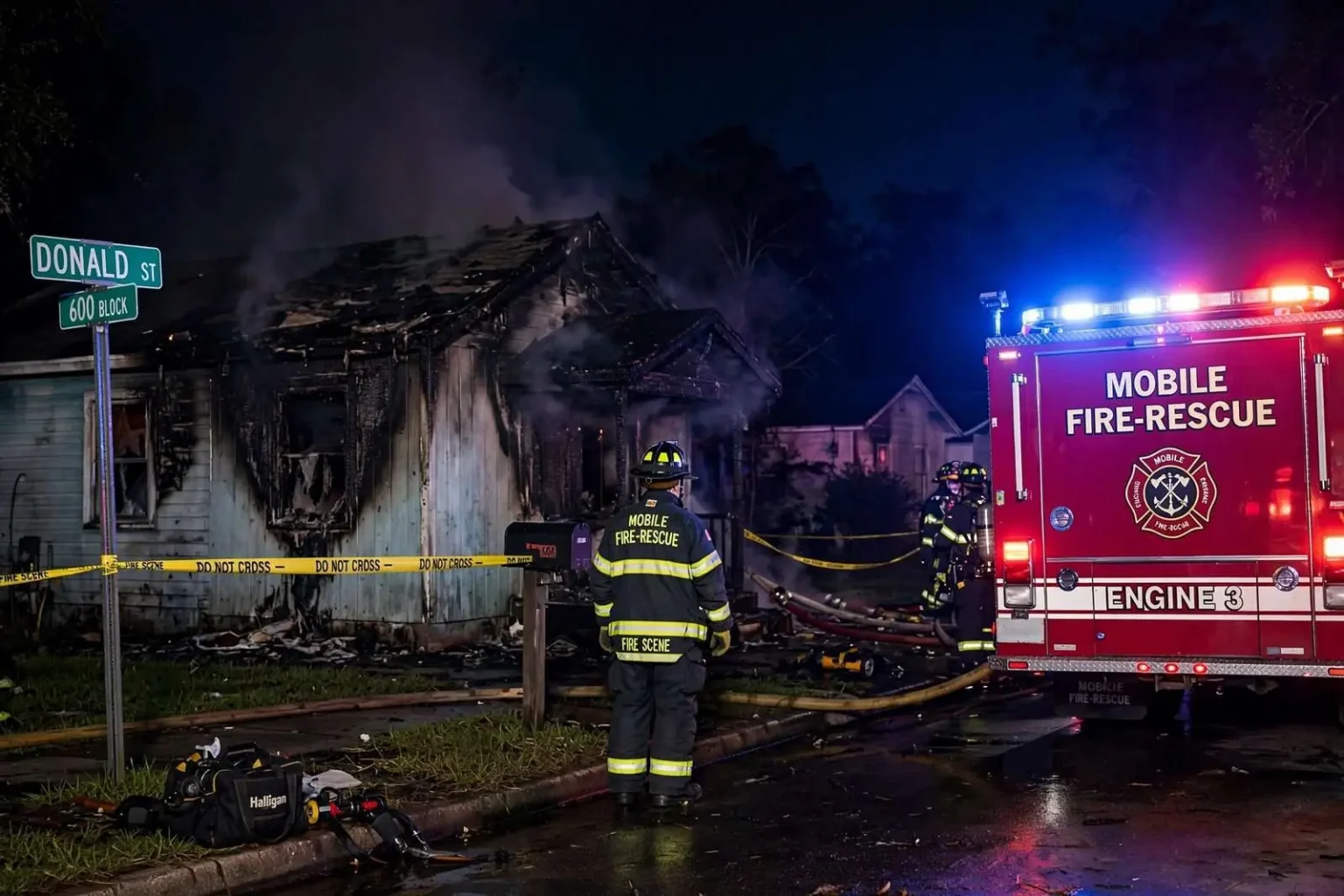
A 68-year-old man has died after a house fire broke out on Donald Street in Mobile, according to Mobile Fire-Rescue. The death added another name to the toll that residential fires take across the Gulf Coast each year, where older housing stock, warm-weather electrical loads, and a large population of seniors living alone combine to make fatal house fires a persistent — and largely preventable — danger.
Shortly before 9 p.m. on Friday, May 25, crews were dispatched to the 600 block of Donald Street after reports of smoke and flames visible from the kitchen of a single-story, wood-frame home. Fire personnel arriving on scene confirmed smoke coming from the structure. The timing of the call mattered: fires that begin in a kitchen in the evening, when residents are awake and active, are often caught in an earlier stage than those that start overnight while a household sleeps — but kitchen fires also spread quickly through grease, cabinetry, and the wall openings behind stoves, and they generate toxic smoke well before they produce dramatic flame.
Quick Search Finds Victim
Witnesses at the scene reported that someone might still be inside the home. Following a rapid search of the residence, firefighters located the 68-year-old victim near the front of the home and removed him. He was transported to a local hospital for evaluation and definitive care, where officials say he died from his injuries.
Locating a victim near the front of a burning home is consistent with the patterns fire investigators see nationwide: occupants often attempt to reach an exit when a fire starts, and are overcome by smoke in doorways, hallways, or just inside front doors. The primary search that firefighters conduct on entering a reported-occupancy structure is among the most time-critical tasks in firefighting, performed in zero visibility by teams moving on their hands and knees along walls, checking beds, sofas, bathrooms, and closets in a systematic pattern. That the crew found the man quickly and got him out alive speaks to the search discipline the department trains on; that he later died despite rescue reflects the lethality of smoke inhalation, which causes the majority of fire deaths rather than burns.
Smoke from a structure fire contains carbon monoxide, hydrogen cyanide, and a range of irritants produced by burning synthetic materials. Victims rescued from such environments may appear conscious at the scene and deteriorate hours later as the gases they inhaled bind with the blood’s oxygen-carrying capacity and with cellular respiration. Hospital teams treating fire victims monitor for these delayed effects in intensive care, and survival beyond the first day substantially improves the odds — but age is a significant risk factor in recovery from smoke inhalation and burns alike, particularly for patients past 65.
Mobile Fire-Rescue, the department that responded, operates as one of the largest fire services in Alabama, with engine and ladder companies distributed across the city and specialized units for heavy rescue, hazmat, and marine response. The department’s standard response to a reported structure fire with possible entrapment sends multiple companies simultaneously — an engine for attack, a ladder or rescue company for search and ventilation, an additional engine for water supply, and a battalion chief for command. A May evening dispatch of this kind typically places the first engine on scene within minutes, and the department’s push toward faster cardiac-arrest and fire response times has been a recurring budget and council topic in recent years.
No additional injuries were reported in the blaze, and fire investigators have not announced a cause. The investigation of a fatal fire follows a defined protocol: the scene is treated as a potential crime scene until investigators can rule out foul play, origin and cause teams map burn patterns and examine appliances and wiring, and in fatal cases the county medical examiner conducts an autopsy to establish the precise cause of death. Investigators also interview neighbors and witnesses — the same accounts that prompted the search that located the victim — and coordinate with utility providers on any meter or service records relevant to the home.
Where the fire originated — the kitchen, per the initial reports — is statistically the most common room of origin in American residential fires, with cooking equipment involved in roughly half of all home fires nationally. The leading causes are unattended cooking, grease ignition, and appliances left on or malfunctioning. Fire agencies across the Gulf Coast run recurring public campaigns around these basics: never leave stovetop cooking unattended, keep a lid within reach to smother pan fires, never use water on a grease fire, and keep a working extinguisher accessible. Prevention messaging tends to intensify in late spring and summer, when insurance and fire-data trends show seasonal upticks tied to holiday cooking, outdoor frying, and air-conditioning loads on older wiring.
The victim’s age placed him in the demographic at highest risk in American fire statistics. National Fire Protection Association data consistently shows that adults 65 and older die in house fires at more than twice the rate of the general population, a gap driven by mobility limitations, slower reaction to alarms, higher rates of living alone, and in some cases medication effects or cognitive changes that delay escape. Fire safety programs aimed at seniors emphasize simple measures with outsized effect: working smoke alarms on every level and inside bedrooms, tested monthly; a phone kept by the bed; escape plans that account for limited mobility; and regular checks by family or neighbors on homes where an older relative lives alone.
Smoke alarm status in the Donald Street home has not been disclosed by investigators, but it is the variable that most often separates fatal residential fires from survivable ones. Roughly three of every five home fire deaths nationally occur in properties with no smoke alarms or alarms that failed to operate, most often from missing, disconnected, or dead batteries. Mobile Fire-Rescue, like most urban departments, installs free smoke alarms for residents who cannot afford them and replaces batteries for seniors and disabled residents on request — a program the department publicizes after fatal fires, when community attention is highest.
The Donald Street neighborhood, in Mobile’s Crichton-Compressed corridor north of downtown, is a grid of mid-century wood-frame cottages of the type involved in this fire. Homes of that era and construction carry specific fire risks: aging wiring never designed for modern appliance loads, few if any structural fire stops, and floor plans that place bedrooms near kitchens and aging electrical panels. Wood-frame houses can be involved in flashover — the point at which every combustible surface ignites simultaneously — in as little as three to five minutes from ignition, a timeframe that has shortened dramatically over recent decades as furnishings have shifted from natural to synthetic materials.
For neighbors, the visible aftermath of a fatal fire — boarded windows, the smell of smoke that lingers for days, the investigative trailers parked outside — is a familiar sequence in older Mobile neighborhoods, and it typically renews local conversations about alarms, extension cords, and space heaters. Fire officials use those moments to repeat their central message: that fire doubles in size roughly every minute, that escape rather than firefighting is the correct instinct for residents, and that a $10 alarm with a working battery remains the single most effective life-saving device in a home. The man’s death, following a rescue that succeeded in reaching him in time to bring him out of the house alive, illustrates both the speed and the limits of even a well-executed response.
No charges have been filed in connection with the fire, and none are necessarily anticipated; fatal fire investigations conclude in a wide range of outcomes, from accidental determinations involving cooking or electrical faults to cases referred for prosecution where negligence or intent is found. The department’s customary practice is to release findings when the investigation closes, though in many cases no public cause is ever formally announced. The victim’s name was withheld pending family notification, in keeping with standard procedure.
The dispatch that brought crews to Donald Street also illustrates how modern fire response is staged. Calls reporting flames visible from a residence are classified as working structural fires, which triggers a first-alarm assignment larger than a routine response and often a automatic mutual-aid element from neighboring jurisdictions. The first-arriving officer makes a rapid size-up — smoke color and velocity, flames visible, structure type, occupancy status — and communicates it to dispatch, decisions that shape how the rest of the assignment is deployed. A report of possible entrapment, as came in here from witnesses, typically upgrades the urgency of search operations immediately and can pull an additional rescue company to the scene.
Hospital care for fire victims extends beyond the emergency department. Patients admitted for smoke inhalation are treated with high-flow oxygen, monitored for airway swelling that can necessitate intubation hours after arrival, and assessed for carbon monoxide poisoning that may require hyperbaric oxygen therapy in severe cases. Burns add fluid resuscitation, wound care, and infection risk to the picture. For a 68-year-old patient, the physiological reserve to survive that cascade is thinner than for a younger adult, which is why age features so prominently in fire fatality data even when the rescue itself is performed within minutes of arrival.
Fatal residential fires also set in motion a support apparatus that most residents never see. The American Red Cross Alabama region responds to house fires across the Gulf Coast more often than to any other disaster type, providing emergency lodging, food, and replacement medications to displaced households — typically within hours of the fire being reported. For fatalities, victim-services staff from the fire department or police department assist the family with notifications, death certificates, and in some cases funeral assistance funds administered through local charities and fire service organizations.
For the broader community, each fatal fire is also a data point in a long-running regional problem. Alabama routinely ranks among the states with the highest per-capita fire death rates in the country, a statistic tied to rural distances, older housing, poverty, and comparatively low rates of working smoke alarms. State and local agencies have targeted the problem with free alarm-distribution programs, school-based education, and — in the case of newer construction codes — requirements for alarms in every bedroom. The Donald Street fire, occurring in an older urban neighborhood rather than a rural one, underscores that the risk is not confined to the state’s remote counties: it is present in every neighborhood where mid-century housing meets an aging resident population.