A Gulf Coast Gardener’s Guide to Growing Roses Without the Fuss
Roses have a reputation for being high-maintenance, but Gulf Coast gardeners say the right variety and a few simple habits make a fragrant, low-fuss rose bed easy to grow in Mobile County.
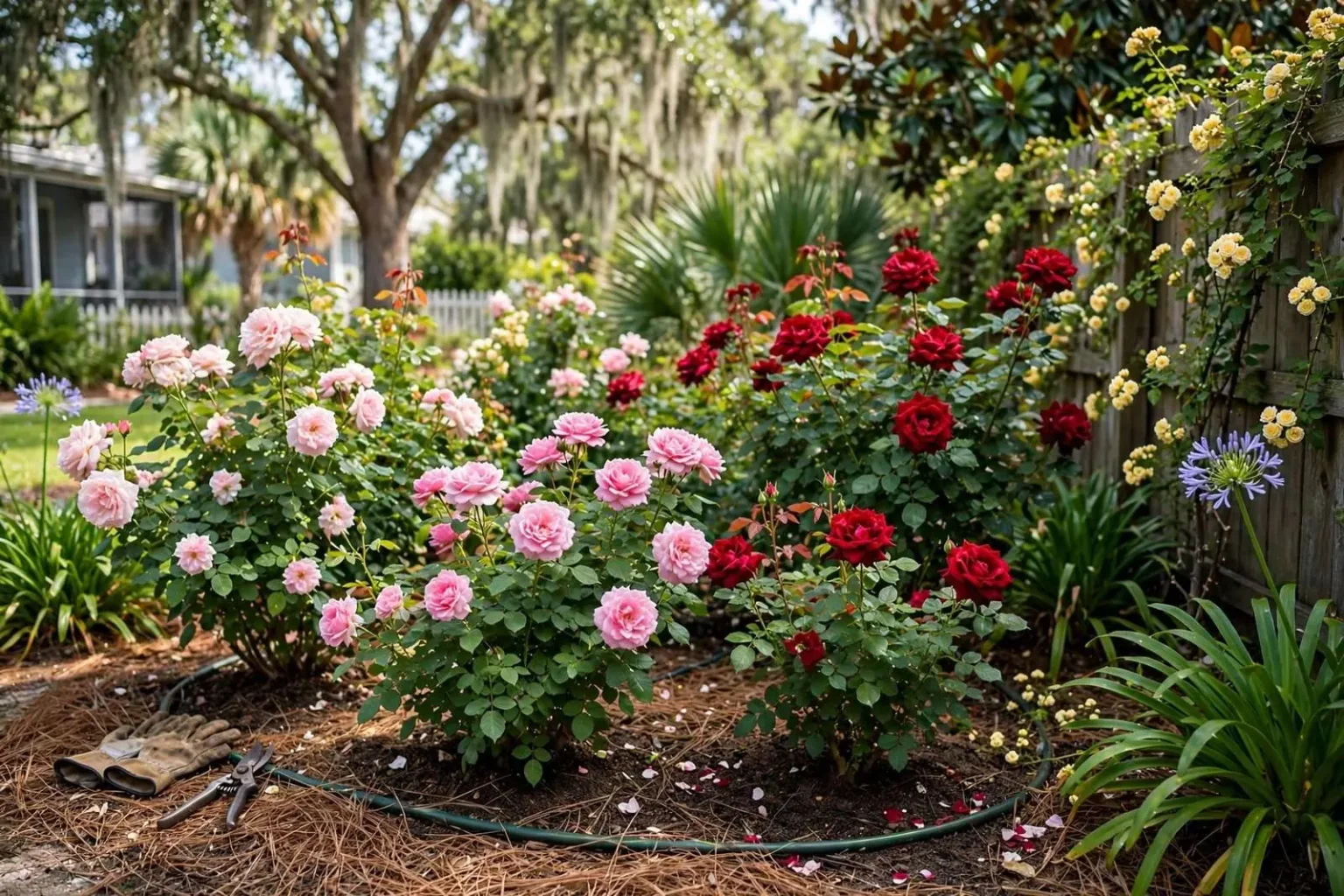
Roses have a reputation for being finicky, but gardeners across Mobile County who have actually tried growing them tend to disagree. With the right variety and a few basic habits, a rose bed can be one of the lowest-maintenance additions to a Gulf Coast yard — and one of the most fragrant.
The reputation problem is real, though, and it keeps a lot of would-be rose growers out of the game entirely. Many newcomers read about the chemical spray schedules that rose societies in other parts of the country recommend and conclude that roses simply are not worth the trouble in a climate as humid as the central Gulf Coast’s. In practice, the gardeners who succeed here skip most of that apparatus entirely. The trick starts with treating roses like the perennials they are. They need what most other perennials need: at least six hours of sunlight a day, decent soil, regular nutrition, good air circulation and consistent watering.
That last point deserves emphasis for anyone moving to the region from farther north. Gulf Coast summers are long, wet and humid, and a rose that tolerates those conditions without complaint is worth far more in a local landscape than a showier variety that collapses into fungal disease by June. Gardeners in this region already manage those same conditions for tomatoes and other backyard staples without much trouble, and roses respond to the same care: a sunny spot, soil amended with compost, a steady feeding schedule and room for air to move between plants.
Skip the Hybrid Teas, Go Old Garden
The biggest mistake new rose growers make is starting with Hybrid Tea roses, which demand constant spraying and attention to stay healthy. Hybrid Teas are the long-stemmed, high-centered blooms of the florist trade, bred for form and cutting rather than for resilience, and in the Deep South they often function as annual shrubs — attractive in spring, exhausted by August, and dead or defoliated by their second year without a rigorous fungicide program.
A better starting point along the Gulf Coast is an Old Garden rose. Many of these varieties have been cultivated for more than a century and require no spraying and very little upkeep beyond deadheading spent blooms to encourage a new flush of flowers. These are the roses that survived in cemetery plantings, dooryard fences and abandoned homesteads across the South for generations — varieties that persisted through decades of neglect and a century of Gulf hurricanes without anyone fertilizing, pruning or spraying them at all. That durability is exactly what a Mobile County gardener wants.
Local gardeners point to a handful of standout varieties: Cramoisi Superieur, Archduke Charles, the thornless Lady Banks, Quietness, Old Blush, Martha Gonzales, Marie Pavie, Carefree Beauty, Caldwell Pink, Prosperity, Belinda’s Dream and Louis Philippe. Between them, the varieties span most of the color spectrum, and the group includes both shrub types and climbers. All of them are repeat bloomers except for Lady Banks.
The range within the list is worth studying before planting. Old Blush and Louis Philippe are among the oldest and most dependable, tolerating shade better than most and shrugging off disease. Cramoisi Superieur produces deep red, quartered blooms almost continuously through the season. Marie Pavie, nearly thornless and fragrant, works well near walkways and entries. Belinda’s Dream, a more modern introduction, combines shrub-rose toughness with Hybrid Tea-style flowers. Caldwell Pink and Carefree Beauty fill out the pink range, while Martha Gonzales offers a compact, red-flowered option for small spaces. Lady Banks, the exception to the repeat-blooming rule, delivers a spectacular single spring explosion of small yellow or white blooms on a thornless plant that can cover a fence or outbuilding — and it is famously vigorous, sometimes overwhelmingly so.
The newer Drift rose varieties are also worth a look — they can thrive for years with nothing more than regular watering. Bred as low, spreading landscape roses, Drifts stay under about two feet tall and several feet wide, which makes them a natural choice for edging walkways, filling parking strips and carpeting slopes where a full-size shrub would crowd its neighbors. They flower in waves from spring through fall and hold up well to the region’s heat and humidity, giving new gardeners a nearly foolproof entry point into the rose family.
Gardeners planning a bed from scratch should think about mature size before they buy anything. Old Garden roses are not miniature plants: shrub varieties commonly reach four to six feet in each direction, and climbers like Lady Banks can exceed fifteen feet in a few seasons along a fence line. Crowding is one of the most common self-inflicted problems in Gulf Coast rose beds, because tight spacing chokes off the air movement that keeps fungal disease in check.
Working With Gulf Coast Conditions
Sunshine is non-negotiable for healthy roses in this climate, and so is staying on top of fertilizer. The Gulf Coast’s frequent, heavy rains wash nutrients out of the soil quickly, so plants need to be fed on a regular schedule to keep blooming well. A rose that blooms heavily consumes nutrients at a remarkable rate, and in a climate where a single afternoon thunderstorm can drop several inches of rain in an hour, whatever was in the topsoil last week may be in Mobile Bay by the weekend. Light, frequent feeding through the growing season outperforms a single heavy application for exactly that reason.
Good air circulation around each plant is just as important, since it’s one of the best defenses against black spot, a common fungal disease that thrives in humid conditions. Black spot shows up as circular black patches on the leaves, followed by yellowing and leaf drop, and in a wet summer it can defoliate a susceptible rose almost completely. Giving roses room to breathe rather than crowding them together helps keep that problem in check, as does choosing a planting site with an open exposure rather than a still, shaded corner against a wall.
Watering habits matter too. Roses should be watered in the morning, aimed at the base of the plant rather than the leaves. Afternoon or evening watering is worth avoiding altogether, since damp leaves left overnight in the region’s high humidity create ideal conditions for disease to take hold. Soaker hoses or drip irrigation solve the problem at its root by keeping foliage dry entirely, and they conserve water during the dry stretches of late summer when supplemental watering matters most.
Soil is the other regional variable. Much of Mobile County sits on sandy loam that drains quickly but holds few nutrients, while pockets of heavy clay hold water but compact easily. Either extreme improves dramatically with a two- to three-inch layer of organic compost worked into the bed at planting and refreshed annually. Compost buffers the sandy soil’s tendency to leach nutrients and loosens clay enough for rose roots to spread. A mulch layer of pine straw or shredded bark — both plentiful and inexpensive locally — keeps soil moisture even, suppresses weeds and prevents rain from splashing fungal spores from the ground onto the lower leaves, which is one of the main ways black spot spreads in the first place.
A Simple Pruning Routine
Pruning intimidates a lot of first-time rose growers, but the process is straightforward if it’s done on a schedule. Many local gardeners aim for Valentine’s Day or thereabouts each year. The date works on two levels: by mid-February the worst of the Gulf Coast’s winter is over in most years, and pruning at the traditional holiday makes the job impossible to forget — the same reminder many Southern gardeners use for trimming crape myrtles.
Start by removing any dead limbs, then cut out branches that rub against or cross one another. Rubbing branches wear away bark at the contact point, creating an open wound where canker organisms and borers can enter, and crossing branches shade one another and trap moisture in the plant’s interior. From there, trim the remaining limbs back to about one-third of the shrub or climber’s overall height.
While trimming, look for buds pointing away from the center of the plant and make each cut just above one of those buds. New growth will then head outward rather than inward, which keeps the center of the plant open and airy — another safeguard against disease. Sharp bypass pruners make clean cuts that seal over quickly; anvil-style tools crush the cane and invite rot. Gardeners in the coastal zone occasionally face winter dieback after a hard freeze, and the Valentine’s Day pruning is the natural time to cut away any wood that did not survive, before the spring growth push begins.
Repeat-blooming varieties reward deadheading — snipping spent blooms just above the first full leaf — with faster rebloom through the season. Lady Banks, which blooms only once in spring, should be pruned immediately after that display instead, since trimming it in winter would remove the wood that carries its flowers.
Where to Find Them Locally
Mobile Botanical Gardens periodically features a selection of roses at its plant sales, making it a good local starting point for gardeners who want to see varieties in person before buying. The gardens’ sales draw from growers who know the regional climate, which means the offerings there tend to skew toward plants that actually perform along the Gulf Coast rather than the generic assortment found at big-box garden centers.
For a wider selection, mail-order nurseries that specialize in antique and Old Garden varieties are also an option for gardeners looking to fill out a bed with several types at once. Specialty mail-order growers propagate the heirloom varieties that general retailers rarely stock, ship bare-root plants in winter for planting in late winter and early spring, and catalog each variety’s habit, fragrance and disease resistance in detail. Ordering in the fall or early winter gives the widest selection, since popular heirlooms sell out before spring.
New gardeners should resist the urge to plant an entire bed at once. A better approach is to start with two or three proven varieties, learn how they behave in the specific microclimate of the yard — sun exposure, drainage, prevailing wind — and expand the following season. Roses establish best when planted in fall or late winter along the Gulf Coast, giving roots time to grow in cool, moist conditions before the first summer arrives.
With the right variety, consistent morning watering and an annual pruning around Valentine’s Day, a rose bed in Mobile County can deliver years of blooms and fragrance without becoming a constant chore. The secret, in the end, is not a cabinet full of sprays but a short list of old, tough varieties matched to the climate — the same roses that have flourished in Gulf Coast gardens for well over a century.