
A look at Alabama’s few competitive State House races in 2022
Alabama's 2022 election features few competitive legislative races, but Baldwin County's Senate District 33 and several Huntsville-area seats are worth.
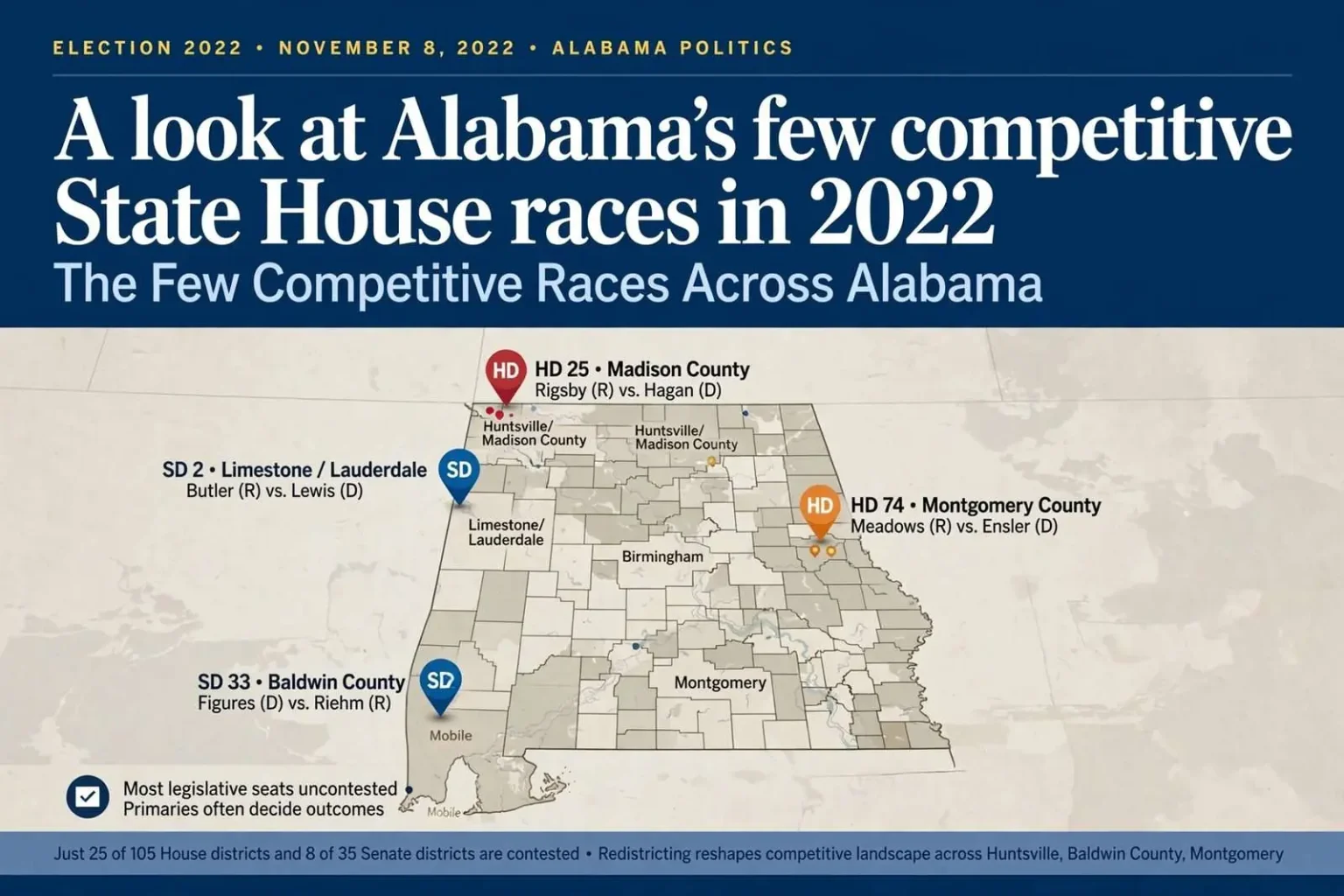
While all 140 seats in Alabama’s Legislature are on the ballot Tuesday, few are truly contested. In the House, just 25 of 105 districts have both a Republican and a Democrat running; in the Senate, only eight of 35 races are two-party contests. The rest of the ballot is populated by districts where one major party — and in many districts, only one candidate at all — appears, a pattern that has made general election day in Alabama a formality for most legislative seats.
The Few Competitive Races Across Alabama
Some of the most competitive districts are in the Huntsville area, where rapid population growth and shifting demographics have unsettled the political map. In House District 25 in Madison County, Republican Phillip Rigsby and Democrat Mallory Hagan are vying for the seat being left by House Speaker Mac McCutcheon, whose retirement opened one of the few genuine toss-up contests in the state. Open seats reliably draw the strongest competition, and the race to succeed the Speaker has attracted resources and attention unusual for a legislative race in Alabama.
Hagan brings a notable profile to the contest — a former Miss America whose statewide name recognition gives her the kind of visibility first-time legislative candidates rarely enjoy, while Rigsby’s campaign runs on the Republican advantage that still defines most Alabama districts. Madison County’s growth, driven by the expanding aerospace and defense economy around Redstone Arsenal, has been reshaping north Alabama politics for a decade, making the Huntsville area the most dynamic political landscape in the state.
Senate District 2 in Limestone and Lauderdale counties, between incumbent Republican Tom Butler and Democrat Kim Lewis, could also shift because of redistricting. The once-a-decade redrawing of legislative lines moved voters between districts in ways that altered the underlying partisan math, and incumbent senators who woke up with new constituents have had to introduce themselves to communities their predecessors represented. Butler’s district is among those whose new shape changed the calculus for both parties.
Political analyst Steve Flowers is also watching Senate District 33 in Baldwin County, where incumbent Democrat Vivian Davis Figures faces a challenge from Pete Riehm in a redrawn district that may no longer be safely blue. “During reapportionment, they sent some of those Republicans into her Democratic district, which has made her district a possible swing district,” Flowers said. Figures, a veteran Mobile-area legislator whose Senate tenure spans decades, has historically represented a district anchored in Mobile County, and the new Baldwin County additions test whether her personal following can stretch across the bay.
In House District 74 in Montgomery County, Republican Charlotte Meadows faces Democrat Phillip Ensler in another district unsettled by redistricting. Montgomery’s legislative districts have been among the most closely watched in the state because the capital city’s demographic balance makes two-party competition genuinely viable — a rarity in Alabama. Both Meadows and Ensler have built profiles in local education and community circles, and the race has drawn attention as a contest where the outcome is genuinely uncertain rather than predetermined.
Why So Few Districts Are in Play
By and large, though, most seats aren’t competitive — a majority of House and Senate districts have just one candidate on the ballot. That arithmetic shapes everything about how the Legislature works: primary elections, not general elections, decide most seats, which pulls both parties toward their activist bases and leaves general election voters with little say over who represents them. Political scientists have long noted that when general elections are foregone conclusions, accountability shifts to party primaries, where turnout is a fraction of the general electorate.
Howard Robinson, a political science professor at Alabama State University, says the lopsided map is driven by how districts are drawn. “Part of our politics and part of our electoral landscape is driven by the way these districts have been created,” he said, pointing to the redistricting process that follows each federal census. District lines packed into safe configurations mean that most incumbents face their real elections years earlier, in primaries, or not at all.
Robinson added that local offices on the ballot still matter for schools, policing and roads — a reminder that down-ballot races for county commissions, school boards, sheriffs and municipal judges carry the day-to-day decisions residents feel most directly. In counties across Alabama, those local contests generate the competition the legislative ballot lacks, and voters whose legislative choices are settled often find genuinely contested races further down the ballot.
For the handful of truly contested legislative races — Madison County’s House District 25, the redistricted Senate seats in the Tennessee Valley and along the bay, Montgomery’s House District 74 — the state’s parties have concentrated their resources accordingly. In a state where the overwhelming majority of legislative outcomes are effectively decided before election day, those few districts receive the advertising, canvassing and candidate visits that most districts never see, making them the only places where Tuesday’s legislative ballot remains genuinely in doubt.
Redistricting’s Long Shadow Over 2022
The 2022 legislative elections arrive amid a broader cycle of change for Alabama’s political map. The redistricting round that followed the 2020 census redrew all 140 legislative districts, and the lines now in effect will define representation for the decade. Population shifts toward Huntsville, Baldwin County and the suburbs of the state’s largest cities have concentrated voters in ways that make some districts more competitive while leaving vast stretches of rural Alabama in single-party territory.
The House’s 105 districts and the Senate’s 35 seats together form the state’s lawmaking body, which controls the budget, taxation, education policy and the framework under which every municipality and county operates. With Republicans holding commanding majorities in both chambers, the handful of competitive districts represents the only realistic path to shifting the chamber’s balance, and neither party’s leadership expects the outcome of a handful of races to threaten the majority. Instead, attention centers on individual incumbents whose redrawn districts put them at risk.
Vivian Davis Figures’s situation illustrates the stakes. A Mobile Democrat with seniority and committee influence, she has represented her district through decades of political change, but reapportionment “sent some of those Republicans into her Democratic district,” as Flowers put it, converting safe territory into a possible swing district. Her race against Pete Riehm has therefore drawn statewide interest as a test of whether incumbents with deep personal roots can hold districts whose underlying partisan composition has shifted beneath them.
The Huntsville-area races carry similar significance for different reasons. Madison County’s explosive growth means its delegation gains influence with each redistricting cycle, and the contest to succeed Speaker Mac McCutcheon in House District 25 will seat a new legislator in one of the state’s most economically consequential regions. Rigsby and Hagan have each campaigned on the issues driving north Alabama’s growth — infrastructure, schools and the pressures of rapid development around Redstone Arsenal’s expanding mission.
What’s at Stake for Voters on Election Day
Turnout, as always, will shape the outcome in the few competitive districts. In a general election where most legislative seats offer no contest, the races that exist draw a disproportionate share of attention, and both parties target their turnout operations on the few addresses where persuasion matters. For Alabama voters in those districts, Tuesday offers a genuine choice; for the rest of the state, the legislative ballot is largely settled, and the action — as Robinson notes — is in the local races that decide who runs the schools, the sheriff’s office and the road department.
The uncompetitive map also has consequences for how candidates and voters interact. In districts without general election opposition, legislators answer primarily to primary electorates, and the incentive structure rewards positioning within the party rather than coalition-building across it. Robinson’s framing — that “part of our politics and part of our electoral landscape is driven by the way these districts have been created” — captures the consensus among the state’s political observers that lines drawn with precision produce legislatures drawn with them as well.
Still, the handful of competitive districts offers a window into how Alabama politics can shift when demography and redistricting align. The Huntsville area’s growth, Montgomery’s balanced electorate and the Baldwin County realignment in Senate District 33 all trace to the same forces: population movement, redrawn lines and candidates who can compete in territories their parties once wrote off. Tuesday’s results in those races will be read closely in both party headquarters as previews of the maps and matchups to come later in the decade.
For voters preparing to head to the polls, the practical takeaway is to check the full ballot before arriving. With legislative races largely settled by district lines, the contests that will most directly affect daily life — county commission, school board, sheriff, probate judge and municipal offices — often sit below the legislative races receiving the advertising. Robinson’s reminder that local offices matter “for schools, policing and roads” is the guidance most applicable to the greatest number of Alabama voters this cycle.
The constitutional officers and statewide races atop the ballot will draw the headlines and the heaviest turnout, but the 2022 legislative picture will be defined by the same narrow band of competitive districts: House District 25 in Madison County, Senate District 2 in the Tennessee Valley, Senate District 33 along the bay and House District 74 in Montgomery. Everywhere else, the Legislature’s next term was largely decided the day the qualifying deadline passed.


