A Mardi Gras Season for the Ages: Packed Parades, Fake Prichard Water Board Cards and a City Cleanup to Remember
Mobile's Carnival season returned in full force this year, drawing packed crowds back downtown and giving parade satirists fresh material in the Prichard Water Board spending scandal.
Mobile’s Mardi Gras season wrapped up this week with what many longtime revelers are calling one of the most spirited Carnival runs in years, as crowds returned to the downtown parade routes in force after the pandemic forced the cancellation of the 2021 parade schedule. With favorable weather for much of the three-week run, parade-goers packed the barricades along Government Street and throughout downtown, catching beads, stuffed animals and moon pies in numbers that suggested a community eager to make up for lost time.
By the time Fat Tuesday arrived, the exhaustion was evident all over the city, a familiar rhythm for anyone who has lived through a full Mobile Carnival season. Locals often note that the length of the season is close to perfect: just long enough to satisfy the appetite for celebration, and just short enough that everyone is more than ready for it to end by the time Ash Wednesday rolls around.
The empty calendar of 2021 made the return feel larger than an ordinary season. Mobile’s Carnival tradition dates to 1703, making it the oldest organized Mardi Gras celebration in the United States, older than the better-known festivities in New Orleans by more than a century. The city’s mystic societies, parade flotillas and dinner balls grew out of that long history, and when the parades were called off two years ago, the absence was felt in neighborhoods from Midtown to West Mobile and across the bay in Baldwin County, where Daphne, Fairhope and Foley stage their own smaller-procession versions of the season.
The rebound also carried economic weight. Bars, restaurants and hotels along Dauphin Street, Government Street and the Bienville Square corridor count on the Carnival run for a significant share of their annual business, and a well-attended season sends visitors through downtown from the first parades in early February through the final rolls on Mardi Gras night. Parking decks filled early on weekend nights, and the usual clusters of tailgating trucks and folding chairs reappeared on the neutral grounds well before sundown.
A cleanup operation on a tight schedule
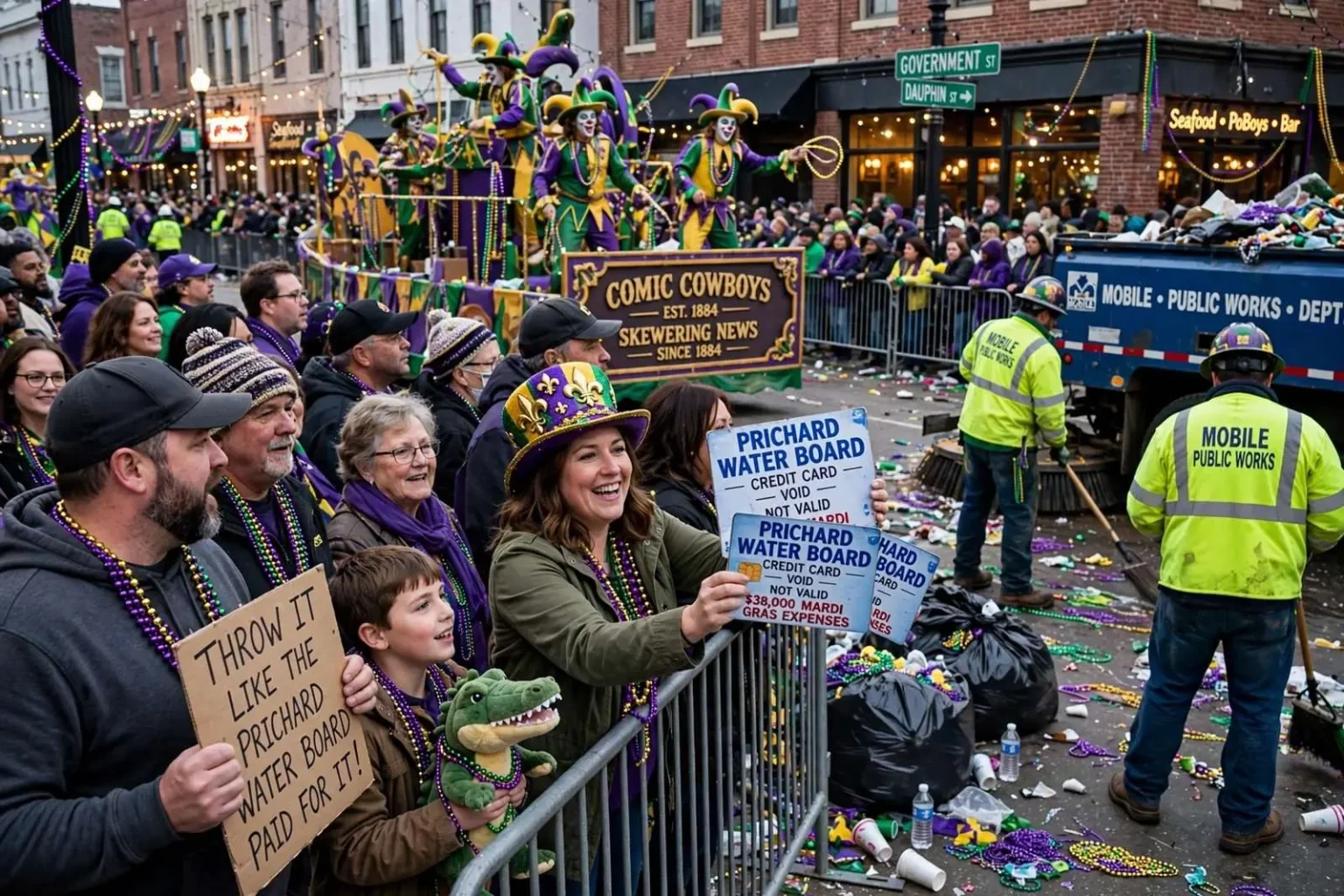
City crews deserve credit for the cleanup effort that follows each parade. Mobile’s Public Works Department clears thousands of pounds of discarded throws from the streets after each parade rolls through downtown, and by the days following the final parades, the transformation is dramatic. What looked like a sea of beads, cups and plastic debris on Fat Tuesday night is typically cleared from the downtown core within days, a testament to a cleanup operation that runs on a tight schedule throughout the entire season.
The work is repetitive by design. After each roll, street sweepers and front-end loaders move down the parade corridors in the overnight hours so that traffic can flow by morning, and the crews repeat the process parade after parade, night after night, until the last float has parked. Residents who live along the routes know the rhythm well: the barricades come down, the noise of the machinery replaces the bands, and by the weekend the neutral grounds look as though nothing happened at all.
The discarded catches themselves have a second life of sorts. Schools, churches and charitable groups across the Mobile area have long collected beads and plush throws for reuse, and the sheer volume of plastic that comes down off the floats each season has made the post-Carnival sweep one of the largest recurring debris operations the city runs each year.
A scandal that rode the parade route
This year’s Carnival season also became an unlikely showcase for one of the region’s biggest news stories of the year: the Prichard Water Works and Sewer Board spending scandal. The story, which broke in early February, revealed that board manager Nia Bradley and others were accused of using Water Board credit cards to make nearly $4 million in questionable purchases, including designer merchandise, high-end travel and college textbooks. The revelations shocked residents already struggling with water and sewer bills in Prichard, and the scandal quickly became fodder for Mardi Gras satire.
Prichard, the city of roughly 20,000 people just north of Mobile along U.S. 45, has weathered years of financial strain, including a nationally noted pension crisis that pushed it toward bankruptcy in the 2000s. For residents there, the idea that a utility board entrusted with basic service had been spending at that scale struck a nerve that no holiday could soften. Water bills that had climbed while service problems lingered were already a common complaint in the city’s neighborhoods, and the credit card disclosures gave that frustration a new focal point.
The Comic Cowboys, the satirical marching group known for skewering the year’s biggest headlines with handmade signboards, were widely expected to take aim at the Water Board scandal during their parade appearance, continuing a tradition of pointed political commentary that has defined the group for more than a century. The organization, founded in 1884, has made a habit of needling mayors, commissioners, athletes and anyone else who made news during the previous year, and its walking parade through downtown remains one of the season’s most anticipated moments precisely because no one is quite sure what the signs will say.
Elsewhere along the parade routes, revelers embraced the joke as their own. On Joe Cain Day, marchers were seen tossing fake Prichard Water Board credit cards into the crowd, including at least one taped to a bag of ramen noodles, a wink at the board’s alleged high-end spending habits. Other parade-goers held up handmade signs reading “ISO a Prichard Water Board credit card” and “throw it like the Prichard Water Board paid for it,” a nod to reports that among the board’s questionable expenses was roughly $38,000 spent on Mardi Gras-related supplies.
Joe Cain Day itself is one of Mobile’s most distinctive contributions to the Carnival calendar. Held the Sunday before Fat Tuesday, it honors Joseph Stillwell Cain, the local clerk who is credited with reviving Carnival celebrations after the Civil War when he paraded through the shell-strewn streets in 1866 dressed as a fictional Chickasaw chief. The day belongs to the people rather than the established societies, with the Merry Widows of Joe Cain wailing at his grave in Church Street Cemetery in the morning and an open procession of ordinary residents, family groups and self-styled marchers following in the afternoon.
That a municipal corruption story from Prichard worked its way so thoroughly into the satire of Mobile’s oldest public celebration said something about how widely the scandal had traveled. By the final week of the season, the references were not confined to one parade or one group; they had spread through the crowds on Government Street the way a good throw or a popular costume does, passed along, repeated and refined night after night.
House parties and the season’s quieter side
Away from the parade routes, private Mardi Gras gatherings across the Mobile area kept the tradition alive in smaller, more personal ways. Backyard and living room parties featuring local bands, jambalaya, king cake and other Carnival staples remained a fixture of the season for many Mobile families and friend groups, echoing the citywide celebration on a more intimate scale.
Those gatherings carry their own rituals. King cakes appear on office counters and kitchen tables from Twelfth Night onward, with the plastic baby hidden inside deciding who bakes or buys the next one. Neighborhood cookouts fill weekend afternoons when the downtown parades do not roll, and on Mardi Gras Day itself many households split the day between a morning procession and an afternoon of gumbo and leftover throws spread across the living room floor.
For businesses, the private side of the season matters as much as the parades. Bakeries across Mobile and Baldwin County sell king cakes by the hundreds through the season, seafood houses supply the gumbo and jambalaya pots, and local bands that work the private party circuit book weekends months in advance. The economy of Carnival stretches well beyond the barricades.
Who marches, and who stands at the barricades
Mobile’s Mardi Gras mystic societies have long drawn scrutiny for their historically segregated membership, a subject explored in depth in documentarian Margaret Brown’s 2008 film “The Order of Myths,” which examined the parallel traditions of Mobile’s Black and white Carnival organizations. The film traced how the city’s oldest white societies, including the Order of Myths itself, and its Black organizations such as the Order of Doves and the Colored Carnival Association had run on separate calendars and separate membership rolls for generations, even while celebrating the same streets and the same season.
The documentary arrived as the city was reckoning publicly with questions that had long been discussed quietly, and in the years since, several societies have opened their rolls more broadly while others have continued to keep their membership private. The history remains part of any honest account of the season: Mobile’s Carnival grew up in a segregated city, and the organizations at its center grew up with it.
Even so, longtime observers of the season point out that the crowds gathered along the parade barricades tell a different story than the organizations themselves. People of all races, ages and backgrounds stand shoulder to shoulder each year waiting for floats to roll by, trading opinions on which krewe has the best throws and swapping catches with strangers, including older parade-goers who make a habit of passing along stuffed animals and prized beads to nearby children.
Anyone who has worked a spot along the route for more than one season knows the small courtesies that hold the crowd together. Families stake out the same corners year after year, sharing ladders and chairs with neighbors, and the experienced hands at the front of the barricades routinely turn around to hand the best catches of the night to the children standing behind them. The crowd polices itself in small ways, too, keeping the crush manageable on Fat Tuesday and looking out for visitors who wandered downtown without knowing how the throws actually fly.
That shared experience along the parade route, community members say, is what continues to define Mardi Gras in Mobile: a citywide celebration that, whatever the divisions behind the scenes, brings tens of thousands of residents together for a few weeks each year to celebrate a tradition that has shaped the city’s identity for generations.
The season now turns toward Lent, with the parades parked, the beads swept up and the mystic societies already planning next year’s themes and floats. If the 2021 shutdown taught the city anything, it was that the appetite for Carnival does not fade in an off year. This winter’s crowds made that plain along every block of the route, from the first rolls through the final float on Mardi Gras night.