A nearly 200-year-old Mobile murder mystery: the Boyington Oak
Mobile author Mary S. Palmer's book revisits the 1834 hanging of Charles Boyington and a growing effort to win him a posthumous pardon.
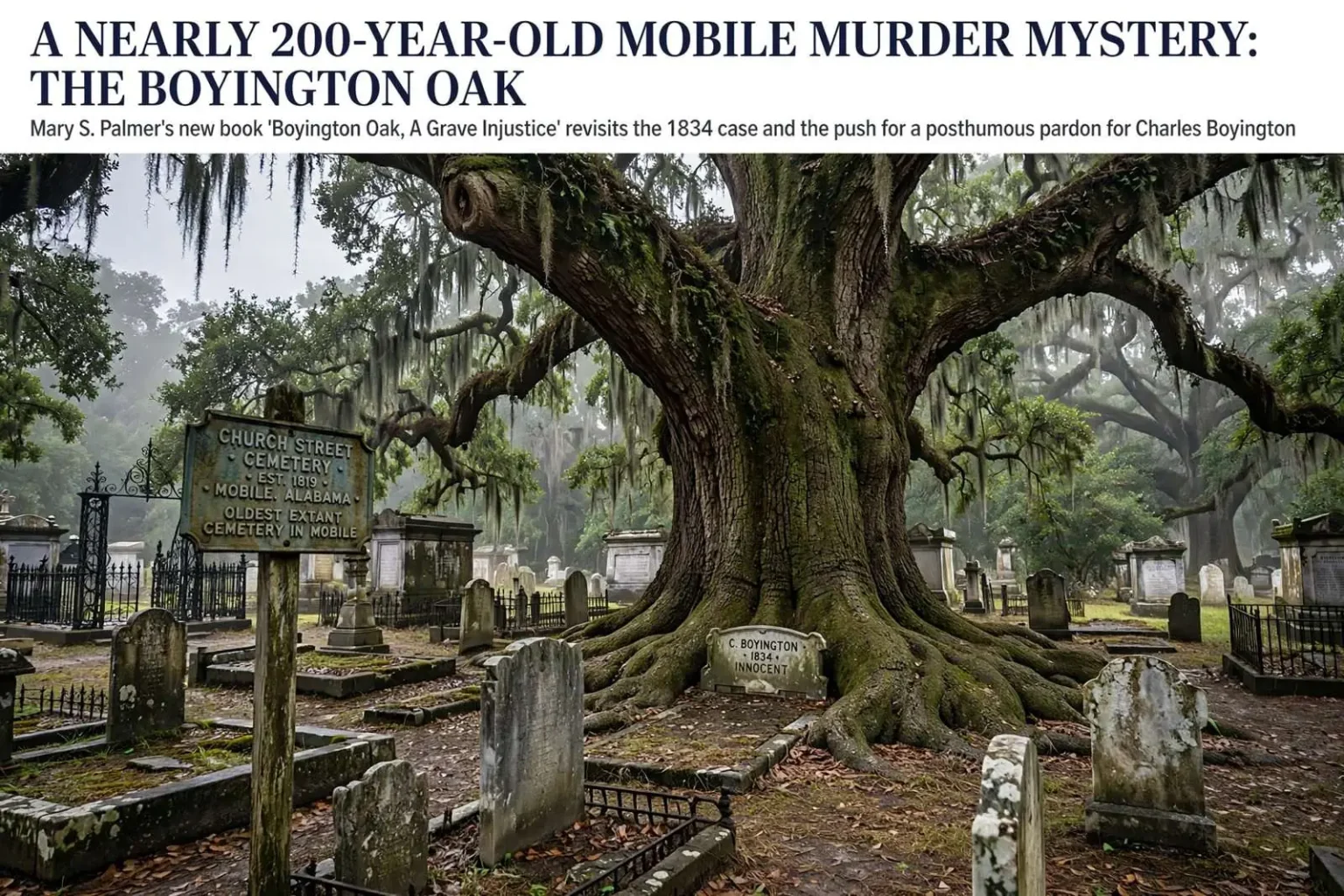
Mobile author Mary S. Palmer’s latest book, “Boyington Oak, A Grave Injustice,” revisits one of the city’s oldest unsolved questions. In 1834, Charles Boyington was hanged for the murder of his friend and roommate, Nathaniel Frost, at Church Street Cemetery. He proclaimed his innocence until the end. Nearly two centuries later, the case remains one of the most haunting chapters in the early history of Alabama’s oldest city, and Palmer’s book has helped renew attention to a story that many Mobilians know only as a fragment of folklore.
“He said sooner or later, I’ll be vindicated, I am innocent,” Palmer said. “And he said this tree will grow from my grave to prove that I’m innocent. The tree did grow, but that’s not unusual, there are a million oaks out here.” The oak that sprouted from Boyington’s grave has stood as part of Mobile history for nearly two centuries, and questions about Boyington’s guilt or innocence have never fully faded. The tree — the Boyington Oak that gives the story its name — has been pointed out to generations of visitors and locals as a living monument to a man’s last words.
The case unfolded in a young, turbulent city. Mobile in the 1830s was a booming cotton port riding a wave of speculation, immigration and disease, with a skyline of new construction and a rough-edged waterfront culture. The murder of Nathaniel Frost shocked the community, and the circumstances of the crime — discovered in the Church Street Graveyard where Frost’s body was found — made for sensational news in the small city. Fear and suspicion ran high in an era when Mobilians had recently endured epidemics and economic panics, and authorities came under pressure to find and punish a killer quickly.
“This is a different case because there was so much evidence that was used that wasn’t worthy of note,” Palmer said. Some of the factual record that she argues supports Boyington’s innocence includes a jury tainted by one member who was convinced of his guilt and another who was not a U.S. citizen. Palmer’s research draws on the trial record and the accounts of contemporaries, and she argues that the proceedings against Boyington fell far short of the standard that even a 19th-century court should have met before sending a man to the gallows.
The case’s aftermath only deepened the mystery. Boyington, a young clockmaker and drifter who had come to Mobile from Georgia, maintained that he had spent the night of the murder in town and had nothing to do with Frost’s death. He pointed to the absence of physical evidence tying him to the killing, but the court was unmoved, and he went to the gallows protesting his innocence and, in effect, promising the city a sign.
The Graveyard That Holds the Story
Church Street Cemetery, established in the early 19th century, is the oldest extant graveyard in Mobile and one of the most historic burial grounds on the Gulf Coast. Located in the heart of downtown, it holds the graves of mayors, soldiers from multiple wars, yellow fever victims and figures from every era of the city’s past. Its live oaks, crumbling tablet stones and iron-fenced family plots make it a frequent stop on ghost tours and history walks, and the Boyington Oak is among its best-known features.
The graveyard sits adjacent to the site of the old Christ Church, from which it takes its name, and it predates most of the cemeteries in south Alabama. Preservationists have worked for decades to document and protect its stones, which record the names of families whose descendants still live in the region. The Boyington story adds a layer of legend to that documentary history, and whether one believes in the oak’s significance or not, it has drawn more attention to the cemetery than any marketing campaign could.
The legend holds that an oak grew directly from Boyington’s grave — a sign, his supporters said then and say now, that nature itself attested to his innocence. Palmer is blunt about the science: oaks sprout in cemeteries constantly, and the tree proves nothing in a court of law. But the image of a man executed with a promise on his lips, followed by a tree rising from his grave, has kept the case alive in Mobile’s memory in a way that hundreds of better-documented convictions from the same era have not been.
A Push for a Pardon
Palmer hopes to write a new chapter in the case. An effort is underway to seek a posthumous pardon for Boyington. “You have to go to the Bureau of Pardons and Paroles,” Palmer said. “I went to the bureau here, and I wrote to the governor, and we had a petition with 55 names.” The appeal is now in legal review with the Bureau.
Posthumous pardons are rare, but not unheard of, in Alabama and across the country. The Alabama Bureau of Pardons and Paroles, which traces its lineage through more than a century of state parole and pardon administration, reviews applications for clemency, and a posthumous case requires the bureau and ultimately the governor to weigh historical evidence rather than a living applicant’s record. Palmer’s petition argues that the trial’s flaws — from the composition of the jury to the questionable evidence — justify correcting the record, even 190 years after the fact.
Why the Case Still Matters
The Boyington case is a study in the dangers of rushed justice. Historians of the early American South have documented how pressure to solve a notorious crime could overwhelm the safeguards of a trial, particularly for outsiders without family or resources in the community. Boyington was a stranger in Mobile, a young man of no standing, accused of killing a prominent local. The combination — an alarming murder, an unpopular defendant and a fearful public — produced a conviction that Palmer and others argue was a foregone conclusion.
The trial’s documented problems remain striking even by the standards of the 1830s. A juror who entered the deliberations already convinced of the defendant’s guilt violated the most basic expectation of impartiality, and the presence of a juror who was not a United States citizen raised questions about eligibility that the record does not resolve. Modern observers reviewing the case have noted that a conviction resting on such a foundation would not survive a day in a contemporary courtroom.
Palmer, a longtime Mobile writer, has built a career around the city’s history and its darker corners, and “Boyington Oak, A Grave Injustice” joins her other works on Alabama crime and history. Her argument is not that a tree proves anything, but that the documentary record — flawed jury, thin evidence, a defendant denied the benefit of doubt — makes the case for innocence compelling on its own terms. The oak, in her telling, is simply the reason the story survived long enough for someone to reexamine it.
A Marker for the Future
Palmer is also hoping to add a plaque or marker so visitors understand the significance of the oak and of Charles Boyington. A historical marker at the cemetery would place the story in context for the tourists and school groups who pass through, distinguishing the documented history from the legend and explaining why the case still resonates. Communities across Alabama have used such markers to surface forgotten chapters of their past, from civil rights sites to industrial landmarks.
Whether the pardon effort succeeds or the marker goes up, the story of Charles Boyington has already outlived everyone who condemned him. The oak that grew from his grave still stands in Church Street Cemetery, and the question he posed with his final breath — sooner or later, will I be vindicated? — is being answered, slowly, by authors, petitioners and historians who refuse to let a 19th-century injustice remain buried. For Mobile, the case is a reminder that the city’s oldest graves hold more than names: some of them hold arguments that are still being made.
The World of 1830s Mobile
Understanding the verdict requires understanding the city in which it was reached. Mobile in 1834 was a port of a few thousand residents, swelling each shipping season with sailors, merchants, laborers and travelers drawn by the cotton trade that flowed down the Alabama and Tombigbee rivers. Wealth was building fast, but so were the problems that came with rapid growth: makeshift housing, violent crime, recurrent epidemics and a court system staffed by a handful of officials trying to impose order on a boomtown. Public executions still drew crowds, and criminal trials moved at a speed that would startle a modern observer.
Church Street Graveyard itself was on the edge of the built city then, and the discovery of Nathaniel Frost’s body within its walls gave the case a macabre quality that seized the public imagination. An 1830s murder in a graveyard was exactly the kind of story that spread by word of mouth through a small port city, and Boyington, as the victim’s friend and housemate, was an easy focus for suspicion. Little about the investigation or trial suggested anyone in authority was searching for alternatives.
Capital punishment in that era left no appeals infrastructure resembling today’s. A convicted man’s options were a petition for executive clemency and public sentiment, and Boyington had neither. His execution was carried out with the formality of the age, and the community largely moved on — leaving the oak, the graveyard and the lingering doubts to keep the question alive.
Alabama’s modern clemency machinery, whatever its limitations, is a different institution altogether. The Bureau of Pardons and Paroles maintains records, investigates applications and can recommend action to the governor, and the bureau’s willingness to place Palmer’s petition into legal review means the case has gotten further along a legitimate path than Boyington himself ever could. A posthumous pardon would not rewrite history, but it would put the state’s own judgment on the record — that the trial of Charles Boyington did not meet the standards of justice.
The story has also found new life through the region’s growing heritage tourism. Mobile’s historic districts, its cemeteries and its narrative traditions draw visitors interested in the city’s long and layered past, and guides who lead tours through Church Street Cemetery regularly recount the Boyington legend. A plaque supported by Palmer’s research would ensure that tourists hear the documented case — the flawed jury, the missing evidence, the lifelong proclamation of innocence — alongside the romantic tale of the tree.