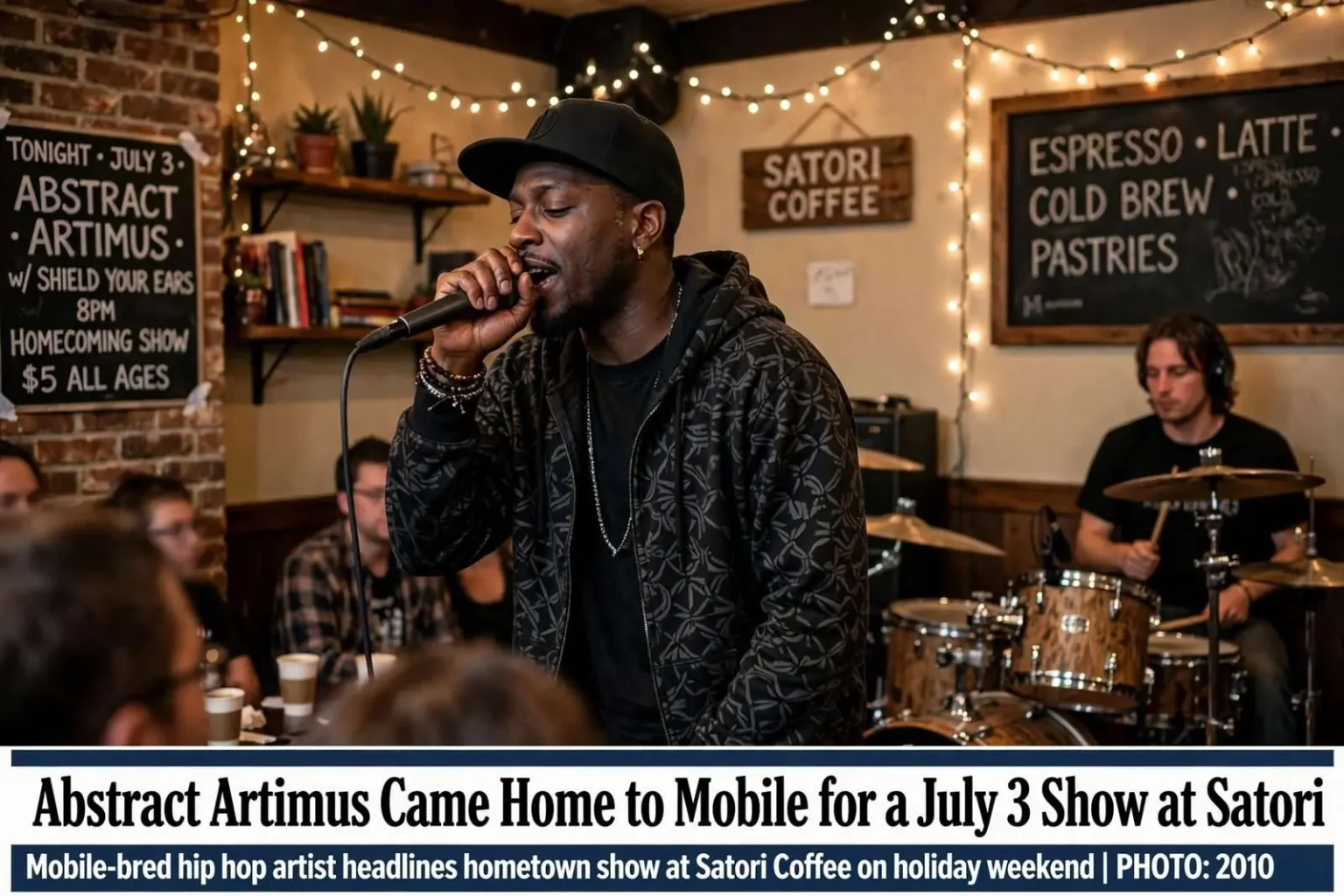
Mobile-bred hip hop artist Abstract Artimus returned to his hometown over the July 4th weekend in 2010, headlining a July 3 performance at Satori Coffee alongside the band Shield Your Ears. The homecoming capped an extensive stretch of touring that had carried the rapper far from the Gulf Coast, and it gave local fans a rare chance to see him on a hometown stage.
Satori Coffee, a coffeehouse that served as a gathering spot for Mobile’s independent music community, had long been known for putting local and touring acts in front of intimate crowds. A July 3 slot put the show squarely in the middle of the holiday weekend, when residents filled downtown Mobile for concerts, cookouts and celebrations along the waterfront, and it positioned the venue as one of the stops on that crowded calendar of entertainment.
For Artimus, the date meant something more than another line on a routing sheet. The rapper, who had built his reputation in Mobile before relocating, returned not as a visitor but as a headliner whose career had grown well beyond the city limits — a homecoming in the fullest sense, staged in the same small-venue circuit that had given him his start.
Hometown roots, big-city ambition
At the time of the show, Artimus was living in Manhattan, where he was writing material for a new album and lining up additional dates in New York and Europe. The move from Mobile to New York placed him in one of the most competitive music markets in the world, among the five boroughs where independent hip hop artists hustled for stage time in clubs, lounges and open-mic nights in every neighborhood.
The album he was writing represented the next step in that climb. New material developed in a Manhattan apartment or studio would eventually find its way into his live sets, and Mobile audiences at Satori got an early hearing of songs that had not yet been recorded or released. For a hometown crowd, that preview carried a particular appeal: hearing work in progress from an artist whose horizons had stretched to Europe while his roots remained on the Gulf Coast.
The touring schedule that preceded the Mobile date had been extensive, taking the rapper through markets across the country. That kind of itinerary — repeated one-night drives, load-ins, soundchecks and hotel rooms — is the reality of independent hip hop, where artists build audiences city by city rather than arriving with major-label machinery behind them. The July 3 show marked a pause in that grind, a night to perform for people who had watched him develop.
A message for Mobile’s young artists
The July 3 date arrived with expectations of its own. Holiday weekends test any venue’s drawing power, with audiences split among competing parties, fireworks displays and family obligations, but hometown headliners historically punch above their weight in those conditions. A performer coming home tends to draw not only regular showgoers but also the extended circle of people who followed his career from a distance and wanted to see it up close again.
Despite the growing itinerary, Artimus described Mobile as his hometown and spoke directly to aspiring musicians in the local scene, urging them to stay committed, keep creating and never give up on their work. It was a message grounded in his own path: an artist who had come up through Mobile’s venues and gone on to tour nationally and plan European dates could tell young writers and performers, with firsthand authority, that the work they were doing in living rooms and open mics could lead somewhere.
That encouragement carried weight in a city whose music scene, like those of many mid-sized Southern cities, has historically produced talent that leaves for larger markets. Atlanta, New Orleans, Houston and Nashville all sit within driving distance, and New York and Los Angeles have long drawn ambitious musicians from the Gulf Coast. For local artists weighing whether to stay or go, Artimus embodied both choices at once — he had left, but he kept coming back, and he kept calling Mobile home.
The rapper’s willingness to address the local scene directly reflected a broader culture among independent artists who remember the venues, promoters and fans that supported them first. Headline sets in hometown rooms are often where established artists repay that debt, playing to crowds that knew them before the touring schedule filled up and the songs started reaching listeners overseas.
The Satori show and Mobile’s independent venues
The Satori Coffee show gave Mobile listeners a chance to hear the new material taking shape far from the Gulf Coast. Coffeehouse venues like Satori occupy a distinctive place in regional music scenes: they book acts that bars cannot, they welcome all-ages crowds, and they foster the kind of attentive listening that songwriters and lyricists need when trying out unreleased work.
The pairing with Shield Your Ears gave the night additional range, joining a hip hop headliner with a band on the same bill. Mixed-genre bills are a hallmark of the independent circuit, where promoters match acts by availability and audience rather than by strict category, and Mobile audiences have historically responded to lineups that blend rap, rock and singer-songwriter sets in a single evening.
Shows like the July 3 date also illustrate how Mobile’s venue ecosystem functioned for touring artists. A hometown act passing through could anchor a bill downtown, drawing their own following while introducing the opening acts to new listeners. Over time, that exchange — local acts supporting each other, touring artists passing through, venues rotating bills — is what sustains a scene between the bigger festival moments the city hosts on its waterfront.
The broader moment for Gulf Coast hip hop
Artimus’s 2010 homecoming came during a period when Southern hip hop had become the dominant force in the genre nationally, with artists from across the region — Alabama, Louisiana, Georgia, Florida — shaping the sound of mainstream and underground rap alike. Mobile, positioned along Interstate 10 between New Orleans and Pensacola, shared in that regional current, with its own artists developing styles rooted in Gulf Coast culture.
The journey from Mobile to Manhattan also tells a story about the economics of independent music. Without label support, artists fund their own recording, their own travel and their own promotion, often working day jobs between tours. An artist writing an album in New York while booking dates on two continents was doing the work of manager, booking agent and publicist as well as performer — the multitasking reality that independent hip hop artists from mid-sized cities know well.
For Mobile audiences, the show was also a reminder of what the city’s music scene was producing: artists with national and international reach who carried the city’s name onto stages far from home. Every successful hometown act that returns to play a local room reinforces the loop — young artists see that the path exists, venues see that the audience shows up, and the scene grows a little more self-sustaining.
The July 3 set list was expected to lean on that new material, giving longtime fans both the songs they had followed and a preview of where the artist was headed. Hearing unreleased work in a small room, before the recordings were finalized, gave the Mobile audience a stake in the album’s development that listeners in larger markets would not have until months later.
The Fourth of July weekend backdrop
The timing of the show gave it a holiday glow. July 4th weekend 2010 fell on a summer when downtown Mobile’s entertainment district was humming, with residents and visitors moving between restaurants, bars and venues in the LoDa district and along Dauphin Street. A hometown hip hop show fit naturally into that weekend’s mix of entertainment options, offering locals an alternative to the fireworks and waterfront crowds.
Holiday weekend shows carry their own energy for performers. Crowds arrive relaxed and ready to celebrate, and for an artist returning home, the atmosphere amplifies the reunion quality of the night — friends from school, family members and longtime supporters all in one room, many of them seeing the new material performed live for the first time.
The July 3 performance stands as a snapshot of an artist mid-ascent: a Mobile native working on a new album in Manhattan, planning dates in New York and Europe, pausing long enough in his hometown to headline a room on a holiday weekend and tell the next wave of local musicians to keep going. For the audience at Satori Coffee that night, it was both a concert and a homecoming — proof that the Gulf Coast’s music scene sends its artists into the world and still calls them back.
For the local scene, the visit also left practical value behind. Out-of-town artists who return home to headline help normalize the idea that Mobile acts can tour and come back, and every such show puts a small amount of touring revenue into a local venue that recycles it into future bookings. That cycle — local success stories reinvested in hometown rooms — is how scenes like Mobile’s survive between generations of artists.