Accident at Government and Stocking Streets in Midtown Mobile Traps Occupant as Driver Flees
A car crashed into a tree at Government and Stocking streets in midtown Mobile on Monday night, trapping at least one person as the driver fled the scene.
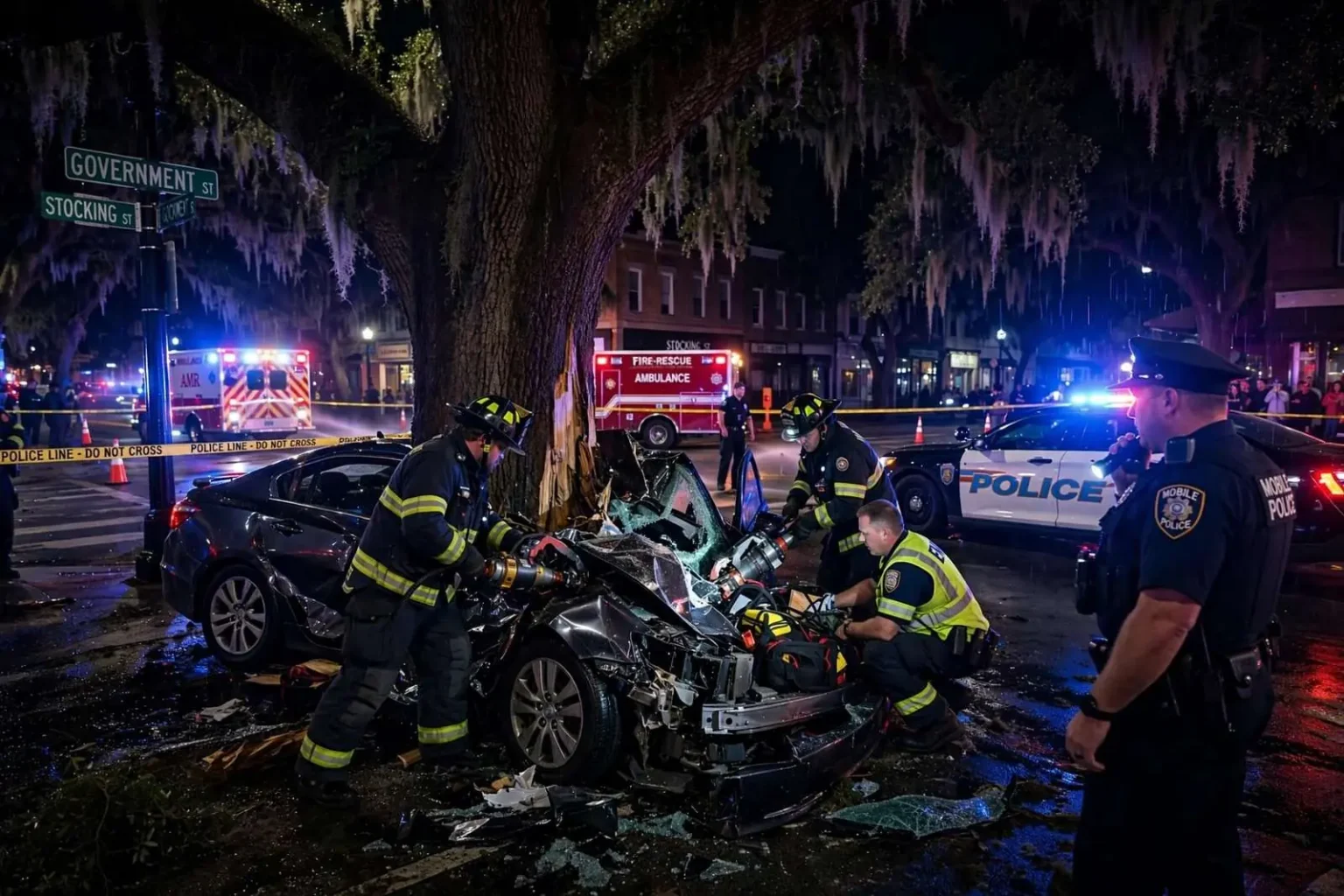
MOBILE, Ala. — An accident was reported Monday night at Government and Stocking streets in midtown Mobile, and the scene quickly became more complicated than a routine crash. It appeared a car had crashed into a tree, and authorities said at least one person was trapped inside the vehicle. The driver fled the scene on foot, leaving an occupant behind as crews worked to free them. Emergency responders were on the scene for an extended period as the incident was developing, and the intersection — already one of midtown’s busiest crossings — was tied up while rescue work proceeded.
The combination of circumstances made the response unusually challenging. A crash with a trapped occupant normally triggers a coordinated extrication involving firefighters, rescue tools, and ambulance crews. A crash where the driver has fled adds a third layer, because police must both support the rescue and begin working a hit-and-run and leaving-the-scene investigation at the same time. Officers were left to piece together who was behind the wheel, why the car left the roadway with such force, and whether the person who ran was injured in the crash itself.
A busy midtown intersection
Government Street is one of Mobile’s oldest and most heavily traveled east-west corridors, carrying traffic from downtown through Spring Hill and connecting midtown neighborhoods to the hospitals, schools, and businesses that line its route. Stocking Street crosses it in the heart of midtown, a residential-and-commercial stretch where the roadway narrows and the tree canopy that gives much of Mobile its character also lines the edges of the pavement. Crashes into trees along Mobile’s older streets are a known hazard of that canopy: the same oaks and shade trees that make the neighborhoods walkable sit close enough to the roadway that a vehicle leaving the lane at speed has little margin before impact.
Monday night conditions add their own challenges. Darkness reduces the visibility of curves and intersections, and nighttime crashes in midtown Mobile often draw additional scrutiny from police because of the questions they raise about speed and impairment. Investigators in cases like this typically examine the vehicle’s path across the roadway, the severity of the impact, and any physical evidence left behind, and they will also want to speak with the person who fled once located. Leaving the scene of a crash involving injuries is a serious offense under Alabama law, and the decision to flee can convert a traffic case into a criminal one.
For the occupant left inside the vehicle, the priority for responders was straightforward: get the person out safely and get medical care started. Extrication work — cutting or dismantling enough of the vehicle to reach a pinned occupant — is a core fire-service skill, and Mobile’s rescue crews perform it regularly on the city’s corridors. How long that work took and the condition of the person once freed were among the details authorities were still working to confirm as the night went on.
How crews respond to a trapped occupant
When dispatchers receive a report of a person trapped in a wrecked vehicle, the response assembles in a predictable order. Fire-rescue units arrive first with hydraulic rescue tools, stabilizing the car so it cannot shift while rescuers work, then removing doors, the roof, or the entire side of the vehicle as needed to reach the occupant. Ambulance crews stage nearby to begin treatment the moment the person is accessible, and police units control traffic and begin the crash investigation. At a midtown intersection like Government and Stocking, traffic control is no small task — the crossing sits on a commuter route, and even a late-evening wreck draws gawkers and rerouted vehicles until the roadway clears.
A driver fleeing on foot disrupts that choreography. Responders cannot assume the driver is uninjured or uninvolved in whatever caused the crash, so officers split their attention between the rescue scene and the search. In a neighborhood of fenced yards, dark side streets, and familiar shortcuts, a person on foot at night has advantages that fade quickly in daylight, and Mobile police typically canvass the area, check with witnesses, and review any available surveillance video from homes and businesses near the intersection.
Witnesses are central to cases like this, and authorities in Mobile routinely ask anyone who saw a crash or a person fleeing the scene to come forward. Details that seem minor — the direction the car was traveling, its speed, which way the driver ran — often become the threads that tie an investigation together. That canvassing work was underway alongside the rescue effort Monday night.
The tree-collision problem
Fixed-object collisions are among the most serious crashes that occur on city streets, and trees are among the most common objects struck. A vehicle that leaves the roadway and hits a tree converts its speed into deceleration almost instantly, and the injuries that result tend to be more severe than in collisions between vehicles, which are engineered to absorb some of each other’s energy. This is why transportation safety guidance treats clear zones beside the roadway — space free of rigid or immovable obstacles — as a key design principle, and why cities balance that principle against the shade, stormwater benefits, and neighborhood character that mature trees provide.
Mobile’s urban forest makes that balance visible on every old street in the city. The live oaks and other canopy trees along Government Street and its cross streets predate most of the traffic that passes beneath them, and the city’s tree-protection ordinances reflect how much residents value them. For drivers, the practical takeaway is the one that crash data repeats: staying in the lane matters more on tree-lined streets than almost anywhere else, because the consequences of a lane departure rise sharply when the roadside is not forgiving.
Nighttime driving in midtown adds the usual cautions. Visibility is shorter, pedestrians and cyclists are harder to see, and intersections like Government and Stocking concentrate turning movements from several directions. Speed management through such crossings — particularly late at night, when empty roads invite faster driving — is the single behavior that most reduces both the likelihood and the severity of the kind of crash reported Monday.
What happens next
As of the initial reports, authorities had not released the identities of those involved, the extent of the occupant’s injuries, or any description of the driver who fled. Those details typically emerge as the investigation proceeds, and police generally follow a crash of this kind with requests for witnesses and, where warranted, warrants or charges related to leaving the scene. The person who fled on foot should understand the trajectory of such cases: fleeing a crash with a trapped and injured occupant is the kind of fact that aggravates charges rather than escaping them, and investigators eventually locate most drivers through witness accounts, vehicle registration, and video.
For the neighborhood around Government and Stocking, the night was a disruption and a reminder. Crews remained on the scene working the incident as it developed, and anyone who drove through midtown Monday evening likely saw the emergency lights and the flagged intersection. The crash left at least one person trapped and in need of rescue, a driver unaccounted for, and a community waiting to learn how badly everyone came through it — a sequence Mobile has seen before on its older corridors, and one its responders train for regularly.
Leaving the scene: the legal stakes
Alabama law is unambiguous about the duty of a driver involved in a crash. A driver must stop at the scene, and when the crash involves injury or death, that duty carries criminal consequences that grow with the severity of the outcome. Leaving the scene of an injury crash is a felony in Alabama, punishable by prison time, fines, and license consequences — and prosecutors treat the fact that a driver abandoned a trapped occupant as an aggravating circumstance rather than a technicality. The person who fled Monday night’s crash on foot will face those realities once located, on top of whatever the crash investigation shows about how the collision happened.
The decision to flee also undermines the driver’s own interests. A driver who stays can help the injured person, be evaluated for injuries, and give an account while memories are fresh; a driver who runs forfeits all of that, and the flight itself becomes evidence. Investigators work backward from the vehicle and from witnesses along Government Street, and searches for fleeing drivers intensify in the first hours.
Residents who may have information are the fastest route to answers. Police ask witnesses to note details they might assume are unimportant: a partial license plate, a bumper sticker, damage visible on the car before the crash, the direction a person ran, clothing, anything that anchors a timeline. Reports can generally be made to Mobile Police directly, and tipsters who prefer anonymity can use the department’s tip lines. In hit-and-run investigations, the first hours matter, both for locating a suspect and for preserving video from doorbell cameras and businesses before it is overwritten.
The occupant left behind
Whatever the investigation concludes about the driver, the person trapped in the vehicle was the night’s urgent concern. Occupants who are pinned after a tree collision frequently face serious injuries — the impact forces involved leave little margin — and rescue crews train constantly for exactly this scenario: unstable vehicle, compromised structure, a patient who cannot be moved until the metal around them is cut away. The outcome for that occupant was not immediately known as the incident was developing, and responders worked through the night under lights at the intersection while the investigation unfolded around them.
Anyone injured in a crash like this faces a long road regardless of fault: emergency treatment, often surgery and rehabilitation, and the insurance complexities that follow when the driver responsible has fled. Injured occupants in a fleeing-driver case generally turn first to the coverage on the vehicle they were riding in — a small comfort measured against an injury, but one that matters to families sorting out the aftermath.
There is also the question that always follows a crash of this kind: why did the driver run? Investigators consider the usual explanations — impairment, no license, an outstanding warrant, or the vehicle itself being borrowed or stolen — but none of them changes the duty to stop. The story of Monday night, as authorities laid it out, is that someone made the worst possible choice at the worst possible moment, and a person was left trapped in a wrecked car at Government and Stocking while the driver disappeared into the midtown dark.
Midtown Mobile and its corridors
The intersection where this happened sits in one of Mobile’s most recognizable districts. Midtown’s grid of historic streets, church steeples, storefronts, and oak-lined avenues runs between downtown and Spring Hill, and Government Street is its spine — carrying commuters at rush hour, students heading to schools along the route, and steady local traffic at nearly every hour. Stocking Street and its neighbors thread through residential blocks where people walk dogs, wait for school buses, and cross on foot in the evenings. A crash that shuts down the crossing, even at night, is felt immediately by anyone rerouting around it.
The crash is also a data point in an ongoing conversation every city of Mobile’s age has with itself about street safety. Older corridors were designed for a different era of traffic, and safety engineers continue to weigh improvements — better lighting, signal timing, crosswalk visibility, and roadside design — against the historic character that makes midtown what it is. Tree-lined streets are loved, and they are also unforgiving; the lesson of a night like Monday is not to remove the canopy but to respect the speeds and sightlines the streets actually permit.
As of the latest reports, the investigation remained active, with authorities working to identify the driver who fled and to account for the condition of the person who was trapped. The scene at Government and Stocking has since returned to the ordinary rhythm of midtown traffic, but the questions from Monday night — who ran, why, and how badly the occupant was hurt — remain open, and anyone with information is urged to bring them to Mobile police.