Acclaimed Cosmologist Michael Turner to Deliver Free Public Lectures at University of South Alabama
Renowned astrophysicist Michael S. Turner presented two free public lectures at South Alabama, exploring dark energy and cosmic acceleration.
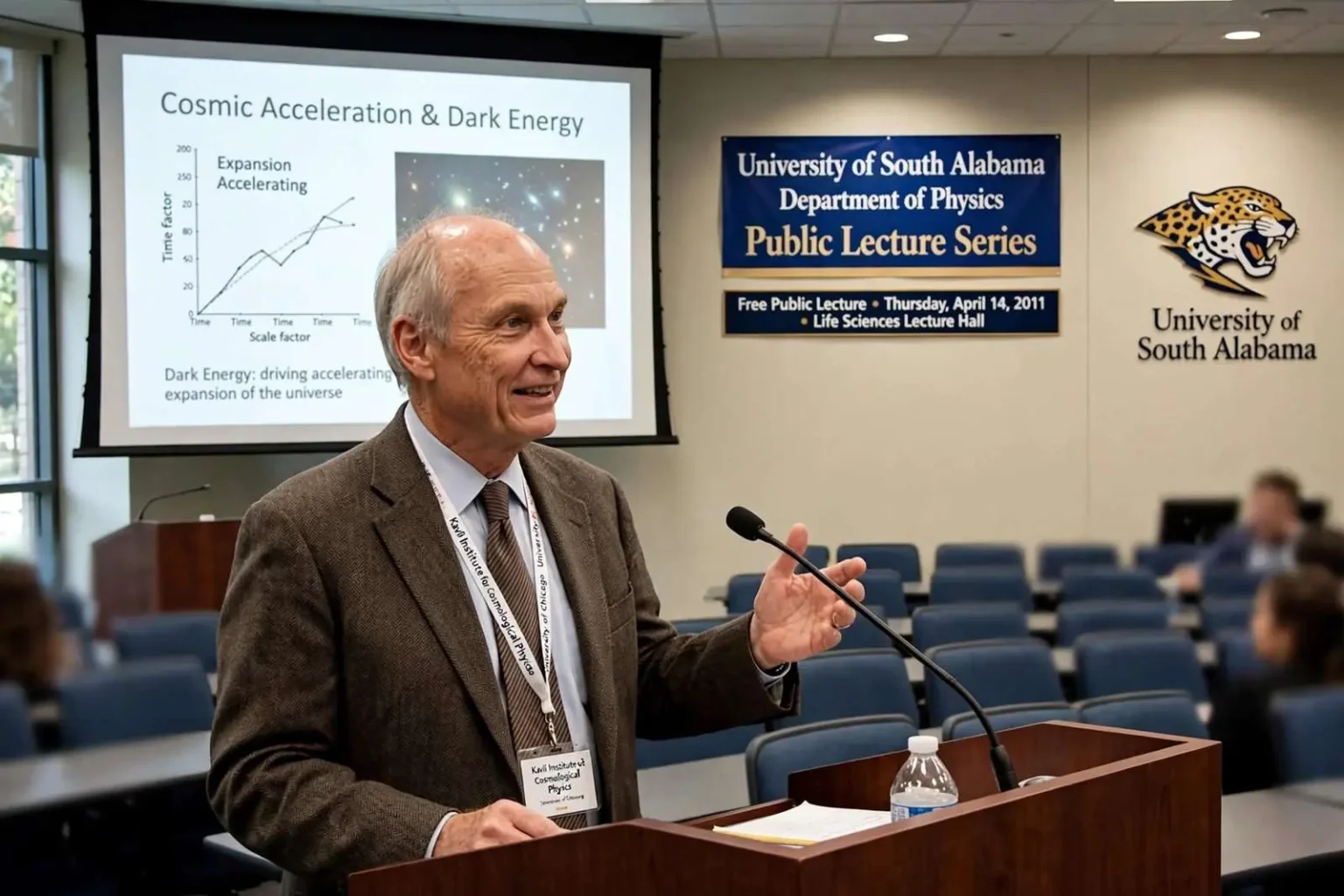
Theoretical astrophysicist Michael S. Turner, one of the most influential figures in modern cosmology, was set to present two free public lectures at the University of South Alabama on Thursday, April 14, 2011. Turner, who served as director of the prestigious Kavli Institute for Cosmological Physics at the University of Chicago, brought decades of groundbreaking research to Mobile for an afternoon and evening of accessible science programming.
Both lectures were sponsored by USA’s Department of Physics and were free and open to the public, giving students, faculty and curious residents of the Gulf Coast a chance to hear from a scientist whose work helped define the field he works in. Admission required nothing more than showing up, an unusual opportunity to hear one of cosmology’s leading voices without buying a ticket.
Turner’s visit placed the University of South Alabama alongside major research institutions that regularly host figures of his stature, and it reflected the physics department’s effort to bring nationally significant science programming to Mobile.
Exploring Dark Energy and Cosmic Acceleration
Turner’s afternoon lecture, titled “Cosmic Acceleration and Dark Energy,” began at 3 p.m. and examined one of the most profound mysteries in modern physics: the observation that the expansion of the universe is not slowing down, as scientists long expected, but is actually speeding up. This phenomenon, known as cosmic acceleration, has reshaped humanity’s understanding of the cosmos and remains one of the most active areas of research in theoretical physics.
The discovery that the universe’s expansion is accelerating — made independently by two teams of astronomers studying distant supernovae in the late 1990s — upended the expectation that gravity must be slowing the cosmic expansion over time. Something else, it turned out, was pushing space apart, and naming and explaining that something became one of the central projects of Turner’s career.
Turner himself played a pivotal role in this field. He is credited with predicting cosmic acceleration before it was observationally confirmed and is widely recognized for coining the term “dark energy” — the mysterious force believed to be driving the universe’s accelerating expansion. The label has since become standard vocabulary in physics classrooms, textbooks and news coverage around the world.
The afternoon talk traced the observational evidence for acceleration and the theoretical ideas proposed to explain it, including the possibility that dark energy is tied to the vacuum energy of space itself. Turner has long argued that resolving the dark energy question ranks among the deepest challenges in physics.
For University of South Alabama students, the lecture offered a window into work happening at the frontier of research, presented by someone who helped build that frontier. For members of the general public, it required no specialized background — Turner built his reputation in part on his ability to explain cosmology in plain language.
How Many Universes?
The evening lecture, “How Many Universes?,” took place at 7:30 p.m. in the Life Sciences Lecture Hall. This broader, more philosophically ambitious talk traced how human understanding of the universe’s size and age has evolved over centuries, from early astronomical observations to modern cosmological models.
That arc runs from sky watchers who first measured the movements of planets, through the realization that the Milky Way is one galaxy among billions, to the modern picture of a universe nearly 14 billion years old that began in a hot, dense state and has been expanding ever since. Each step in that story pushed humanity’s sense of scale outward.
Turner concluded with speculations about the multiverse — the theoretical possibility that our universe is just one of many — and the deep philosophical questions that concept raises. If other universes exist, they may be forever beyond observation, which places the idea at the uneasy boundary between testable science and informed speculation.
The evening presentation was supported by the American Astronomical Society, reflecting the national significance of Turner’s work and public outreach efforts. The society, the major professional organization of astronomers in the United States, sponsors programming that brings leading researchers before public audiences across the country.
A Career of Landmark Contributions
Turner’s credentials placed him among the most decorated physicists of his generation. Holding the title of Bruce V. and Diana M. Rauner Distinguished Service Professor at the University of Chicago, he helped pioneer the interdisciplinary field of particle astrophysics and cosmology — an approach that treats the universe itself as a laboratory for testing theories about the smallest particles of matter.
That blending of the very large and the very small has proven remarkably productive. Questions about what happened in the first fractions of a second after the Big Bang can be probed with the physics of elementary particles, while particle accelerators on Earth can recreate conditions that existed when the universe was young. Turner’s career has been built on working both directions at once.
His scholarly contributions included key ideas that led to the cold dark matter theory of structure formation and demonstrating how quantum fluctuations during cosmic inflation evolved into the seeds of galaxies. In that picture, the galaxies and clusters that fill today’s night sky grew from microscopic ripples in the fabric of space stretched to cosmic size during the universe’s earliest moments.
His long list of honors included the Warner Prize and the Dannie Heineman Prize from the American Astronomical Society, the Lilienfeld Prize from the American Physical Society, and the 2011 Darwin Lecture of the Royal Astronomical Society. He was elected to the presidential line of the American Physical Society in 2010, a distinction that placed him in line to lead one of the largest professional societies in American physics.
Beyond research, Turner served as chief scientist at Argonne National Laboratory, assistant director for Mathematical and Physical Sciences at the National Science Foundation, and led the influential National Academy study “Quarks to the Cosmos,” which shaped the strategic direction of the field for years. Each of those roles put him at the point where science policy meets basic research, helping decide how the nation invests in projects that probe the origins of the universe.
His leadership of the Kavli Institute for Cosmological Physics at the University of Chicago tied those threads together. The institute brings physicists, astronomers and instrument builders under one roof to pursue questions about dark matter, dark energy and the early universe, and Turner’s tenure as director made it one of the recognized centers of the field.
Bringing Big-Picture Science to Mobile
The University of South Alabama’s Department of Physics sponsored both talks as part of its effort to expose the campus and the Mobile community to working scientists of national standing. Public lectures of this kind serve double duty: they give undergraduates contact with researchers whose names appear in their textbooks, and they give local residents a reason to step onto a university campus they might otherwise never visit.
Mobile has no large professional astronomy community of its own, which makes visits like Turner’s especially valuable on the Gulf Coast. Amateur astronomers, teachers and students from across the region could attend without traveling to New Orleans, Atlanta or Huntsville, cities that more routinely host events of this caliber.
The timing also mattered. Cosmic acceleration was then barely a decade old as a discovery, and the scientific community was still arguing vigorously about what dark energy might be. Audiences in the Life Sciences Lecture Hall were hearing about a live controversy, not a settled chapter of history — a rare chance to watch an active research debate from the front row.
Turner’s dual talks also illustrated the two moods of modern cosmology. The afternoon session leaned toward the technical and observational, while the evening session reached toward questions that philosophers and physicists share. Both, though, grew out of the same body of work that made Turner a fixture in the field.
For a Thursday in April, the university offered its students and neighbors an afternoon and evening spent considering the fate of the universe — at no charge, and with one of the people responsible for framing the question standing at the podium.
The Questions Behind the Lectures
Dark energy sits at the center of a puzzle that has stubbornly resisted two decades of work. Astronomers know how fast the universe is accelerating to impressive precision, but they do not know what is causing it, and every straightforward explanation proposed so far has run into trouble when tested against observation. That combination — a precisely measured effect with no agreed cause — is exactly the kind of problem that draws physicists into a field.
The stakes extend beyond cosmology. If dark energy turns out to be a property of empty space, then physics lacks a fundamental explanation for most of the energy in the universe, since measurements place ordinary matter at only a small fraction of the cosmic total. Dark matter accounts for another large share, and neither has been identified in the laboratory. The missing pieces make cosmology a field where discoveries about the sky and discoveries about matter feed each other constantly.
The multiverse question, the subject of the evening lecture, follows naturally from that same line of research. Some theories that explain the early universe predict that the process that created our cosmos could have happened many times, in many places, producing regions with different physical conditions. Whether such regions count as separate universes, whether they could ever be observed, and whether the idea can be tested at all are questions that Turner and others have debated in journals and at conferences for years.
Presenting those questions to a general audience required the same skill Turner brought to coining “dark energy” in the first place: the ability to compress a technically dense subject into language a newcomer can follow. Speakers who can do that are rare, and universities compete for them precisely because a good public lecture can change how a community thinks about science.
Students weighing whether to attend had a simple calculation in front of them. The lectures cost nothing, required no physics background, and offered direct contact with a scientist whose terminology they had likely already used in class without knowing where it came from. Few evenings in Mobile that spring combined all three.