Accused Cop Killer Marco Perez Seeks Youthful Offender Status as State Weighs Death Penalty
Marco Perez, charged with capital murder in the 2019 killing of Mobile Police Officer Sean Tuder, is seeking youthful offender status.
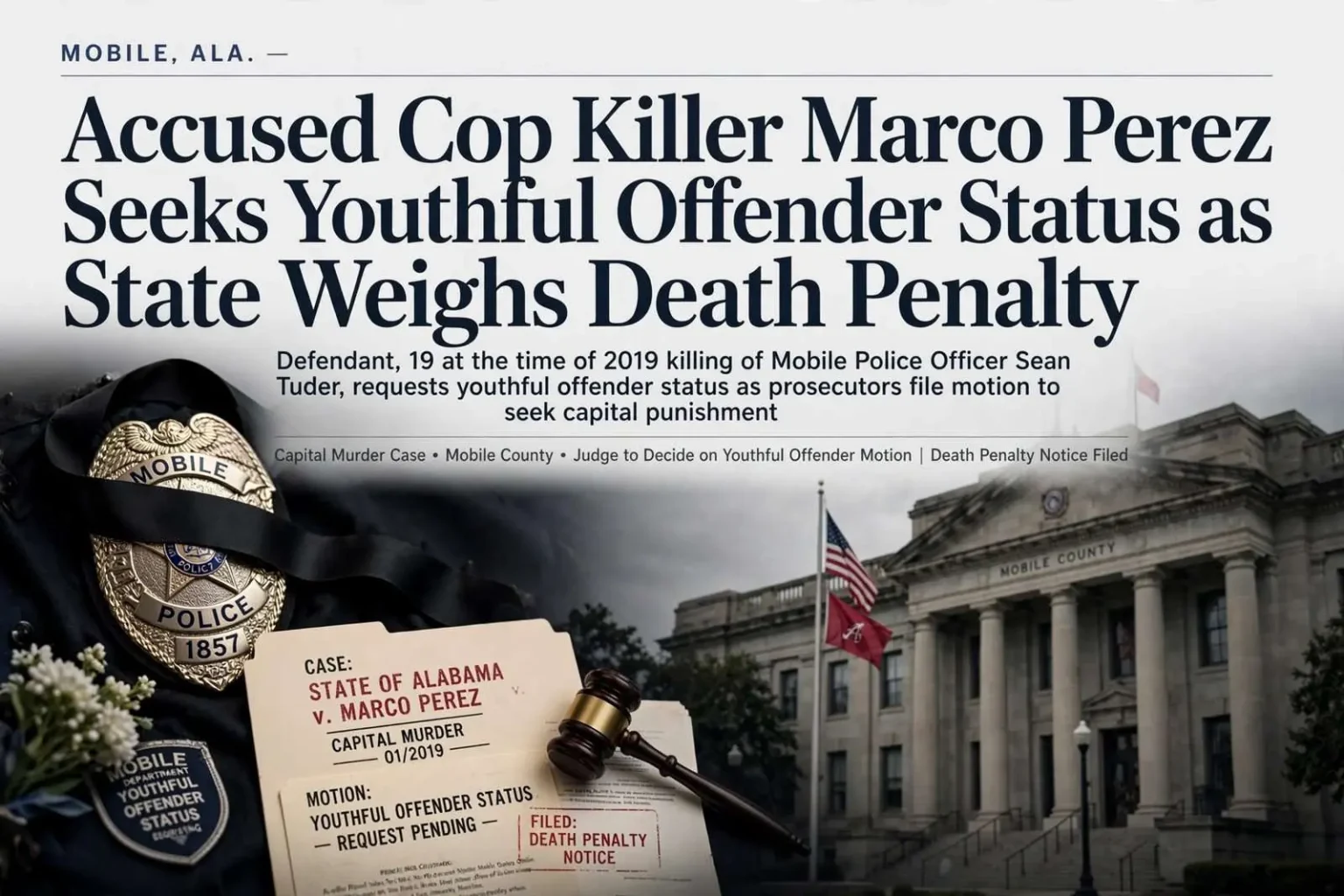
MOBILE, Ala. — The man charged in the death of Mobile Police Officer Sean Tuder is seeking youthful offender status, a move that could fundamentally change how his case is handled in an Alabama courtroom. Marco Perez is charged with capital murder in the January 2019 slaying of Tuder, and his request for youthful offender treatment comes at the same time prosecutors have signaled they intend to pursue the ultimate penalty in the case.
Perez was 19 years old at the time of the shooting, which is what makes him eligible under Alabama law to request youthful offender status. The request places before a judge a question that weighs the age of the accused against the gravity of the alleged offense. Tuder, a Mobile police officer, was shot and killed while working undercover in West Mobile, a loss that shook the department and the city in the days and weeks that followed.
Investigators said a stolen gun was used in the murder. That detail matters in Alabama, where the use of a stolen firearm in the killing of a police officer is part of the landscape of aggravating circumstances prosecutors weigh when deciding how to charge and punish a case. The weapon’s origin has been a consistent thread in the case as it has moved through the court system since the January 2019 shooting.
The push and pull between the two filings defines where the case now stands. Earlier this week, prosecutors filed a motion saying they intend to seek the death penalty. Days later, the defense is asking a judge to certify Perez as a youthful offender — a designation that would close the courtroom, seal the record, and cap any potential sentence far below what capital murder ordinarily carries.
What youthful offender status means in Alabama
Alabama’s youthful offender law is among the more distinctive features of the state’s criminal justice system. A person who was under 21 at the time of an alleged offense can ask the court for youthful offender treatment, and the decision rests entirely with the judge. There is no automatic entitlement; the judge considers factors such as the nature of the alleged crime, the defendant’s age, prior record, and the interest of justice before granting or denying the request.
If granted, the consequences are sweeping. Proceedings are closed to the public, records are sealed, and the potential punishment is dramatically limited — a youthful offender cannot face the death penalty or life imprisonment, and any commitment runs through the state’s youth system rather than the adult prison system. For a capital murder case, that difference is the difference between a possible death sentence and a disposition measured in a few years of supervised or committed custody.
Prosecutors opposed to the designation will argue that the alleged crime — the killing of a police officer in the line of duty — is precisely the kind of case the youthful offender statute was never meant to shield. Defense counsel, meanwhile, will point to Perez’s age at the time of the shooting and the purpose of the law, which recognizes that young adults are developmentally different from older defendants. The judge’s ruling on the request will shape every other decision in the case, including whether the death penalty remains a legally available outcome at all.
The capital murder charge itself reflects the specifics of Alabama law. Under the state’s statute, the intentional murder of a police officer acting in the line of duty is charged as capital murder, a category that removes the possibility of bail and exposes the defendant to the harshest penalties Alabama can impose. The law treats the killing of a law enforcement officer as a distinct and aggravated category, recognizing the officer’s official role at the time of the offense.
The loss of Sean Tuder in January 2019 sent a shock through Mobile’s law enforcement community. Tuder was working undercover in West Mobile when he was shot, a reminder of the particular risks that plainclothes and undercover assignments carry. Officers working in that capacity operate without the visible protections of a marked unit or a uniform, and when something goes wrong, the margin for error is thin. Fellow officers, city officials, and residents across Mobile responded to the death with an outpouring of public mourning, and the case has been followed closely in the community ever since.
West Mobile, where the shooting occurred, is a broad stretch of the city that includes residential neighborhoods, apartment complexes, and commercial corridors. Undercover work in such an area often involves surveillance and enforcement aimed at street-level crime, and officers assigned to those details move between roles that require constant judgment about when to identify themselves and when to stay in character. The circumstances of Tuder’s death became part of the broader conversation in Mobile about officer safety, gun violence, and the flow of stolen firearms through the region.
That last point — the stolen gun — connects this case to a policy issue that Alabama law enforcement agencies have highlighted repeatedly. Stolen firearms circulate through secondary channels and surface in violent crimes across Mobile County, and police departments urge residents to report stolen guns immediately and to secure weapons in homes and vehicles. When a stolen weapon is used in the killing of a police officer, investigators typically trace its path from the original owner to the scene, a process that can add charges or identify additional actors along the way.
The death penalty decision
The prosecution’s motion to seek the death penalty, filed earlier in the week, sets a formal deadline of sorts for the case. In Alabama, the decision to pursue capital punishment is made by the district attorney, subject to review by a review committee under state procedures, and once the state files its notice, the case moves onto a track that includes additional penalties-phase proceedings if there is a conviction. Capital cases are also handled with stricter procedural protections at every stage, from jury selection to sentencing, because of what is at stake.
Alabama remains one of the states where capital punishment is actively sought and carried out, and Mobile County has historically been among the jurisdictions that use the penalty. Prosecutors in capital cases must prove at least one aggravating circumstance beyond the murder itself, and the killing of a police officer in the line of duty is among the clearest aggravators the statute provides. The defense, in a capital case, presents mitigating evidence — the defendant’s age, background, and circumstances — to argue for a sentence of life without parole instead of death.
The youthful offender request and the death penalty notice are on a collision course by design. If the judge grants youthful offender status, the death penalty is off the table entirely and the case leaves the public eye. If the request is denied, Perez faces the capital process as an adult, with the prosecution’s already-filed notice signaling the state’s intent to ask a jury for a death sentence upon conviction. Either way, the judge’s certification decision will be the pivot on which the rest of the case turns, and both sides have staked their strategies on opposite outcomes.
For now, the case remains pending before the Mobile County court, with the defense request awaiting a ruling. The resolution of the youthful offender motion will determine whether Sean Tuder’s killing is litigated in an open capital trial — with the death penalty as the state’s stated goal — or in a closed proceeding under the protections Alabama extends to defendants who were teenagers when the alleged crime occurred.
The procedural fight now underway is a familiar one in Alabama courtrooms, but it carries particular weight when the underlying charge is capital murder. Judges weighing youthful offender requests in serious felony cases must balance the rehabilitative purpose of the statute against the community’s interest in open proceedings for the most serious crimes. The ruling is typically made after a hearing at which the defense presents evidence about the defendant’s age, background, and prospects for rehabilitation, and prosecutors argue the severity of the offense and the significance of public scrutiny in a case of this magnitude.
If the request is denied, the case would proceed through the standard capital litigation path in Mobile County. That includes an initial appearance and bond determination — capital murder is non-bailable under the Alabama Constitution — followed by grand jury indictment, extensive discovery, pretrial motions, and a trial before a jury selected through individual questioning about their views on the death penalty. If a jury convicts, the same panel would hear evidence in a separate sentencing phase and recommend a sentence of death or life without parole, with the judge making the final determination under Alabama’s capital sentencing framework.
If the request is granted instead, the contrast could hardly be sharper. The case would move to a closed courtroom, the record would be sealed from public view, and the outcome would be governed by the youthful offender statute’s limits rather than the capital code. Supporters of the law describe it as a recognition that people who commit offenses just past childhood are still developing, and that the state’s interest is better served by supervision and rehabilitation than by permanent adult sanctions. Critics, particularly in cases involving the death of a police officer, argue that the classification is inappropriate for the most violent alleged offenses.
The broader picture in Mobile County
Capital cases in Mobile County draw sustained public attention, and the killing of a police officer more than any other crime. Officers’ deaths are rare but defining events for a department, shaping training, policy, and morale for years afterward. In the years since Tuder’s death, Mobile police have continued undercover and plainclothes operations across the city, and the circumstances of the January 2019 shooting remain a reference point in discussions about how those details are planned and supported.
The stolen firearm at the center of the investigation also reflects a persistent regional concern. Law enforcement agencies across south Alabama have emphasized gun theft prevention, warning vehicle owners in particular that weapons left in unsecured cars are a leading source of stolen firearms. Those weapons surface in cases across the county, and their recovery often generates additional evidence about networks that trade in stolen guns. In this case, investigators said early on that the weapon used in the murder was stolen, a fact that has remained part of the public record of the case.
Whatever the judge decides on the youthful offender motion, the request itself ensures that the case will remain in the public eye for the foreseeable future. A ruling either way is likely to be followed by further proceedings that will take months, if not longer, to resolve — hearings on the death penalty notice, pretrial motions, and eventually trial or disposition under whichever framework applies. The family, fellow officers, and the Mobile community that mourned Sean Tuder in 2019 continue to follow the case as it moves through the courts, while the defense pursues every avenue available to a defendant who was 19 years old when the alleged crime occurred.