ADEM seeks public comment on tighter rules for land application of byproducts
ADEM has opened public comment on revised Alabama rules governing land application of biosolids and poultry residuals, with a March 17 hearing in.
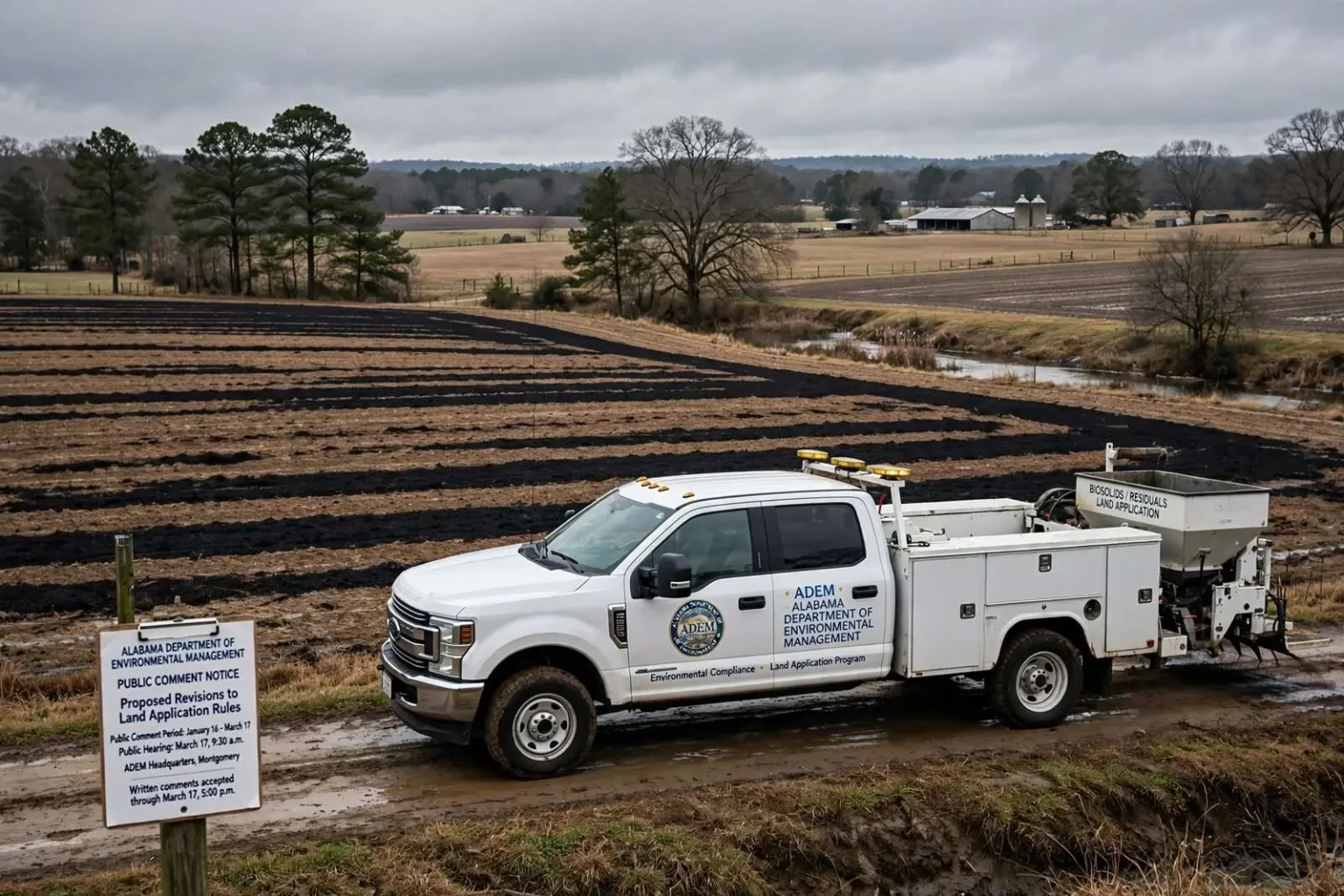
The Alabama Department of Environmental Management has opened a public comment period and scheduled a hearing on proposed revisions to state rules governing the beneficial use of by-product materials spread on land as fertilizer. The proposal touches a practice that operates across much of Alabama, where treated residuals from municipal and industrial processes are applied to fields and pastures as a soil amendment instead of being hauled to a landfill.
The draft changes cover materials such as biosolids from wastewater treatment plants and residuals from poultry and other food processing, which are applied to soil rather than sent to disposal. Alabama’s poultry industry makes the question a practical one across the state’s northern counties, where processing operations generate a steady stream of residuals, and wastewater plants in municipalities of every size produce biosolids that must go somewhere once treatment is complete.
Land application, when properly managed, returns organic material and nutrients to the soil and reduces the volume of waste that must be disposed of by other means. Farmers benefit from the fertilizer value of the materials, and generators avoid disposal costs. The regulatory challenge — and the source of the complaints that prompted the rewrite — lies in how the materials are stored, transported and spread, and in what happens to neighbors living beside the fields where they are applied.
How the state’s rules developed
ADEM adopted the state’s first guidelines for land application in 2020, after Alabama had relied on federal Environmental Protection Agency rules that did not address food-processing residuals. Until then, the state’s framework covered the biosolids side of the practice through the federal standards but left a gap for the residuals generated by poultry and food processing, a significant omission in a state where those industries anchor large parts of the rural economy.
Director Lance LeFleur said the agency has since gathered data and researched lingering problems, then drafted tighter controls to better protect neighboring landowners and residents. The agency’s approach in the years since 2020 gave its staff field experience with how the first-generation guidelines performed in practice, and the draft revisions reflect the issues that surfaced as applications increased across the state.
The proposal puts Alabama in line with a broader movement among states that regulate land application directly rather than deferring entirely to federal baselines. States with heavy agricultural and processing activity have increasingly written their own standards for testing, setbacks and record-keeping, aiming to keep the beneficial use of residuals viable while answering the concerns of the people who live near application sites.
Comment period and public hearing
The comment period runs Jan. 16 through March 17. A public hearing where interested parties can give oral or written input is set for March 17 at 9:30 a.m. at ADEM’s headquarters in Montgomery. The schedule gives farmers, wastewater operators, poultry companies, environmental groups and residents two months to review the draft rules and prepare comments.
Written comments are accepted through 5 p.m. that day, and attendance at the hearing is not required for comments to be included in the record. Submissions made by mail or through the agency’s channels during the comment window carry the same weight in the rulemaking process as testimony delivered in the hearing room, an arrangement that matters for residents in rural counties who are hours from Montgomery.
Public input on environmental rules at ADEM typically shapes the final text, particularly when the affected parties span such different interests. Operators weigh compliance costs and operational feasibility, while neighboring landowners press for stronger testing, notification and setback provisions. The record assembled during the comment period becomes the foundation for whatever version of the rules the department ultimately adopts.
What the proposed changes would do
Proposed updates would clarify definitions, add pollutant and pathogen testing requirements, strengthen operating standards for land application, and extend registration cycles from one year to three. The definitional cleanups aim to remove ambiguity about which materials fall under the rules, while the testing requirements would establish a more consistent picture of what is being spread on the state’s fields and how often.
They also add phosphorus nutrient application limits, tighten notification and nutrient-management planning rules, and set design and operating requirements for impoundments that hold treated residuals. The phosphorus limits address a nutrient that accumulates in soils when organic materials are applied repeatedly to the same ground, with the potential to move into waterways through runoff — a concern that links the land application rules to the broader health of Alabama’s rivers and streams.
The notification and planning provisions would give neighboring property owners and local officials better information about when and where applications occur, and nutrient-management planning ties each application site to a documented assessment of what the soil can absorb. The impoundment standards, new to the state’s framework, would govern the structures where residuals are stored before spreading, covering how they are built and operated.
Extending registration cycles from one year to three reduces the paperwork burden on regular participants in the program while keeping them within a longer-term regulatory relationship, a trade-off that drew attention from both operators and oversight advocates as the draft moved toward the comment period.
Why the agency rewrote the rules
LeFleur said the revisions respond to complaints from adjacent property owners about offensive odors and other side effects of by-product application, which the department investigated while drafting the stricter rules. Those complaints, rising from communities where large-scale applications had increased, gave the rewrite its practical focus: the neighbors of application sites wanted the state to set clearer expectations for how the practice would be conducted beside their homes and property lines.
Odor complaints are the most visible of the concerns, but they are not the only ones that regulators weighed. Runoff from application fields, the condition of roads used by hauling trucks, and questions about long-term accumulation of nutrients and pollutants in the soil all figured into the department’s research as it moved from data-gathering to drafting.
Because of the COVID-19 pandemic, attendees at the Montgomery hearing must wear masks and undergo temperature screening. The precautions reflect the public-health measures in place at state facilities during the pandemic, and they shape how the hearing itself will run for the farmers, company representatives and residents who make the trip to the department’s headquarters.
The department will accept comments through the close of the period before determining the final form of the revisions, and the outcome will set the framework under which biosolids and processing residuals are applied to Alabama land for years to come.
The stakes for Alabama agriculture and waterways
The rulemaking carries real stakes for both sides of the practice. For the poultry and food processing industries, land application is an outlet that keeps residuals out of landfills and lowers operating costs, and tighter rules translate directly into compliance expenses and operational adjustments. For farmers who receive the materials, the nutrient content of biosolids and processing residuals can offset commercial fertilizer purchases, making access to well-managed application programs an economic matter as well as an agricultural one.
Alabama’s waterways add another dimension to the debate. The state’s rivers and reservoirs are sensitive to nutrient loading, and excess phosphorus in runoff contributes to the kind of algal growth that degrades water quality downstream. By writing phosphorus application limits into the rules, the department is connecting the day-to-day practice of spreading residuals to the long-term condition of the waters that drain the state’s farmland.
The testing requirements for pollutants and pathogens likewise speak to concerns that have followed biosolids programs nationally, where questions about what remains in treated materials after processing have prompted several states to revisit their standards. Alabama’s draft rules would give the state its own baseline for verifying that materials applied to land meet health and environmental expectations rather than relying solely on federal screening.
How the department balances these interests will become clear as the comment period proceeds. Operators will press for standards they can meet without ending the practice, while residents and environmental advocates will test whether the proposed testing, notification and impoundment provisions go far enough to protect the communities beside the fields.
What happens after the comment period closes
Once the comment period ends on March 17, the department will review the record — written submissions and hearing testimony alike — and determine whether the draft rules need revision before adoption. Significant comment often produces changes to definitions, deadlines and thresholds, and the department’s staff will reconcile the concerns raised with the operational realities described by the businesses and municipalities that must live under the final rules.
Adopted rules would then govern how biosolids and processing residuals are registered, tested, stored and applied across Alabama, replacing the first-generation guidelines the department wrote in 2020. Operators would need to align their practices with the new testing schedules, nutrient limits and impoundment standards, and the state’s field staff would take on the inspection and enforcement work the rules require.
For residents who raised the complaints that started the rewrite, the final rules will be measured against a simple question: whether applications near their property look, smell and affect their land differently than before. The notification provisions and nutrient-management planning requirements are aimed squarely at that experience, giving neighbors advance knowledge of applications and tying each site to a documented plan.
The Montgomery hearing on March 17 at 9:30 a.m. remains the scheduled opportunity for input in person, with masks and temperature screening required because of the pandemic, and written comments accepted through 5 p.m. that day for anyone who prefers to submit their views without attending. Either route places a comment in the record the department will use to finish the state’s tightest set of land application rules to date.