Africatown’s Spirit of Our Ancestors Festival Honors the Story of the Clotilda
The Spirit of Our Ancestors Festival brought Clotilda descendants to Africatown in Mobile for drumming, remembrance and heritage tourism efforts.
A Festival Rooted in Ancestry
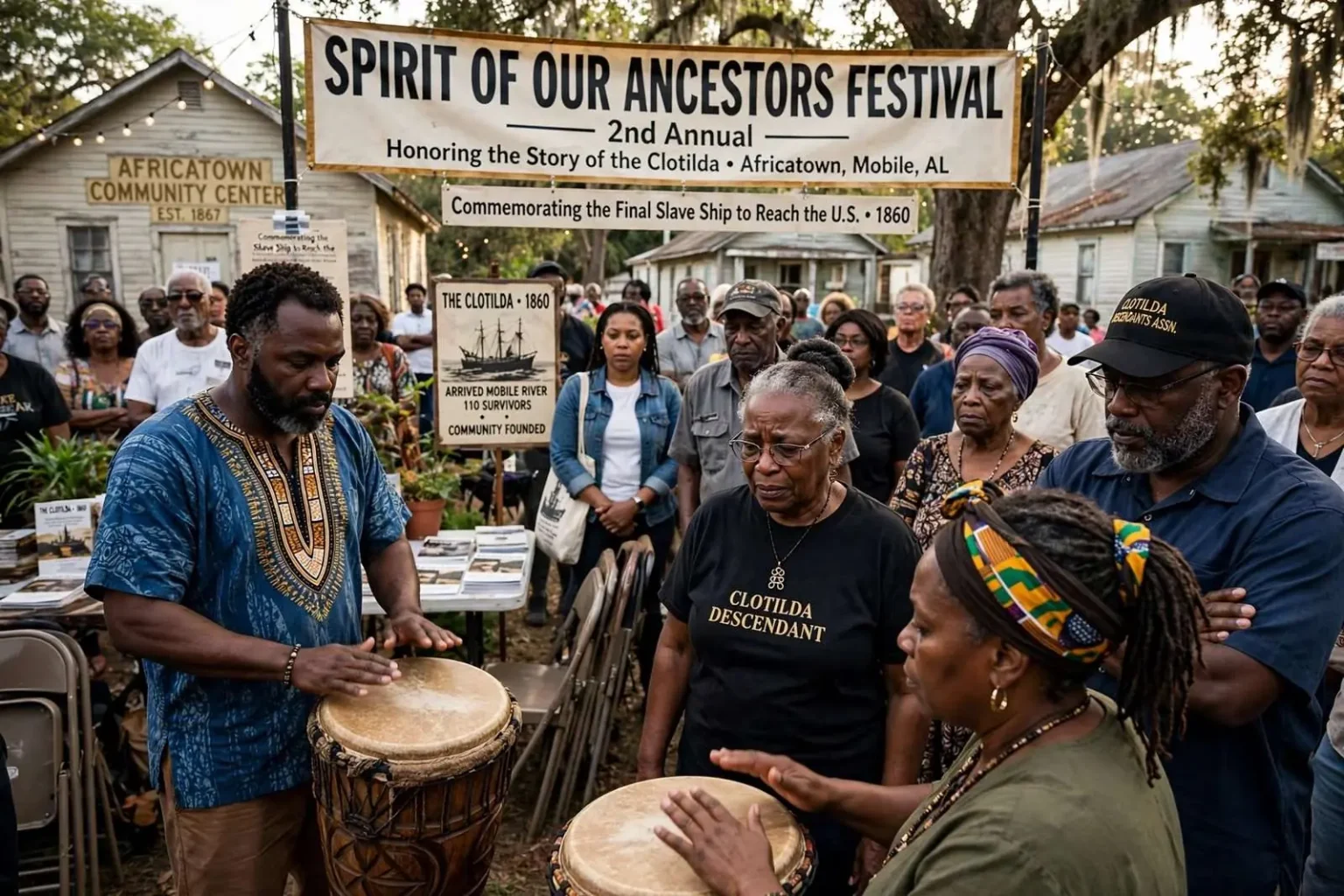
Dozens of people gathered in Mobile’s Africatown community for the second annual Spirit of Our Ancestors Festival, a two-day program commemorating the history of the Clotilda, the final slave ship to reach the United States. The event opened with a traditional African drumming ceremony designed to raise awareness of the community’s rich history and ensure it is not forgotten. For a neighborhood whose story is one of the most remarkable in American history, the festival has quickly become its signature public celebration.
Descendants of the Clotilda’s captive African passengers took part in the program, describing themselves as the living embodiment of their ancestors’ dreams. Verndetta Keeby, a descendant of the ship’s survivors, said the history carries deep personal weight. “Because of what our ancestors went through, that history is important to me,” she said. In Africatown, that history is not an abstraction from a textbook — it is a family story, carried in names, homes and graves across the community north of downtown Mobile.
The two-day format allowed the festival to move beyond a single ceremony, layering drumming, speeches and community gatherings into a program that honored both mourning and endurance. Organizers positioned the event as both commemoration and education, drawing visitors from across Mobile while giving descendants a formal occasion to gather in the place their ancestors built.
A Push to Make Africatown a Destination
Organizers used the festival to renew their call for Africatown to be developed into a major tourist and history destination. Darron Patterson, president of the Clotilda Descendents Association, said the community’s story deserves a wide audience. “They need to know the story. If they know the story, I think they would enjoy what a wonderful story this is,” Patterson said. “It started out to be something sinister, but look what it’s turned out to be.”
Then-U.S. Senator Doug Jones of Alabama also addressed the gathering, urging that whatever improvements come to the neighborhood, the funds raised through the effort should remain in Africatown itself. “It can be done if people pull together and realize the importance of this,” Jones said. “This is the place where tragedy turned to triumph.”
The senator’s warning touched the central anxiety that has shadowed the community’s revival: that investment and tourism dollars could flow around Africatown rather than into it. Residents and descendants have long argued that any development built on the community’s history must deliver tangible benefit — jobs, improvements, ownership — to the people who preserved that history for generations when few others would tell it.
The Story of the Clotilda
The Clotilda was the last known vessel to bring enslaved Africans to the United States, arriving in Mobile in 1860 decades after the international slave trade was outlawed. The voyage itself was a crime — a smuggling run defying federal law — undertaken on a wager by those who believed the trade could still be conducted in secret. The more than 100 African captives aboard were hidden after their arrival, and the ship was scuttled to conceal the evidence of the crime.
After emancipation, a group of the ship’s survivors pooled their resources and founded the Africatown community north of downtown Mobile — a settlement built by free people who had been born free in Africa, stolen from it, and who now built their own churches, schools and homes on American soil. It is the only known community in the United States founded by survivors of the transatlantic slave trade, a distinction that makes Africatown’s preservation a matter of national historical significance.
The search for the wreck captivated historians and residents for decades. In 2019, the ship’s wreck was confirmed in the Mobile River, a discovery that energized preservation and heritage efforts across the community and drew international attention to Mobile. The confirmation transformed the story from oral history and archival research into physical evidence — a documented site that anchors the case for memorialization, education and heritage tourism.
Why the Story Resonates Beyond Mobile
The Clotilda’s story connects Mobile to one of the defining moral catastrophes of American history, and to a story of resilience that stands almost alone in the historical record. The survivors’ decision to build a community together — preserving African names, traditions and family bonds — created a living legacy that descendants carry today. That is what Patterson means when he says the story “started out to be something sinister, but look what it’s turned out to be.”
National attention has grown steadily since the wreck confirmation, with journalists, historians and filmmakers documenting the community’s past and present. For Africatown, the challenge is converting that attention into permanent benefit: museums, markers, investment in aging infrastructure, and economic development that the community controls. The festival is part of that strategy — a recurring, visible event that keeps the story in the public eye between the larger milestones.
Drumming as Remembrance
The traditional African drumming ceremony that opened the festival was more than a performance; in West African tradition, the drum is a voice — an instrument of communication, ceremony and memory. Opening a commemoration of the Clotilda with drumming reached back past 1860, past the middle passage, to the cultures from which the ship’s captives were stolen. For descendants in the audience, it was a sound that predates the community itself.
That choice of opening reflects how Africatown has always honored its founding: not only as a story of suffering, but as a story of identity preserved. The survivors brought languages, skills and traditions across the ocean, and their descendants have kept the connection alive through churches, family stories and public gatherings like this one. The festival’s drummers placed the community’s founding where it belongs — at the intersection of African heritage and Alabama history.
What a Heritage Destination Would Mean
The organizers’ vision of Africatown as a major tourist and history destination has concrete elements behind it. The confirmed wreck site in the Mobile River, the community’s historic church and cemetery, and the storytelling tradition embodied by descendants like Keeby and Patterson together form the foundation of a heritage destination comparable in significance to any in the South. Visitors who come to Mobile for its ports, beaches and battleship could just as easily stand where the survivors of the Clotilda built their lives — if the infrastructure exists to receive them.
That is the “if” that Jones and the festival’s organizers pressed. Heritage tourism of national significance requires investment: interpretation, access, signage, and staffing. The senator’s insistence that funds raised through the effort remain in Africatown itself speaks to a documented pattern in which historic Black communities see attention and money pass them by. Descendants have been explicit that the next chapter of the story must be written with the community, not merely about it.
For the dozens who gathered this year, the second annual festival demonstrated that the community’s story draws a crowd. The task ahead, as organizers framed it, is to turn that crowd into a permanent current of visitors — and to make sure that when they come, the benefit flows to the families who never stopped telling the story.
The Descendants’ Role in the Revival
The descendants of the Clotilda’s survivors are not passive subjects of this history — they are its custodians and its advocates. Organizations such as the Clotilda Descendents Association have spent decades keeping the story alive through family records, community programs and public speaking, long before the wreck’s confirmation made national headlines. At the festival, descendants like Keeby and Patterson addressed the crowd not as historians reciting a past but as family members describing their own inheritance.
That living custody shapes every public conversation about Africatown’s future. When decisions arise about how the wreck is studied, how the story is interpreted and how development proceeds, descendants insist on a seat at the table. Their presence at the festival — billed as the living embodiment of their ancestors’ dreams — is itself part of the argument: the community the survivors founded still exists, still belongs to their families, and still speaks for itself.
Mobile’s Broader Reckoning With the Clotilda
The festival arrives amid a wider effort across Mobile to reckon with the Clotilda’s history. The wreck’s confirmation in the Mobile River placed the city at the center of a national story, and institutions across the area have moved to document and interpret it. Each public event adds to a record that was, for more than a century and a half, deliberately hidden — the ship scuttled, the captives concealed, the crime unprosecuted.
The two-day festival gives that reckoning a home in the community itself. Rather than leaving the telling to museums and documentaries alone, Africatown’s own event puts descendants on the program, opens with their traditions and sets the agenda around their priorities. In its second year, the Spirit of Our Ancestors Festival has established itself as the annual moment when the community tells its own story in its own voice — and reminds Mobile, and the nation, that the history it honors is still unfolding.