
AHSAA says fall sports will start on time; local districts decide whether to play
The AHSAA says fall sports will start on time but leaves the decision to play up to local districts as Mobile and Baldwin counties weigh pandemic risks.
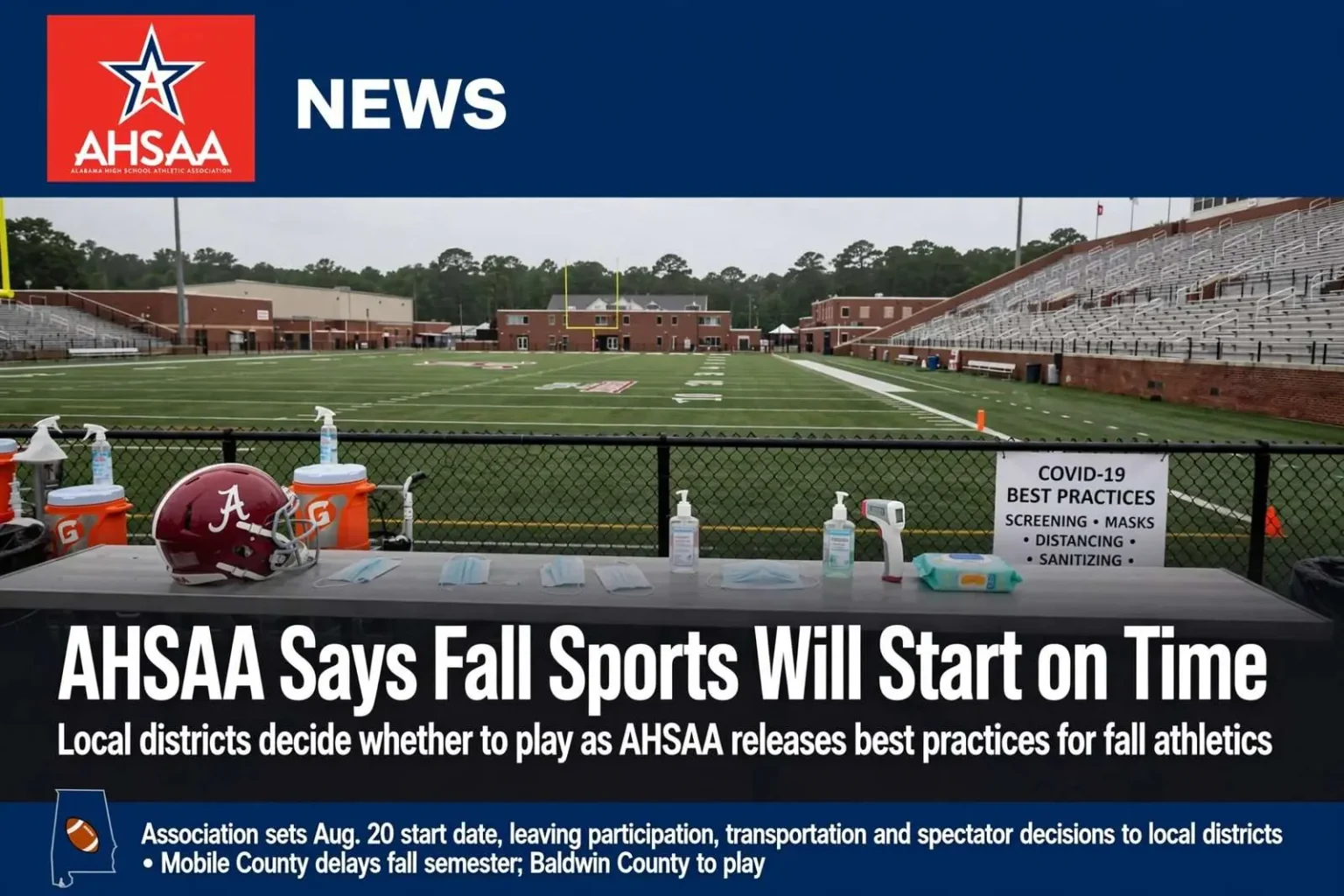
The Alabama High School Athletic Association has released its “best practices” for resuming fall sports in the coming weeks, a list of requirements and recommendations that leaves key decisions about participation, transportation and spectators up to local school districts. At a Thursday press conference, AHSAA Executive Director Steve Savarese said the central board of control’s priority was to develop practices that “mitigate but not eliminate” the risk of COVID-19 exposure for coaches and student-athletes. Even if seasons are shortened by rising case counts, the AHSAA wanted to give local schools flexibility rather than a one-size-fits-all mandate.
The framework reflects the reality of trying to govern athletics across a state where the pandemic’s footprint varied sharply from county to county. A uniform statewide order strong enough for the hardest-hit areas would have been unnecessarily restrictive for places with little community spread, and a loose framework alone would have left schools with no guidance at all. The AHSAA’s answer was to set the floor — requirements around acclimation, contact and reporting — while leaving the ceiling to superintendents and principals who know their local conditions.
That approach distributes hard decisions to the local level, which is where the associations’ member schools and their communities prefer them made, but it also means neighboring districts may reach opposite conclusions. Two schools separated by a county line could field teams in one system and sit out in the other, and the schedules both play will have to accommodate whichever games fall through.
“Parents now have options not only about how they educate their children, but they must make a personal choice about whether they should allow their children to participate in extracurricular activities,” Savarese said, adding that the board let schools play or not play without penalty and use local health information to guide decisions. The framing put families, not just districts, at the center of the decision: a student whose school plays sports can still stay home, and the association’s rules allow for that individual choice without sanction.
The calendar and the acclimation rule
With the AHSAA’s green light, schools may begin fall practice as early as July 27, though the first week is limited to acclimation and no full-contact drills in sports such as football. The competitive season starts as scheduled Aug. 20.
The acclimation week is a longstanding Alabama tradition adapted to a pandemic year. The state’s late-summer heat and humidity make a gradual return to outdoor exertion a matter of safety in any season — heat illness has shaped AHSAA practice rules for years, with restrictions on when teams can practice, how long sessions run and what equipment players wear in the earliest days. In 2020 the acclimation period served double duty: it protected against heat, and it gave coaches and trainers a week to establish screening routines, hydration protocols and distancing measures before bodies began colliding.
Keeping the Aug. 20 competitive start intact was the association’s clearest signal of intent. Moving the date would have cascaded through the entire year — playoffs, championships, basketball and spring sports already shuffled by the lost spring of 2020 — and the AHSAA chose instead to protect the calendar and let individual programs decide whether they could meet it.
Programs that forgo games because of outbreaks would not be penalized, though forfeits would count as losses to be reviewed at season’s end. The carve-out is a practical compromise: teams need opponents to schedule against, and the possibility of last-minute cancellations — a positive test on a Thursday for a Friday game — required a rule that lets a season continue without punishing the school that pulled its students out. The end-of-season review leaves room for the association to adjust standings where forfeits distort playoff positioning, a recognition that a pandemic loss is not quite the same as a loss on the field.
Mobile County’s open question
The Mobile County Public School System is delaying its fall semester until September and offering only online instruction into November. MCPSS has not said whether its high schools will play fall sports and has already postponed middle school sports indefinitely.
The gap between the association’s calendar and the district’s academic calendar is the central tension for Mobile County athletics. A student body that will not enter a school building until September — and will learn remotely into November — is a student body whose athletes cannot gather in a field house for practice, and the district’s silence on high school sports has left coaches, players and families in a holding pattern while the rest of the state’s programs begin acclimation week.
The stakes are considerable for a system Mobile County’s size. Its high schools populate some of the state’s most storied football programs and its most competitive rosters in volleyball, cross country and swimming, and its athletes are regularly recruited across the Southeast. A season played without Mobile County’s largest schools would change the texture of regional competition; a season played with them requires solving the problem of practicing and traveling while the district’s classrooms remain virtual.
The indefinite postponement of middle school sports is a separate loss with its own consequences. Middle school athletics feed the high school pipelines — the ninth-grade rosters that varsity programs depend on are built in those younger leagues — and a lost year at that level will be felt when those students finally reach high school teams. For now, the district has offered no timeline for their return.
Baldwin County’s answer
Across the bay, Baldwin County Schools Superintendent Eddie Tyler, a former football coach, said his district fully intends to participate, joking he hoped college football would follow so he “has something to do on Saturdays.”
Tyler’s background gives the district’s position its color: a superintendent who coached the sport understands the calendar, the conditioning needs and the culture of a Friday night program, and his declaration that Baldwin County intends to play puts the two systems flanking Mobile Bay on opposite trajectories. Baldwin’s schools will practice while Mobile’s wait, and the rivalry games that usually anchor both counties’ early seasons will depend on whether Mobile County ultimately fields teams.
The two-county contrast is a compact demonstration of the AHSAA’s design. The association set the same rules for both systems; the superintendents, looking at their own health data, academic calendars and communities, reached different answers. Neither choice is penalized, and both are exactly what the “best practices” document anticipated.
What happens next in Mobile County will resolve the region’s biggest open question. If MCPSS high schools join the season, games will be played under restrictions nobody has tested at scale — buses, bleachers, band members, concession stands all managed against the virus. If the district sits out the fall, its athletes will lose a season at precisely the ages when exposure to recruiters and varsity experience matters most, and Baldwin’s schedule will carry open weeks where Mobile County opponents used to be.
Across the state, the Aug. 20 start now stands as the test of the whole framework: the requirements, the acclimation week, the local flexibility and the no-penalty forfeits all get their first real examination when the first Friday night arrives. However it goes, the 2020 season will be remembered as the one Alabama athletics played — or didn’t — one district at a time.
The best-practices document itself covers the operational details most fans never think about: screening athletes and coaches before practices and games, sanitizing shared equipment, managing locker room capacity, handling water stations that used to be communal coolers, and deciding who is allowed on a sideline at all. Transportation is among the thorniest items left to districts — a school bus is an enclosed space where fifty athletes sit closer together than they ever would in a huddle — and systems have weighed staggered trips, assigned seats and open windows as partial answers.
Spectator policy is the other decision handed to local control, and it may be the most visible of all. Friday night attendance in Alabama normally runs from hundreds at small schools to thousands at the largest stadiums, and each district must now decide whether bleachers open at all, at what capacity, and whether tickets go to parents only. Band programs, cheerleaders and dance lines — the parts of a Friday night that are not the game — face their own restrictions on rehearsal and performance, since music-making in particular carries transmission risks that have shaped guidance nationwide.
The summer behind this announcement was an anxious one for Alabama athletics. Spring sports lost their entire 2020 season, and through June and July the question was never whether fall sports would look different but whether they would exist at all. Other states cancelled outright or pushed football to spring; Alabama chose to try, betting that local control plus layer precautions could produce a season worth the risk. Savarese’s “mitigate but not eliminate” phrasing was the honest center of that bet — the association never promised safety, only structure.
For the athletes themselves, the summer’s uncertainty carried real costs either way. Players spent the offseason unsure whether to train for a season that might not come, and seniors faced the possibility that their final year would vanish as completely as the spring’s did. The announcement of a firm start date gave them at least a target, even if the district-by-district decisions mean some will watch Aug. 20 come and go without a game.