Air Force Concedes Cost-Estimate Error That Had Favored Boeing in Tanker Fight
The U.S. Air Force admitted a cost-calculation error that had favored Boeing in the tanker contract evaluation, adding a new twist to a dispute with direct stakes for a proposed Northrop Grumman/EADS assembly line at Mobile's Brookley Field.
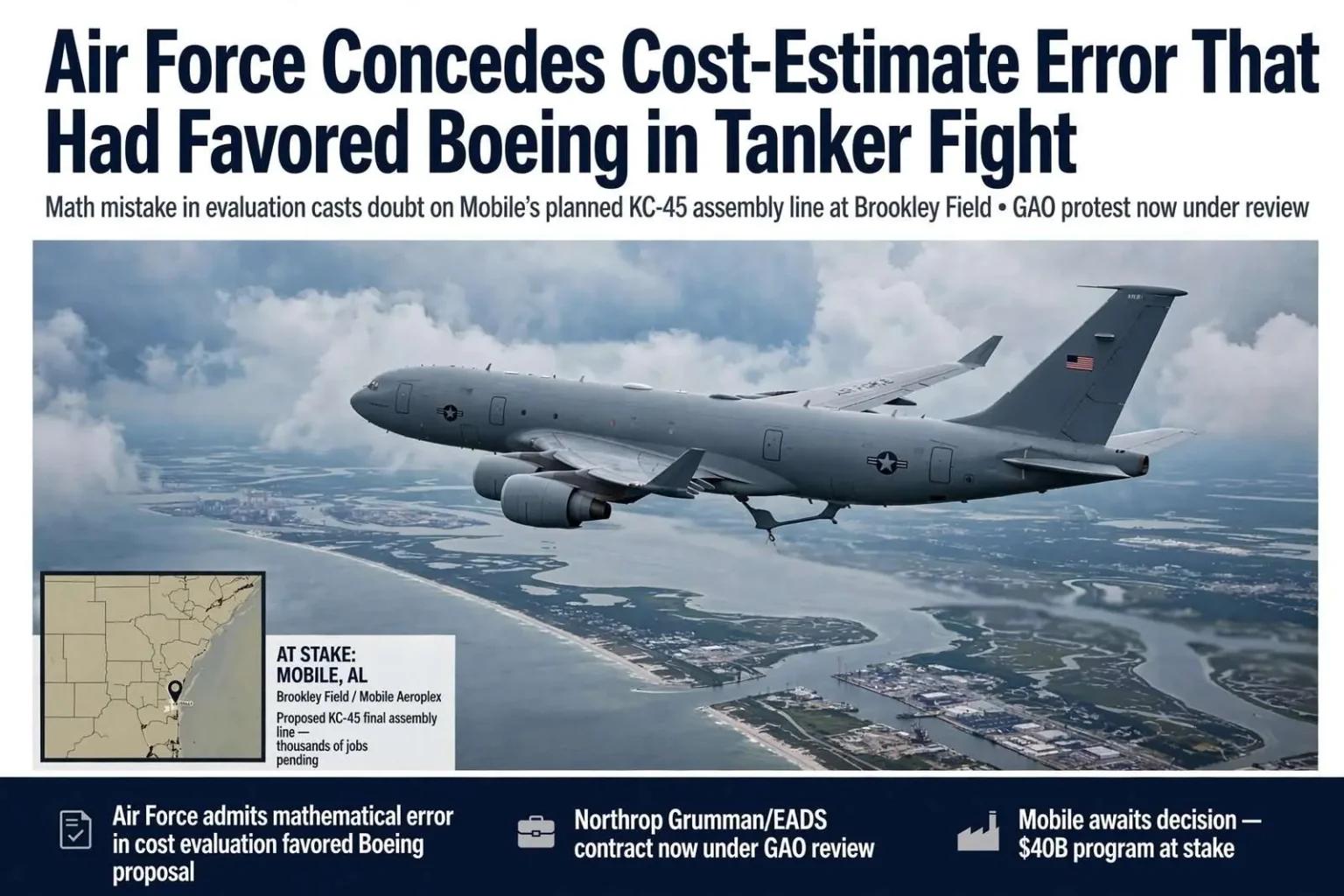
The U.S. Air Force has acknowledged that it made a significant mathematical error while evaluating the cost effectiveness of the two competing aircraft in the multibillion-dollar aerial refueling tanker competition, an admission that carried immediate implications for Mobile’s bid to land a major new aircraft assembly operation at Brookley Field. The disclosure was first reported by national news outlets, and it landed at a moment when the tanker program was already among the most closely contested defense procurements in Washington. According to that reporting, the Air Force’s error in calculating the relative costs of the Boeing tanker proposal versus the Northrop Grumman and EADS proposal had worked in Boeing’s favor, understating the comparative cost of Boeing’s aircraft relative to the winning Northrop Grumman/EADS design during the evaluation process.
The admission cut against the losing bidder in an unusual way. Protested contract awards often turn on questions of judgment or procedure, but here the service itself conceded that a number at the heart of the comparison was simply wrong. Boeing had built much of its protest case around the argument that the competition’s cost mathematics were flawed, and the Air Force’s acknowledgment lent that argument at least partial credibility even as officials stressed that the mistake did not, by itself, unravel the award.
Northrop Grumman, which together with European aerospace partner EADS had already been awarded the contract in the Air Force’s original decision, moved quickly to insist that the calculation error did not change the underlying strength of its bid. According to CNBC, the company maintained that its proposal remained the best value for the Air Force regardless of the math mistake, and that its win was not built on any improper advantage stemming from the error. Company officials pointed to the breadth of the evaluation, which weighed capability, price and a range of operational factors, and argued that correcting a single computation would not reshape the overall result.
What Is at Stake for Mobile
The stakes of the dispute run directly through Mobile. Under the terms of the original award, Northrop Grumman and EADS planned to build a final assembly line for the new KC-45 tanker aircraft at Mobile’s Brookley Field complex, a project local officials and business leaders had promoted as a potential anchor for thousands of aerospace jobs and a broader manufacturing renaissance along the Gulf Coast. Brookley, a former Air Force base at the southern edge of the city that now operates as the Mobile Aeroplex, had been courting aviation employers for years, and winning the tanker line was framed locally as the kind of once-in-a-generation industrial prize that could permanently change the region’s economy.
The assembly line was projected to bring skilled manufacturing work in airframe assembly, systems integration and aircraft finishing, along with a supply chain of smaller contractors that typically clusters around a major final assembly operation. Economic development officials in Mobile and across Alabama had spent years assembling incentives, workforce training programs and infrastructure arguments aimed at landing the plant, and the original award was celebrated at every level of state government as validation of that effort.
Boeing’s Protest at the GAO
Boeing, which builds its competing tanker in Washington state, formally protested the Air Force’s original decision to the Government Accountability Office, arguing the competition had been unfairly tilted toward the larger Northrop Grumman/EADS aircraft. The Government Accountability Office is Congress’s investigative arm and hears bid protests from disappointed offerors on federal contracts, with a statutory deadline of 100 days to issue a decision. Its lawyers review the procurement record, hear arguments from both sides and can recommend that the Air Force re-open the competition, revise its evaluation or uphold the award. The admission of a math error does not by itself determine the outcome of Boeing’s protest, but it adds a new wrinkle to a review that had already drawn intense political and industry attention.
Protests of this scale rarely stay confined to procurement lawyers. Members of Congress from the affected states weigh in with letters and hearings, and the tanker fight had already become a proxy battle between the delegations of Washington and Alabama, each arguing that its state offered the better workforce and the better long-term value to the taxpayer. The Air Force, for its part, faced pressure to defend the integrity of an evaluation it had already conceded contained a significant computational mistake, while both bidders worked to frame the error in the light most favorable to their side.
A Program Decades in the Making
The Air Force’s tanker replacement program, aimed at replacing the service’s aging fleet of Eisenhower-era refueling aircraft, has been valued at up to $40 billion over its full life, making it one of the largest defense contracts in decades and a prize that both Boeing’s home state of Washington and Alabama’s congressional delegation have fought hard to see land in their respective states. The aircraft the tankers are meant to replace have served since the late 1950s, refueling bombers, fighters and cargo aircraft in mid-air and extending the reach of nearly every American air campaign since. Keeping that fleet flying has required ever-more-intensive maintenance, and the Air Force has argued for years that replacement could not wait much longer.
The competition itself has stretched across multiple rounds and multiple years, with earlier attempts derailed by protests and by questions about how the requirements were written. Each restart raised the stakes for the communities hoping to win the work, and by the time the current award was announced, Mobile’s pursuit of the tanker line had become one of the most persistent economic development campaigns in the region’s history. The GAO protest was the latest chapter in a saga that had already outlasted several acquisition strategies and several sets of procurement rules.
What the Error Means for the Evaluation
Cost evaluation in a competition of this size is a sprawling exercise. Evaluators model fuel consumption, maintenance burdens, construction costs and decades of life-cycle expenses, then run those numbers through weighting formulas prescribed by the request for proposals. A mathematical slip in that process can shift the perceived gap between bidders even when the underlying assumptions are sound, which is why the Air Force’s concession matters even if officials believe the winning aircraft would still prevail on the corrected numbers. The agency had not detailed publicly which specific figures were misstated or by how much when the disclosure was reported.
For Northrop Grumman and EADS, the task ahead was to demonstrate that the error was immaterial to the outcome, while Boeing worked to persuade the GAO that the flawed numbers were symptomatic of a deeper problem with the evaluation. The GAO’s decision would determine whether the Air Force could proceed with the award as made, whether it should correct the evaluation and re-decide, or whether the competition should be reopened altogether, with each possible outcome carrying very different consequences for Mobile.
Mobile Waits on Washington
For Mobile, the tanker contract has become one of the most closely watched economic development stories in years, with the promise of a large aircraft assembly workforce arriving on the heels of other major industrial wins along the Gulf Coast. The region had already attracted shipbuilding, chemical manufacturing and a growing aviation services sector, but a final assembly line for a major military aircraft would represent a different order of investment, one that comes with long-term military commitments and a national profile for the city’s industrial base.
Any disruption to the award, whether through a successful Boeing protest or a re-opened competition, would directly affect those jobs and the broader momentum local officials have been building around the region’s aerospace and manufacturing prospects. Local leaders have watched the protest process closely, aware that Mobile’s hopes now rest with lawyers in Washington rather than anything within the city’s control. Until the GAO rules, the KC-45 assembly line remains a promise on paper at Brookley Field, and the math error acknowledged by the Air Force has given every side a fresh argument in the fight over whether it ever will be.
The Aircraft and the Mission
The KC-45 that Northrop Grumman and EADS proposed to build in Mobile is a variant of a proven airframe, adapted for the Air Force’s refueling mission with modern boom technology, expanded fuel capacity and a flight deck designed for contemporary operations. Tankers are among the least glamorous but most essential aircraft in the military inventory: without them, long-range bombing runs, transoceanic fighter deployments and rapid cargo movements all become dramatically harder. That dependence is why the replacement program has drawn such fierce competition, and why the fight over where the aircraft will be built has been waged with such intensity by both states.
EADS, the European parent of Airbus, would have served as Northrop Grumman’s production partner in the Mobile venture, a transatlantic pairing that itself became a talking point in the political debate. Supporters argued the partnership demonstrated global confidence in the Gulf Coast workforce, while critics of the award questioned foreign involvement in a flagship defense program. Northrop Grumman and EADS maintained throughout that the aircraft would be built largely by American workers in Alabama, with the final assembly line at Brookley serving as the heart of the production effort.
The Road Ahead for the Program
Whatever the GAO decides, the larger program faces more twists before an aircraft ever rolls out of an Alabama or Washington hangar. Funding for new tankers must still move through annual defense budgets, and Congress has repeatedly scrutinized the program’s acquisition strategy. A re-opened competition would add years to a replacement effort the Air Force already describes as urgent, a delay that military officials have warned carries its own operational risks as the aging fleet grows older.
In the near term, attention shifts to the Government Accountability Office’s ruling and the Air Force’s response to its own admission. Mobile officials have continued to promote the city’s workforce, its deepwater port and its growing aviation cluster as reasons the original decision should stand, while Boeing and its allies press the case that the flawed cost evaluation demands a second chance. The math error has become the latest fulcrum in a competition where every decimal point carries the weight of billions of dollars and thousands of prospective jobs, and where two states are waiting on the same handful of pages in a federal procurement file.