
Airbus Expected to Leave Mobile Downtown Airport Terminal by Year’s End, Paving Way for Expansion
Mobile Downtown Airport officials expect Airbus out of the temporary terminal by year's end, opening the door to a 50,000-square-foot expansion.
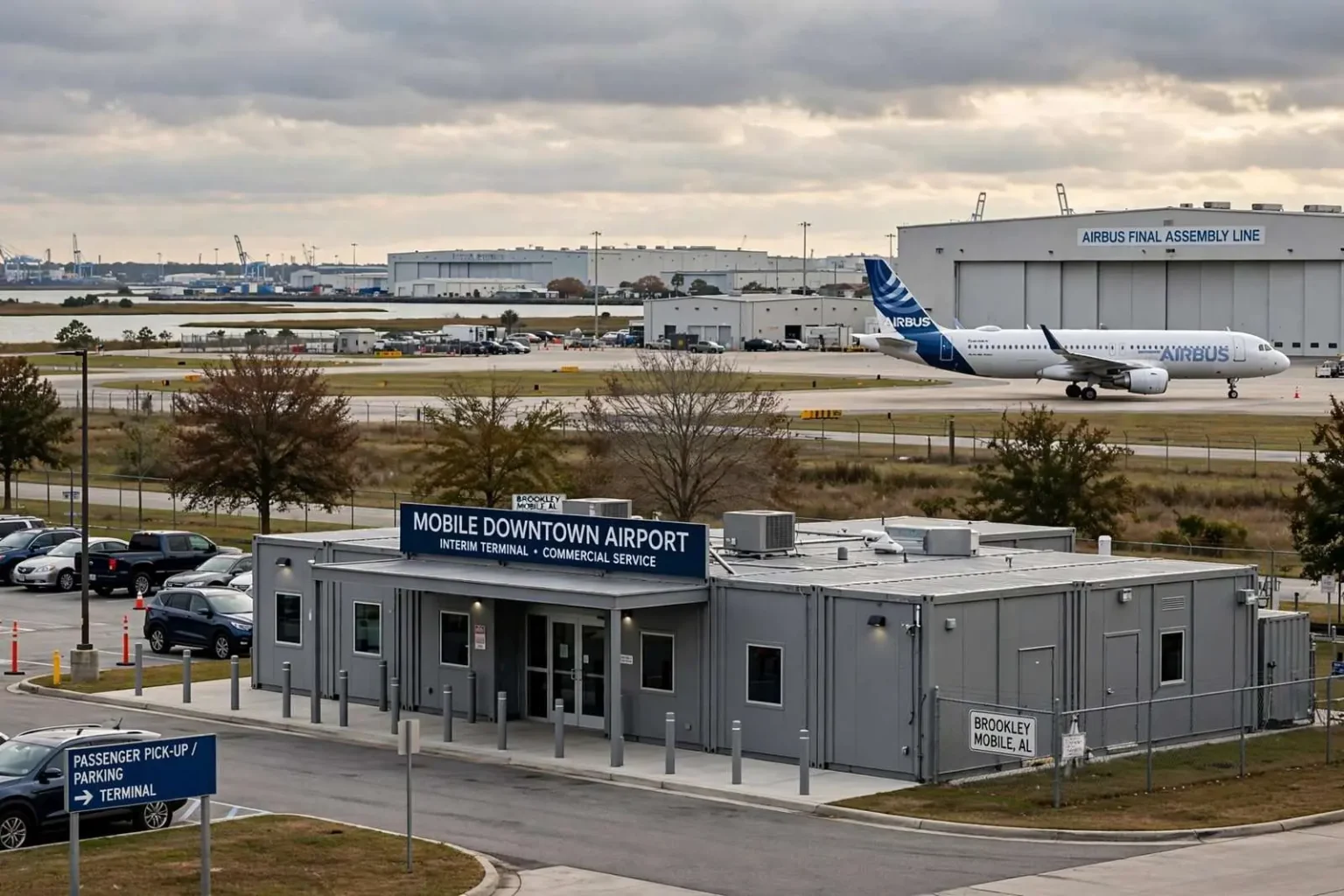
The Mobile Downtown Airport is preparing for its next chapter, with officials saying Airbus should vacate half of the facility’s temporary terminal before the year is out — a move that would clear the way for a major expansion. The airport, which opened its interim terminal only months ago, is already outgrowing the stopgap arrangement that got its passenger service off the ground.
Airport Authority President Chris Curry said Airbus, which has occupied one side of the temporary terminal since the facility opened in May, is expected to be out by the end of 2019. The aerospace giant used the space while its permanent facilities at the Brookley complex were being arranged, and its departure would hand the airport the room it needs to grow on its own terms.
Through September, the airport recorded nearly 29,000 passenger movements through the interim terminal since it began operating. For a facility serving a metro area that had never before had commercial air service on its downtown side, those numbers represent a meaningful early showing — and evidence that travelers are embracing an airport minutes from downtown instead of the cross-town drive to the region’s main field.
Expansion plans on hold pending Airbus move
Curry said the airport needs the aerospace company out of its roughly 28,000-square-foot portion before work can begin. Once that happens, the Airport Authority board will weigh a buildout of that side, which has already been designed and could come together quickly. Having engineering drawings ready before the space frees up means the board can move from decision to construction without a long design phase in between.
“Which would give us 50,000 square feet of terminal space,” Curry said, describing a project that would add two gates and more hold room for passengers than the current setup offers. Doubling the terminal footprint addresses the classic growth constraint of an interim facility: the more flights an airport adds, the more gates and seating it needs to keep departures flowing, and a small terminal can cap the schedule before the demand ever gets there.
The timing could line up well with airline planning cycles. Carriers are already mapping their spring routes, and Curry said the airport could be positioned to pursue expansion opportunities around spring 2020 if they materialize. Airlines set their schedules many months in advance, which means an airport hoping to attract new service must be able to show gates, capacity and terminal space before the airlines ask — not after.
Recruiting new air service
While Curry declined to name which airlines the authority is talking with, he said recruiting additional destinations is an ongoing effort at the airport, which currently serves as the home base for low-cost carrier service at Brookley. Air service recruitment is a standing function of every growing airport: staff travel to industry route conferences, compile demand studies and make the case that a market can support new nonstop flights.
For travelers in the Mobile area, each new destination won by the downtown airport translates directly into alternatives: shorter drives to catch a flight, potentially lower fares from competition between the region’s airports, and nonstop options that spare connections through distant hubs. The presence of a low-cost carrier at Brookley has already shifted some of that equation, drawing passengers who watch fares closely and giving the airport an early base of ridership to show other airlines.
The airport’s location is its signature advantage. Sitting on the Brookley complex south of downtown, the field puts passengers minutes from the central business district, and its highway connections serve not just Mobile but the Baldwin County side of the bay, where fast-growing communities have long driven across town for their flights. Airport officials have made that geographic case to carriers repeatedly: the catchment area for this airport reaches across the bay and down the coast.
The Airbus presence at Brookley gives the airport a second story to tell. The aerospace company’s final assembly line has made the complex an international destination for suppliers, executives and visitors connected to the aerospace industry, and every one of those travelers is a potential passenger for the field just down the street. Airport leaders have long argued that a city with a global industrial anchor should have a commercial airport to match.
Growth beyond the terminal
Expansion talk also extends beyond the terminal itself. The airport finalized its purchase of a University of South Alabama Foundation property near Brookley in April, and Curry said the authority would be interested in working with the foundation or a future developer to grow the airport’s footprint. Land acquisition rarely makes headlines, but at an airport hemmed in by an industrial campus and the water, controlling adjacent parcels is the raw material of every future project.
The foundation has produced renderings for a “Brookley by the Bay” concept on the land, though no official plans are in place. The concept imagery has circulated as part of the broader conversation about what the Brookley peninsula could become — a district that already combines aerospace manufacturing, industrial operations and now commercial aviation, all beside the waterfront a short drive from downtown.
The airport’s own history mirrors Mobile’s efforts to reinvent the site. The Brookley field was a military installation until its closure decades ago, a loss that cost the region thousands of jobs before the site was rebuilt as an industrial aeroplex and, eventually, the home of Airbus’s American assembly operations. Adding commercial passenger service in 2019 marked the return of scheduled airline travel to a field that once knew it well, and officials have treated the early months as the opening chapter of a longer story.
What happens next depends on the sequencing the authority has laid out: Airbus clears out of its half of the terminal, the board authorizes the designed buildout, two new gates and expanded hold room take shape, and the airport enters the spring 2020 planning season with a facility that can support more carriers and more destinations than the interim setup ever could.
For now, passengers continue to move through a terminal that was meant to be temporary, and nearly 29,000 traveler movements later, the airport’s leadership says the case for permanence is building with every full flight. The half of the terminal Airbus leaves behind is, in that sense, the most important space at the airport — the place where the facility’s future square footage, gates and destinations will either be built or deferred.
Regional aviation watchers have followed the downtown airport’s start with an eye on the split between the two fields that now serve Mobile. The established airport on the city’s western side continues to handle the bulk of the region’s traditional airline service, while the downtown field has staked its identity on convenience and low fares. Officials in both camps have generally framed the arrangement as complementary rather than zero-sum, noting that metro areas of similar size often support multiple fields when each occupies a distinct niche.
Parking and ground access factor into that case. The downtown airport’s short drives and compact layout appeal to business travelers and day-trippers, while the passenger counts recorded through September suggest a base of regular users is forming faster than some observers expected for a brand-new operation. Every month of data strengthens the airport’s hand when it sits down with a carrier evaluating whether Mobile can support an additional route.
The board’s coming decision on the terminal buildout will also set the pace for everything that follows. A project that adds two gates may sound modest, but at an airport of this size those two gates represent the difference between a one-carrier operation and a multi-carrier schedule, between a bank of morning departures and a full day of flights, and between a terminal that handles a full aircraft turnaround at a time and one that can juggle several at once.
Authority officials have emphasized that the interim terminal was always understood to be a first step, not the destination. The building let the airport begin passenger service without waiting years for permanent construction, while the permanent plan matured behind it. With the Airbus departure now expected before year’s end, the transition from stopgap to permanent facility — 50,000 square feet, two new gates and room for the destinations the authority is still recruiting — is finally within reach.
Community leaders in the neighborhoods around Brookley have watched the airport’s growth with a mix of enthusiasm and attention to detail. Commercial service brings traffic, jobs and contractor work to the district, and officials have stressed that the expansion projects are confined to airport property with existing access routes. The broader revitalization of the peninsula — aerospace plants, port operations and now an airline terminal — has made Brookley one of the most closely watched corners of the city for anyone tracking where Mobile’s economy is heading next.


