
Airbus HR Director Jennifer Ogle Details Mobile Hiring Plans for 2014
Airbus HR director Jennifer Ogle outlines the company's 2014 hiring plans for its Mobile assembly line, from engineering roles to assembly technicians.
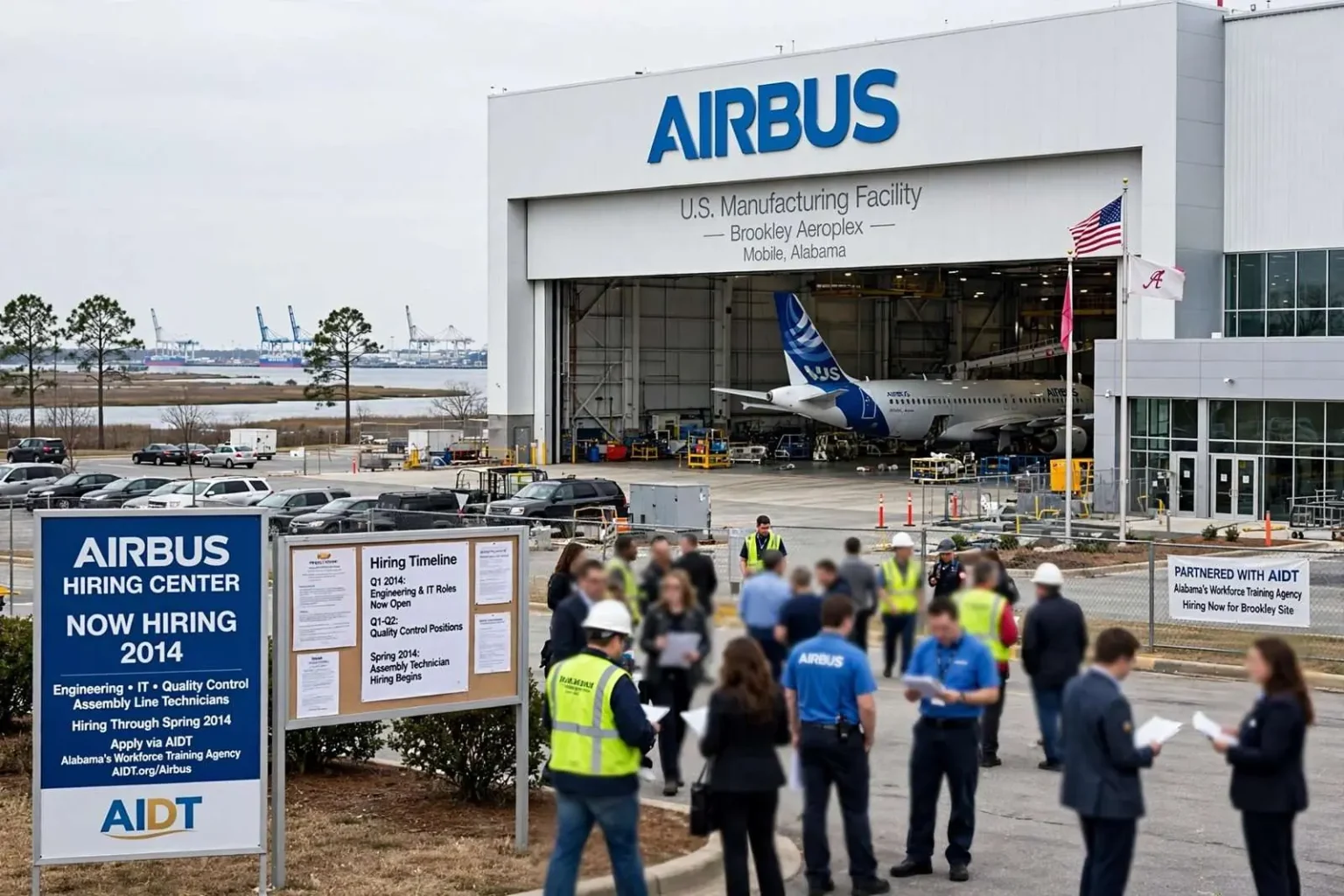
Airbus is in the middle of a rapid hiring push at its Brookley Aeroplex assembly line in Mobile, and the company’s top human resources executive says the ramp-up will accelerate through 2014. In a recent interview, Jennifer Ogle, director of human resources for Airbus Americas’ Mobile operation, outlined the company’s recruiting calendar for the first half of the year — a schedule that moves from engineers and information technology specialists to the assembly-line technicians who will actually build the jets.
Engineering and information technology positions were already being posted in the first quarter, she said, and a backlog of quality-control roles was already open. Come spring, Airbus planned to begin posting assembly-line technician jobs. Collectively, the company was looking to add technical, IT, manufacturing and assembly-line positions during the first half of 2014.
Ogle said it was difficult to predict exactly how many people would be employed at the site by December, calling it a rolling process. The first wave of new hires completed training in Germany and France the previous October, and the company anticipated putting hundreds of people through training in waves over the course of the year based on need. That rolling approach mirrors the way Airbus brought its other final assembly lines online: a core of experienced personnel first, followed by successive training classes as production milestones approach.
The recruiting calendar
The sequence of hiring matters for job seekers tracking the plant’s growth. Early hires in engineering and IT build the systems and processes the factory will run on; quality-control specialists establish the inspection regime that aircraft certification demands; and assembly-line technicians, hired later, step into jobs designed around the methods the earlier groups documented. For local applicants, that means the technician positions — typically the largest single category at a final assembly line — were still ahead in the spring posting round.
Quality-control roles carry particular weight in aircraft manufacturing. Every fastener, wiring harness and panel on a commercial jet is inspected and documented under Federal Aviation Administration rules, and the inspectors and quality engineers hired at Brookley were building the compliance record the plant would carry with it for decades. The fact that a backlog of those roles was already open signaled that Airbus was staffing the oversight structure before the production floor itself.
AIDT: Alabama’s recruiting partner
Airbus is working with AIDT, Alabama’s workforce training agency, as its sole recruiting partner. Ogle praised the organization’s deep knowledge of the community, saying AIDT had proven invaluable in locating the best candidates.
AIDT, an arm of the Alabama Department of Commerce headquartered in Montgomery, has spent decades handling workforce recruitment and training for the state’s major industrial recruits — automotive plants, shipbuilders, aerospace suppliers and others. The agency screens applicants, runs pre-employment training programs and manages the logistics of standing up a workforce at scale, all at no cost to employers or trainees. For a project of Airbus’s size, AIDT’s role begins with publicizing openings and sifting applications, and continues through the classroom and hands-on instruction that prepares workers for aircraft-assembly standards.
Who the candidates are
So far, many of the candidates interviewed and hired have come from seasoned aviation backgrounds, including military aviation and commercial aviation, though Ogle said that does not rule out hiring people from other backgrounds as the workforce grows. The Gulf Coast is unusually rich in exactly that experience: the region’s shipyards, aviation depots and military installations have produced generations of workers skilled in precision fabrication, avionics, quality assurance and heavy-industry safety practices.
The company is also building relationships with local educational institutions. Airbus had already hired a graduate of the University of South Alabama’s engineering program as one of its initial manufacturing engineers, and Ogle expected many more candidates from those programs as the number of technical positions grew. The effort also involves the Brookley Aeroplex, the Alabama Community College System and the broader community college network — institutions that train the technicians, welders, machinists and industrial-maintenance workers a final assembly line depends on.
For students in those programs, the plant’s arrival has reshaped career planning. Engineering students at South Alabama can now see a path that does not require leaving the region, and community-college programs across the state have aligned coursework with the skills Airbus and its suppliers list in job postings. The company’s hiring wave ripples well beyond its own payroll, since suppliers and service firms setting up around Brookley hire from the same candidate pool.
Brookley: from Air Force base to aerospace campus
The plant sits at the Brookley Aeroplex, the industrial airport complex along Mobile Bay that was Brookley Air Force Base until its closure in the late 1960s. The base’s closure cost the region thousands of jobs and remains one of the defining economic events in Mobile’s modern history; the aeroplex that replaced it has spent decades redeveloping runways, hangars and waterfront industrial land. Airbus’s decision to build the first Airbus final assembly line on U.S. soil there marked the largest single step yet in the site’s recovery, anchoring the field’s identity as an aerospace campus.
The facility will assemble the A320 Family of single-aisle jets — the workhorse airliners that dominate the global market — bringing airframes, interiors and final production steps to Mobile. Aircraft assembled at Brookley will roll out of a purpose-built hangar adjacent to the aeroplex runways, allowing finished jets to flight-test and deliver directly from the site.
What the hiring means for Mobile
The distinction between the assembly line’s own employees and the wider job creation is significant for local job seekers. Beyond the positions Airbus fills directly, each final assembly line supports suppliers, logistics firms, maintenance contractors and service companies that cluster near the work. Mobile’s economic development officials have projected the project’s indirect employment in the thousands over time, with the direct hiring described here forming the core of that growth.
The training pipeline also matters. Hundreds of workers cycling through instruction in Germany and France — and the parallel classroom work AIDT runs in Alabama — spreads aviation-grade manufacturing know-how across the local workforce permanently. Workers trained to aerospace standards carry those skills with them, whether they stay at Airbus for decades or move among the Gulf Coast’s other aerospace employers, a dynamic that regional economists view as a rising floor for local wages and standards.
How to pursue a job at the plant
Because AIDT serves as the sole recruiting partner, interested applicants apply through AIDT’s Airbus project recruitment rather than directly to the company. The agency posts openings as each hiring wave approaches, screens applications and invites qualified candidates to assessment and training. Job seekers are typically advised to prepare documentation of work history, certifications and any aviation or manufacturing experience, and to apply early in each posting window, since technician classes are filled from ranked applicant pools.
The first half of 2014 schedule — engineering and IT in the first quarter, quality-control roles already open, technicians in the spring — gives the Gulf Coast workforce a clear calendar. For the region, the interview remarks from Ogle were less a single announcement than a progress report: the assembly line’s transformation of the Brookley Aeroplex was moving from construction sites and contracts to something tangible, measured in training classes completed in Europe and hundreds of names on hiring lists being assembled in Mobile.
The pace of hiring also reflects the physical construction sequence at Brookley. Final assembly lines are built in phases — the hangar structure first, then tooling, then utilities and test equipment — and each phase requires a different mix of workers. Engineers hired early participate in defining the production system; the technicians hired in spring train on representative work before the first Mobile-built airframe enters the line. By sequencing hiring this way, Airbus avoids carrying a large payroll before the floor can absorb it, while still having trained hands ready when the production rate steps up.
State officials have framed the project as a generational milestone for Alabama’s industrial economy, joining the automotive plants that transformed the state in the 1990s and 2000s. Aerospace had long been a presence in Huntsville and along the Gulf Coast, but commercial aircraft final assembly puts Alabama in a small club of places worldwide where large commercial jets are built. For Mobile specifically, the recruitment capped years of pursuit by state and local development officials, who courted Airbus through site visits, incentive negotiations and the rehabilitation of the Brookley site itself — investment that preceded and enabled the hiring wave now underway.
For the candidates themselves, the interview process with AIDT emphasizes not just technical skill but the discipline aircraft manufacturing demands: attention to detail, safety awareness and the ability to follow exacting written procedures. Workers coming from military aviation backgrounds tend to arrive familiar with that culture of documentation and inspection, which is one reason the early hiring pools skewed toward them. As the workforce expands toward the full assembly operation, the emphasis will broaden to trainable precision-trade skills — the aptitudes measured in AIDT’s assessment process — rather than prior aviation experience alone.


