Inside Look: Airbus Unveils Its $600 Million Mobile Assembly Plant
Airbus opened its new $600 million Brookley assembly facility in Mobile to media ahead of its official opening, showcasing a major aerospace milestone.
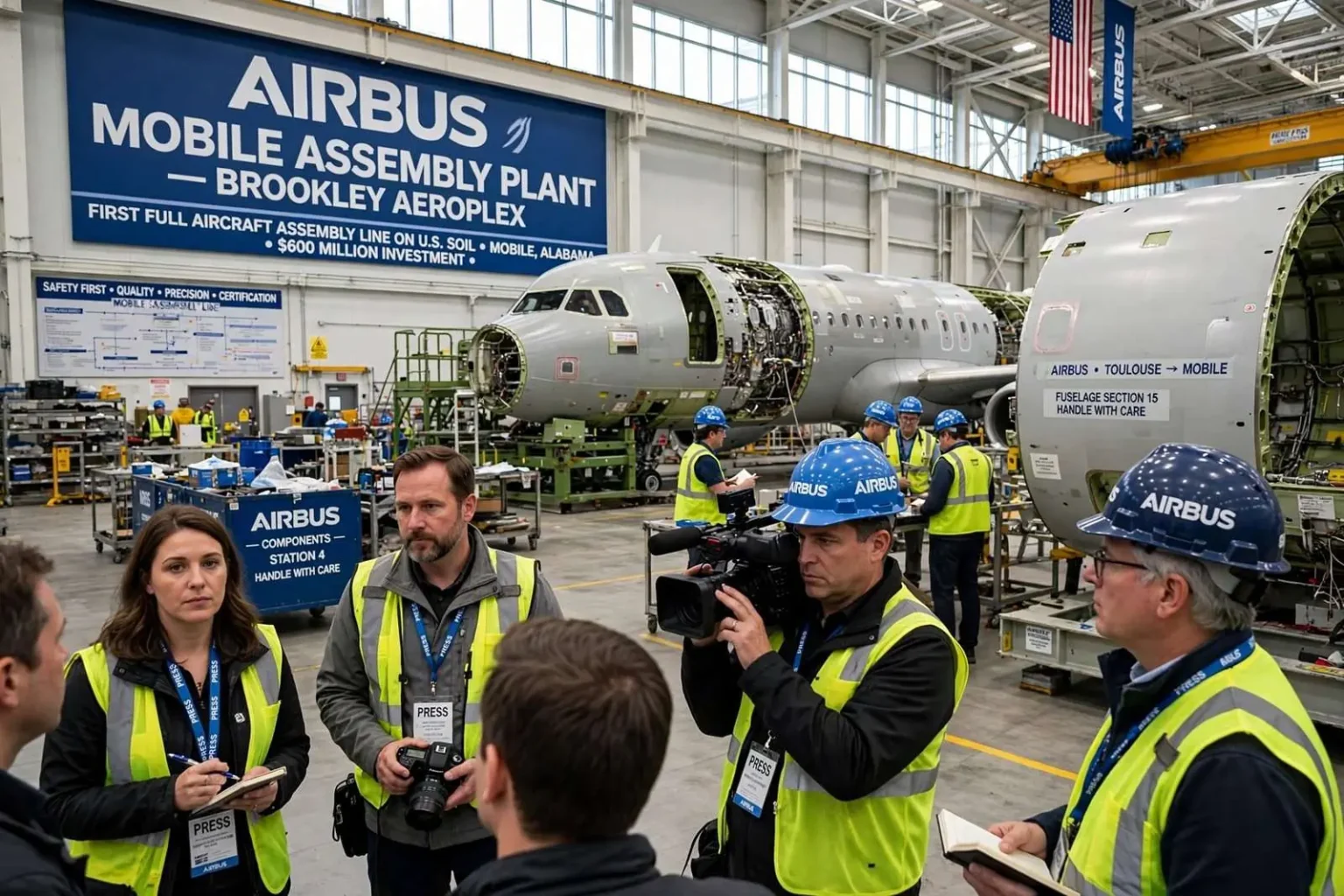
Journalists from around the world got an early look this week inside Airbus’s new $600 million manufacturing facility at Brookley Aeroplex in Mobile, just a day before the plant’s official grand opening ceremony. The tour offered a rare preview of the sprawling complex, which spans more than 200,000 square feet and represents one of the largest industrial investments in the history of the Gulf Coast region. Airbus asked visiting media to hold off publishing photos until the facility’s formal opening, treating the unveiling as a milestone moment for both the company and the aerospace community that had anticipated the plant’s completion for years.
The embargo gave the opening the feel of a global reveal. Reporters who walked the floor this week could describe what they saw — the scale, the tooling, the assembly stations — but the images would wait for the ceremony, when Mobile would formally introduce itself to the world as the newest city in Airbus’s manufacturing network. For a region more accustomed to exporting pine products, chemicals and ships than to hosting international aerospace press, the global media attention was itself part of the story.
First on U.S. Soil
The Mobile facility marks Airbus’s first full aircraft assembly line on U.S. soil, a project that had been years in the making since the European aerospace giant first announced plans to build in the region. Construction of the plant at the former Brookley Air Force Base site began in 2013, following a lengthy competition among several states for the investment. When the announcement came, it ended years of speculation and quiet courting — and it placed Mobile on a short list of cities anywhere in the world where commercial jets are put together piece by piece.
Inside, the plant is outfitted with state-of-the-art tooling and assembly stations designed to bring together fuselage sections, wings and other major components shipped in from Airbus facilities in Europe. The logistics alone are a feat: fuselage barrels and wings arrive by sea and by specialized transport, moving from the docks to the Brookley floor on schedules measured in days, with each section timed to enter the line in sequence. The plant operates on the same principles that govern Airbus’s assembly lines in Toulouse, Hamburg, Tianjin and elsewhere — a global supply chain choreographed so that a jet takes shape steadily along a single flow line.
Once fully staffed, the site is expected to employ hundreds of local workers building single-aisle aircraft for airlines across North America. The workforce is being hired and trained in phases, with experienced Airbus personnel from Europe working alongside new Mobile hires during the ramp-up — a deliberate transfer of skills designed to make the Mobile line self-sufficient over time. For the local workers involved, the training represents something Mobile has not offered at this scale in decades: apprenticeship in one of the most technically demanding manufacturing disciplines in the world.
Why Mobile Won
The Mobile plant has been widely viewed as a turning point for Alabama’s aerospace and advanced manufacturing sector, positioning the state alongside more established aviation hubs. Local and state officials had spent years courting Airbus and other aerospace suppliers, betting that landing a major final assembly operation would help anchor a broader supply chain of parts manufacturers and support businesses in the Mobile area. That bet was grounded in a track record: Alabama had already proven with its automotive industry that a major international manufacturer would come with suppliers in tow, and aerospace promised to repeat the pattern at higher skill and wage levels.
Community and business leaders have pointed to the facility as a validation of Mobile’s deep-water port access, its existing aerospace workforce experience and its Gulf Coast location, which offers direct shipping routes for the oversized aircraft components that arrive from overseas. The port is the linchpin of the whole arrangement: wings and fuselage sections are enormous, high-value cargoes that few U.S. ports could receive, stage and move with the reliability an assembly line demands. Mobile’s harbor connects directly to the Atlantic shipping lanes that carry the components from European plants, making the logistics chain shorter and more predictable than it would be almost anywhere else on the American coast.
The site itself contributed as much as the port. Brookley Aeroplex — the former Brookley Air Force Base, which the Pentagon closed in the late 1960s and the city converted into an industrial airport complex — offered runways, industrial land and an existing aviation culture that had never fully left the property. In the decades after the base closure, the airport authority steadily filled Brookley with aerospace tenants, maintenance operations and manufacturers, keeping skills and infrastructure alive on the site until a tenant of Airbus’s scale arrived to justify the city’s long patience.
The Airplane Being Built
The single-aisle aircraft taking shape at Brookley is the workhorse of the world’s airline fleets — the narrow-body jets that carry the majority of passengers on routes across North America and beyond. Demand for that category of aircraft has been running at record levels, with airlines placing orders years ahead of delivery slots. That demand is what makes the Mobile line strategically valuable to Airbus: building aircraft on U.S. soil, close to U.S. customers, insulates the company from currency swings and shortens the delivery chain for one of its most important markets.
For the airlines that will receive the jets, Mobile is now a delivery point on par with the company’s European and Asian facilities. Each aircraft that rolls off the line represents months of coordinated work — structures arriving across the Atlantic, systems installed station by station, engines mounted, paint applied, and flight tests completed before the plane departs Brookley’s runway for an airline’s fleet. The presence of that operation in Mobile means the region now participates in every one of those steps.
The Ramp Ahead
Officials have said the facility is expected to ramp up production gradually as new hires complete training and the assembly line reaches full operating capacity. That pace is deliberate. Aircraft assembly tolerances are measured in fractions of millimeters, and the certification requirements governing commercial aviation mean that quality must be built into the workforce before output targets take over. The phased approach — hire, train, produce, expand — mirrors what worked at Airbus’s other assembly sites, and Mobile’s early production is being managed as much for learning as for volume.
The plant’s opening has been described by regional economic development officials as one of the most significant announcements for Mobile’s economy in recent memory, with ripple effects expected for suppliers, logistics companies and the broader workforce across Mobile and Baldwin counties. Those ripples arrive in stages: supplier plants that locate near Brookley, trucking and warehousing contracts that grow with each aircraft, community college and university programs that align curricula with aerospace hiring, and the general signal the plant sends to every site-selection consultant weighing the Gulf Coast. A region that can build commercial jets, the argument runs, can build nearly anything it sets its mind to.
The grand opening ceremony will mark the moment the world sees what Mobile has spent years preparing. Behind the ribbon-cutting stands a decade of negotiation, a $600 million investment, hundreds of new manufacturing jobs, and a bet — shared by state officials, the port, the airport authority and the city — that Mobile’s future would be built in the same place its aviation past began, on the shores of Mobile Bay at Brookley.
The Workforce Behind the Line
Building an aerospace workforce from scratch in Mobile has been a coordinated project involving the company, the state, and the region’s educational institutions. Training programs have been developed to teach the composite fabrication, structures assembly and quality inspection disciplines the line requires, drawing applicants from across Mobile and Baldwin counties — many of them veterans, graduates of the area’s technical programs, or experienced tradespeople from the shipbuilding and process industries along the coast. The wages and skills those jobs carry have already begun reshaping the regional labor market, giving skilled workers a reason to build careers in Mobile rather than leave for other aerospace hubs.
The supplier pipeline matters just as much to the region’s long-term prospects. Final assembly lines pull dozens of suppliers into orbit around them — parts fabrication, tooling, logistics, cleaning and coating services, engineering support — and Mobile’s economic developers have spent the years since the announcement recruiting exactly that ecosystem onto and around the Brookley campus. Each supplier that opens a shop adds jobs that do not depend on any single aircraft program, deepening the industrial base the original investment started.
What the Opening Means for the Coast
The ceremony this week was the culmination, but the changes are already visible across the region. The aerospace corridor around Brookley has expanded steadily as announcements followed the Airbus decision, and the plant’s presence gives recruiters a concrete answer to the question every prospective company asks: is this a place where advanced manufacturing actually works? Mobile can now answer with an operating assembly line, a growing supplier base, and a port that handles aircraft components as a matter of routine.
For Baldwin County, the effects arrive across the bay — workers commuting in, suppliers scouting sites, and the general lift to the two-county labor market that a $600 million investment produces. Regional leaders have long described Mobile and Baldwin as a single economy joined by the bay and the interstate, and the Airbus operation treats them that way: a workforce pool of hundreds of thousands, a logistics network spanning the port and the highways, and a quality-of-life pitch that leans on both counties’ growth.
The journalists who walked the floor this week saw the physical answer to a question Mobile has been working on since Brookley’s fighter jets left in the 1960s: what becomes of a great airfield when the Air Force goes home? This week’s answer is a 200,000-square-foot factory where the world’s largest aircraft maker builds jets for the American market — and, if the region’s hopes hold, the first chapter of an aerospace cluster that will keep growing long after the grand opening’s confetti is swept away.