Three Republicans, One Ballot, No Runoff: The August 11 Special Primary That Will Likely Decide Who Represents Coastal Alabama
Jerry Carl, John Mills and Austin Sidwell are competing for the Republican nomination in Alabama's 1st Congressional District on Aug. 11 — a plurality contest with no runoff, in a summer election where turnout is the biggest unknown.
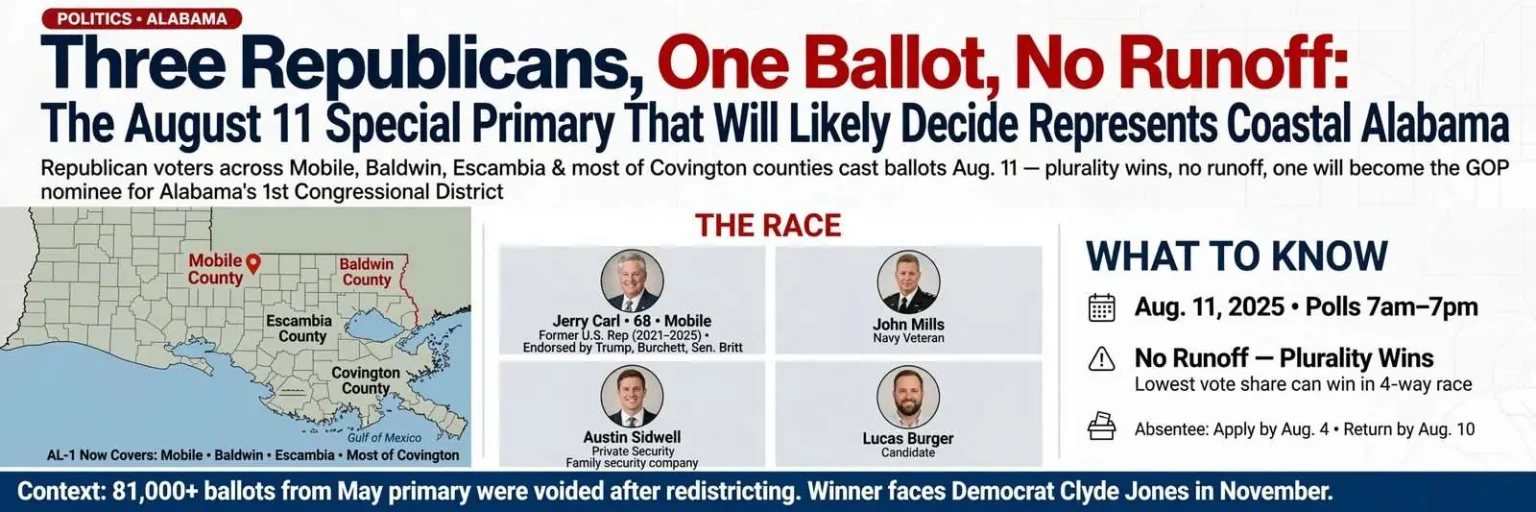
On August 11, Republican voters across Mobile, Baldwin, Escambia and most of Covington counties will pick a nominee for Alabama’s 1st Congressional District in a special primary with an unusual feature: there is no runoff. Whoever finishes first, by however slim a margin, becomes the nominee.
In a district this reliably Republican, that makes August 11 the election that most likely determines who represents coastal Alabama in Congress — and it is being held in the deadest stretch of the political calendar, in the middle of a Gulf Coast summer.
The Four Candidates
Republican voters will choose among:
- Jerry Carl, 68, of Mobile, who represented the district in Congress from 2021 until he lost the 2024 Republican nomination to Barry Moore.
- John Mills, a Navy veteran.
- Austin Sidwell, who works at his family’s private security company.
- Lucas Burger, who also qualified for the Republican primary ballot.
Carl has been direct about wanting the job back. “I had sold all my businesses and was anticipating finishing out my working career in Congress,” he said in a phone interview. “I wanted to go back in. I did a great job when I was in there, and I plan on doing a great job when I get back in there.”
The winner will face Clyde Jones, the only Democrat who qualified for the seat, in November.
How the District Got Here
The path to this election runs through one of the most consequential redistricting fights in Alabama history, and it is worth laying out plainly.
The Alabama Legislature passed a congressional map in 2023. That map was struck down as racially discriminatory. A court-ordered map was used instead in the 2024 elections, and it produced the election of two Black representatives from Alabama — the first time in state history.
That fight began with Allen v. Milligan, in which the U.S. Supreme Court ruled in June 2023 that Alabama's 2021 congressional map likely violated Section 2 of the Voting Rights Act by including only one majority-Black district out of seven. The Legislature's 2023 replacement map, which still contained only one majority-Black district, is the map a federal three-judge panel then rejected, leading to the court-drawn lines used in 2024.
This spring, a U.S. Supreme Court order cleared the way for the state to use the 2023 Legislature-passed map after all. Following a special legislative session, Gov. Kay Ivey called special elections in the 1st, 2nd, 6th and 7th congressional districts to accommodate the new lines.
The consequences for voters in the 1st District were immediate and jarring. Before the 2023 map took effect this spring, seven Republicans were running in the district. A primary was actually held on May 19, and 81,205 votes were cast — and then voided outright because of the special election. Under those voided results, Carl and state Rep. Rhett Marques of Enterprise would have advanced to a runoff. Marques has since qualified in the 2nd District instead, where six Republicans are competing.
In other words: more than 81,000 coastal Alabamians already voted in this race once, and their ballots no longer count for anything.
Why the Seat Is Open
The district’s current representative, Barry Moore of Enterprise, won the Republican nomination for U.S. Senate in June and is seeking to succeed Sen. Tommy Tuberville, who is the party’s nominee for governor. Under the redrawn lines, Moore likely would not have qualified to run for re-election in the 1st District anyway.
The Turnout Problem — and Why It Is a Real Strategic Variable
An August special primary with no runoff creates a specific and somewhat unpredictable dynamic.
First, plurality wins reward intensity over breadth. A candidate with a smaller but highly motivated base can win outright without ever demonstrating majority support — something a runoff would normally test. With four candidates on the ballot, a nomination could theoretically be won with well under half the vote.
Second, low-turnout elections magnify the value of organization. When the electorate shrinks, the voters who remain are disproportionately the most reliable, most partisan and often the oldest — and the campaign that knows exactly who those people are and can get them to a polling place has an outsized advantage over one relying on general name recognition.
Third, voter fatigue is a legitimate concern here in a way it usually is not. These are voters who were asked to turn out in May, told their votes were nullified, and are now being asked to do it again in August. That is a hard sell, and every campaign in the district knows it.
What the District Covers
Alabama’s 1st Congressional District now takes in all of Mobile County, all of Baldwin County, all of Escambia County and all but the northeast corner of Covington County — the ports, the beaches, the shipyards, the rural timber and farming communities, and the military and aerospace employers that anchor the coastal economy.
Voters who want a say in who represents that district should check their registration status and polling location well before August 11. In a race decided by plurality in the middle of summer, the margin of victory may be smaller than the number of people who simply forgot the election was happening.
Voting Logistics
Polls will be open from 7 a.m. to 7 p.m. on Election Day, Aug. 11. Because the special election falls under new district lines, voters are encouraged to verify their registration status, polling location and district beforehand, since any of the three may have changed since they last cast a ballot. Sample ballots are available in advance for both the Mobile County and Baldwin County Republican primaries.
For voters planning to cast an absentee ballot, Alabama’s deadlines fall in early August: the deadline to apply for an absentee ballot by mail is Aug. 4, in-person absentee voting at county courthouses closes Aug. 6, and mailed absentee ballots must be received by election officials by Aug. 10 to be counted.
Update: U.S. Rep. Tim Burchett Endorses Jerry Carl
U.S. Rep. Tim Burchett, R-Tenn., has endorsed former U.S. Rep. Jerry Carl in the Aug. 11 Republican special primary, adding to the list of national Republican figures backing Carl’s comeback bid. In a video posted by Carl’s campaign, Burchett said: “I’m proud to support my buddy Jerry Carl. I hope he gets back to Congress. We really need him.” He added: “He’s not one of those guys who’s out there talking all the time, but when he does say something, it makes good sense. Like the President, I’m for Jerry Carl.”
Carl has also been endorsed by President Trump, U.S. Sen. Katie Britt and various business organizations as he seeks to return to the AL-1 seat he held from 2021 to 2025, before losing the 2024 Republican primary to Barry Moore following court-ordered redistricting that merged their districts. With Moore now running for U.S. Senate, Carl launched his comeback bid after the U.S. Supreme Court restored the 1st District to a South Alabama-based configuration.