AL.com Pulls the Plug on Reader Comments After Two Decades of Rowdy Debate
Alabama Media Group has shut down reader comments on AL.com, saying moderation costs outweighed value as a tiny fraction of users drove most posts.
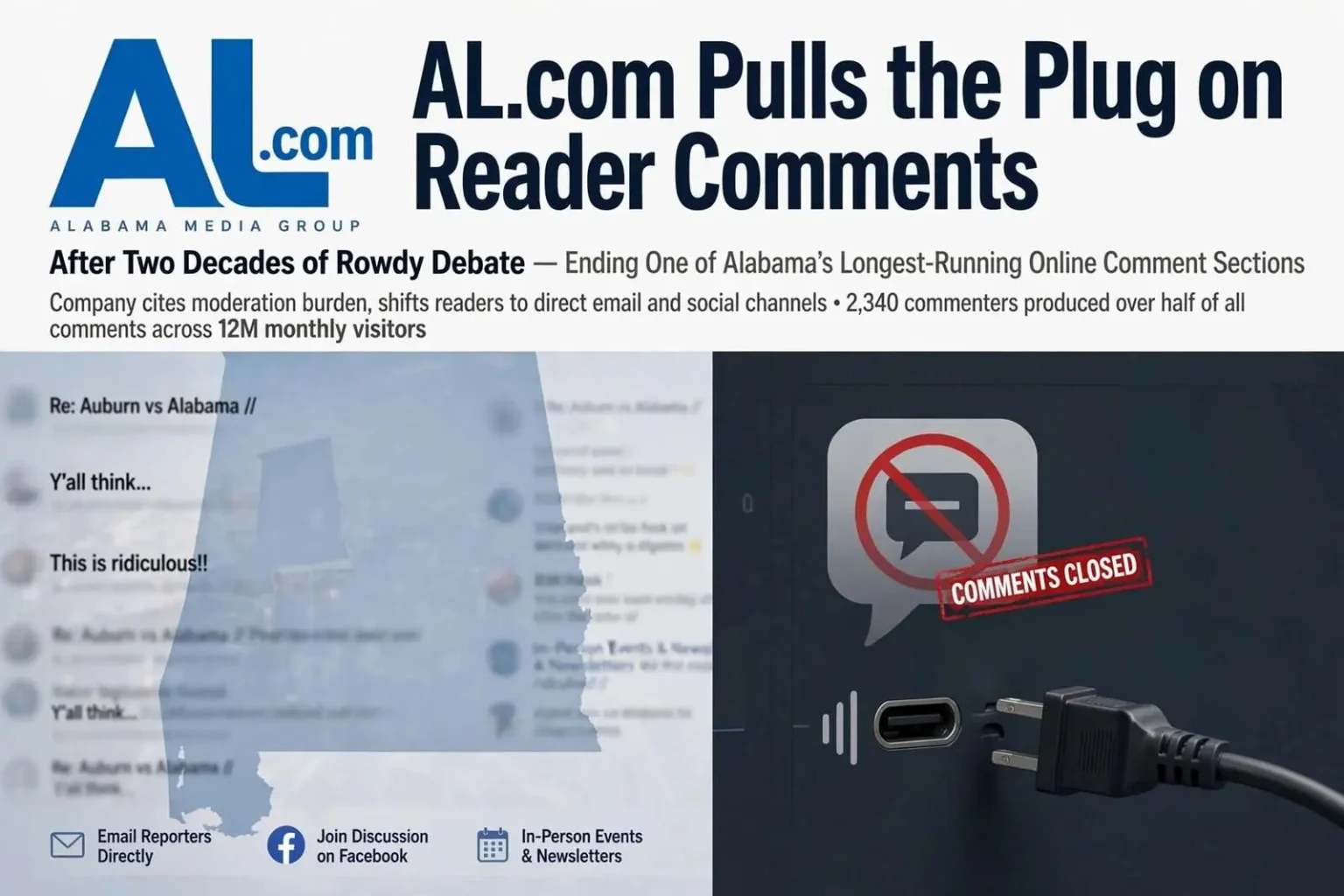
Alabama Media Group has retired reader comments on AL.com, ending one of the state’s longest-running — and rowdiest — online comment sections. The change closed a chapter that stretched back to the earliest days of the site, when reader conversation was not a feature of the operation but the core of it.
The company cited the time and resources required to police the forums and pointed readers instead toward what it called a more constructive space for engagement. Moderation had become an escalating burden: comment threads required constant attention to catch abuse, spam and off-topic attacks, and the volume of flagged material grew faster than the conversation itself.
Comments have been a defining feature of the site almost from birth. When it launched as Alabama Live, much of the content was built around reader conversation, with news, sports and entertainment mixed in. The site began as a place for Alabamians to talk to each other online, in an era when such forums were among the few gathering spaces the state had on the internet.
Over time, the operation evolved into a real-time digital news organization while conversations migrated from forums to comment threads and, more recently, to social media and in-person events. The evolution mirrored the wider transformation of local news: readers who once lingered on a story’s comment section increasingly carried those conversations to Facebook and Twitter, where they responded directly to reporters and to each other without the news organization hosting the exchange.
A tiny fraction drove most of the noise
In its announcement, the company acknowledged how lopsided the conversation had become. Across Advance Publications’ websites, which draw roughly 50 million unique visitors a month, just 2,340 people produced more than half of all comments — meaning only a sliver of AL.com’s 12 million monthly visitors ever left or even read one.
Those numbers reframed what “community engagement” actually looked like on the site. A comment section that appeared to represent a broad public conversation was, in practice, dominated by a small, self-selected group — a pattern researchers had documented across the industry. For the vast majority of readers, the comment section was something to scroll past or avoid entirely, and for some, it was a reason to disengage from stories altogether.
For readers, the practical changes are modest: no more scrolling past hundreds of comments to reach the end of a story, no more threads that veer into insults, and a direct email line to reporters that existed all along but was easy to overlook. For reporters, the change removes a daily source of distraction and, they hope, redirects energy toward the reporting itself. The retirement of comments ends the site’s oldest experiment in audience participation — but not, the company insists, its commitment to hearing from the people it covers.
The change mirrors moves across the industry: Cleveland.com, The Plain Dealer’s website, dropped comments the same week, and outlets nationwide have been shutting down anonymous threads over the past decade as trolling and vitriol mounted. What began as an experiment in openness — letting anyone respond instantly to any story — had curdled in many places into an environment that drove readers away rather than drawing them in.
Company statements noted that uncivil exchanges and off-topic attacks consume moderation resources that are better spent on local reporting, and that anonymous platforms also invite political operatives working under multiple screen names. That second concern had become increasingly visible in Alabama, where heated political cycles turned comment threads into battlegrounds for coordinated messaging that looked like grassroots conversation but was not.
The economics of moderation made the decision easier to defend. Reviewing flagged comments, enforcing community rules and handling appeals required staff time that produced no revenue, while the quality of the conversation — and sometimes the reputation of the stories it sat beneath — declined. News organizations that once viewed comment sections as essential community infrastructure increasingly concluded that the costs outweighed the engagement.
What replaces the comment section
Readers who still want to reach reporters directly can do so by clicking staff bylines for email addresses — a feature many other outlets have abandoned. The company framed direct email as a higher-value channel: a message to a reporter reaches a person who can respond, verify and follow up, unlike a comment dropped into a thread of thousands.
For Alabama and Auburn sports chatter, the company is steering fans toward its dedicated Facebook pages. Sports conversation — historically the loudest corner of any Alabama comment section — moves there along with the rest of the engagement, on platforms where fans are already gathered and where the conversations are moderated by community dynamics as much as by the company.
The retirement of comments also closes out a distinctive era of Alabama internet history. The forums of the Alabama Live era — and the comment threads that followed — hosted years of argument, humor, breaking-news crowdsourcing and the particular brand of football-related intensity that only Alabama readers can generate. For better and worse, the comment section was where the state talked, and its shutdown removes one of the few shared spaces that crossed geography and politics.
Media analysts have noted the irony in the trajectory: comment sections were once promoted as the future of journalism — a way to let the audience participate in the news — but the participation they attracted was rarely the kind editors hoped for. The most engaged commenters were not always representative, and the loudest voices tended to crowd out the many readers who preferred to react silently. Engagement metrics eventually told the story: millions of readers, thousands of commenters.
The shift also reflects how the relationship between news organizations and audiences has changed structurally. In the forum era, the news site owned the conversation; now the conversation happens wherever the audience already is, and the news organization’s role is to publish, respond and distribute — not to host. Events, newsletters and social channels have replaced the comment thread as the places where a newsroom and its readers meet, and Alabama Media Group’s in-person events were part of that same reallocation of attention.
For readers, the practical changes are modest: no more scrolling past hundreds of comments to find the end of a story, no more threads that veer into insults, and a direct email line to reporters that existed all along but was easy to overlook. For the reporters, the change removes a daily source of distraction and, they hope, redirects energy toward the reporting itself.
AL.com remains the state’s largest digital news operation, and the comment shutdown does not change what it publishes — only where its readers talk about it. The era of the rowdy Alabama comment section is over, ended not with a scandal but with arithmetic: too few people commenting, too many resources consumed, and better places for the conversation to live. The state’s loudest online stage has gone dark, and its audience has moved on to stages it does not have to moderate.
Alabama Media Group’s retirement of comments was followed closely by media watchers in the state, in part because AL.com’s comment sections had played an outsized role in the state’s political and sports life for two decades. Threads on major political stories routinely ran into the hundreds of comments, and the site’s Auburn and Alabama coverage generated some of the most active fan arguments anywhere on the internet — arguments that now move fully to social media.
The shutdown of anonymous commenting puts AL.com alongside a growing list of news organizations that have concluded the format no longer serves readers. Studies of online news communities have repeatedly found that uncivil comments can distort how readers understand a story — readers exposed to rude comment threads often rate the news content itself as less credible, a finding that gave editors a journalistic, not merely operational, reason to act.
The 2,340-commenter statistic also highlighted the gap between perception and participation. A visitor scanning a comment section might reasonably assume it reflected a broad sample of Alabama opinion; in fact it represented a tiny, repeat cadre — roughly the size of a high school senior class — producing the majority of everything posted across a network serving tens of millions of monthly readers. The end of comments, by that math, silences almost no one while relieving the newsroom of a nightly cleanup.
What remains is the byline email — an older, slower, more accountable form of engagement. A reader who emails a reporter has attached a name, an address and often a specific question, and reporters answer. The company’s decision to keep and highlight that channel, when many outlets have buried their contact information, suggests it values the kind of reader contact that leads to corrections, tips and follow-up stories rather than the kind that leads nowhere.
For now, the threads are gone, the forums are closed, and the conversation continues where most of the internet’s conversations now live. Alabama Media Group’s bet is that its readers — twelve million a month — will follow the reporting regardless of where the arguing happens, and that the newsroom’s time is better spent finding stories than refereeing the fights beneath them.