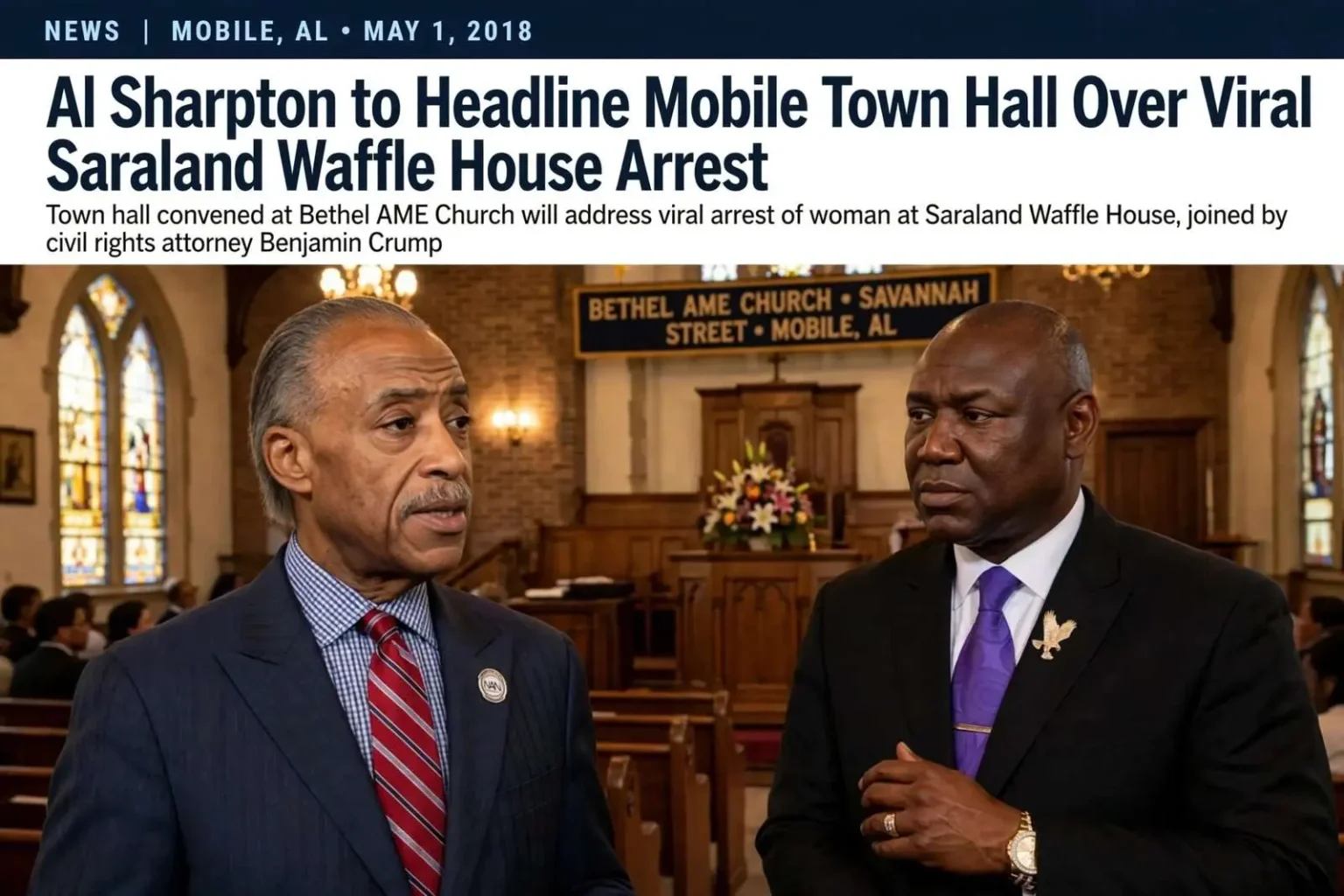
The Rev. Al Sharpton brought a national spotlight to Mobile in the spring of 2018, announcing a town hall meeting to address the arrest of Chikesia Clemons at a Saraland Waffle House — an incident captured on video that spread rapidly across social media and ignited debate over policing in the Mobile suburb. The town hall, which Sharpton hosted alongside Clemons and civil rights attorney Benjamin Crump, was scheduled for the evening of Tuesday, May 1, at Bethel AME Church on Savannah Street in Mobile. Clemons also appeared with Sharpton on his MSNBC program “PoliticsNation” in the days leading up to the gathering.
The choice of venue placed the gathering in one of Mobile’s most historically significant African American congregations. Bethel AME Church on Savannah Street sits in the heart of the city’s historic Black business and church district near downtown, a neighborhood where civil rights-era meetings were once held and where congregations have hosted community forums for generations. A church setting gave the event both the seating capacity the expected crowd required and the symbolic weight that civil rights gatherings in the South have long drawn from their host congregations, and it signaled that the event’s organizers intended it as a community forum rather than a rally staged at a government building.
Sharpton’s arrival in Mobile marked a notable escalation in the case’s public profile. As the president of the National Action Network and a decades-long figure in civil rights advocacy, Sharpton has built a career on taking contested police encounters in small and mid-sized cities and pressing them onto the national stage, and his announcements reliably draw local, regional and national press to the communities involved. His decision to schedule a town hall in Mobile within days of the viral video meant that Saraland, a suburb of roughly 14,000 residents north of Mobile, suddenly found itself the subject of coverage and commentary from outlets far beyond the Gulf Coast.
What Sparked the Controversy
Clemons was arrested by three Saraland police officers on April 22, 2018, on charges of disorderly conduct and resisting arrest. Cellphone video of the encounter showed officers placing her on the restaurant floor, with her breast exposed during the struggle to handcuff her. The footage drew widespread criticism online, and Crump described the arrest as an assault, saying witnesses reported that Clemons appeared sober and coherent before police arrived. Clemons maintained the confrontation began as a dispute over plastic utensils. Her attorney also represented that she had been threatened during the arrest.
The video’s spread followed a pattern that had become familiar by 2018. Within hours of the arrest, the footage had been viewed and shared millions of times, with viewers across the country weighing in on the proportionality of the officers’ response and the visibility of Clemons during the struggle. The incident became a rallying point for commentary about the treatment of Black women by police, and civil rights organizations cited it in broader conversations about use-of-force standards and de-escalation training. For Saraland, the viral attention was unprecedented, and the city spent the following weeks responding to a level of scrutiny no prior incident had generated.
Police Defended the Response
Saraland police publicly defended their officers’ conduct days after the arrest. At a press conference, investigators presented surveillance footage from inside the restaurant along with a 911 call in which a caller reported that patrons were drunk, disorderly, and refusing to leave. Detectives said Clemons and another woman, Canita Adams, had been asked to leave the business but returned and directed profanity at employees, according to statements gathered from several witnesses on scene. Addressing an officer’s recorded remark about breaking Clemons’ arm, the department’s public information officer characterized the statement as a description of cause and effect rather than a threat. Waffle House likewise stood behind the police response.
The dueling accounts — a viral cellphone video on one side, surveillance footage and witness statements on the other — defined the public argument over the case from its first days. Supporters of Clemons pointed to the physical dimensions of the arrest and the exposure captured on video, while the department’s presentation was aimed at establishing the conduct that preceded officers’ arrival. The competing narratives played out not just in press conferences but in the town hall itself, where organizers gave Clemons and her legal team a platform to present their account directly to the community, and where residents were able to hear both the family’s description of the encounter and the context the department had offered.
Crump’s involvement connected the case to a national network of high-profile civil rights litigation. The attorney, known for representing families in some of the most closely watched police-involved cases of the previous decade, framed the arrest as part of a larger pattern deserving of scrutiny, and his presence alongside Sharpton at the Mobile town hall underscored that the case was being positioned for possible legal action as well as public advocacy. Clemons’ appearance on national television in the days before the event extended the same argument to a national audience, and the combined effect kept the case in headlines well past the news cycle that a local arrest would normally have occupied.
The Town Hall and Its Aftermath
Town hall gatherings of this kind serve several purposes at once, and the May 1 event in Mobile was no exception. For the family, it offered a public accounting of what happened and an organized show of support. For the community, it created a structured space to raise questions about policing practices in the suburbs — questions that resonated in Mobile County, where residents move between city and suburban jurisdictions daily and encounter different police departments with different policies. For the national figures involved, it was a stage from which to press for review of the case, whether through charging decisions, departmental investigations or civil litigation.
The Mobile town hall became one of the most prominent local flashpoints in a case that continued to move through the courts for years afterward. The criminal charges against Clemons remained the immediate legal matter while the public debate continued, and the case became a reference point in ongoing discussions about police accountability in suburban departments across Alabama. Civil rights advocates continued to cite the arrest in training materials, editorials and public meetings in the months that followed, and the video itself remained among the most widely shared Alabama law enforcement encounters of its year.
The case also illustrated how quickly a local incident now travels. In earlier eras, an arrest at a suburban restaurant would have remained a local story, covered by Mobile’s television stations and newspapers and forgotten within a week. By 2018, a passerby’s cellphone changed that equation permanently. The Saraland Waffle House arrest joined a series of viral encounters that shaped the national conversation about policing in the late 2010s, and smaller cities like Saraland learned that their police departments were now subject to the same instant, worldwide scrutiny as the largest departments in the country.
For Mobile’s community, the town hall at Bethel AME carried meaning beyond the specific case. Congregations and civic organizations in the city had hosted forums on policing and community relations many times before, but the presence of nationally known figures like Sharpton and Crump drew an overflow audience and gave local advocates a larger platform for concerns they had raised for years. The event’s organizers emphasized both the specific case and the broader questions it raised, and the discussion that night fed into continuing conversations between area residents and the law enforcement agencies that serve them.
What happened at the Saraland Waffle House on April 22, 2018, and the response that followed, remains a defining episode in the relationship between that suburb’s police department and the wider public. The town hall Sharpton announced, held with Clemons and Crump at Bethel AME Church on Savannah Street, ensured that the dispute over plastic utensils, the struggle on the restaurant floor and the conflicting accounts of what led to it would be examined not only in Saraland’s municipal court but in the court of national public opinion — a scrutiny the case continued to draw as it moved through the legal system in the years that followed.
The legal timeline that followed the town hall stretched far longer than the public attention did. Cases involving contested arrests typically pass through municipal court, potential appeals and, when civil claims are filed, the federal court system, and the Clemons case proceeded through that machinery over years while advocates periodically revived the public conversation. Each stage brought renewed coverage locally, and the name Saraland became familiar to readers far from Alabama who had never visited the Gulf Coast but knew the details of the arrest from the video. The case outlived most of the news cycle that created it, moving at the pace of the courts while the debate it sparked continued in comment sections, classrooms and community meetings across the region.
In the end, the episode stands as a case study in how policing disputes unfold in the modern era: an arrest on a weeknight, a video seen by millions, a department defending its officers with surveillance footage and witness statements, a family represented by a nationally known attorney, and a famous advocate arriving within days to convene a community forum. Every element of that sequence played out between April 22 and May 1 of 2018, compressed into a span of days that transformed a suburban Waffle House parking lot into one of the most discussed locations on the Alabama Gulf Coast.