Rules of the Road: How Alabama’s 2010 Ballot Would Be Filled
Democrats opened statewide qualifying in January and Republicans in March, with both parties closing April 2 for June 1 primaries. Nearly every office in Alabama was on the 2010 ballot.
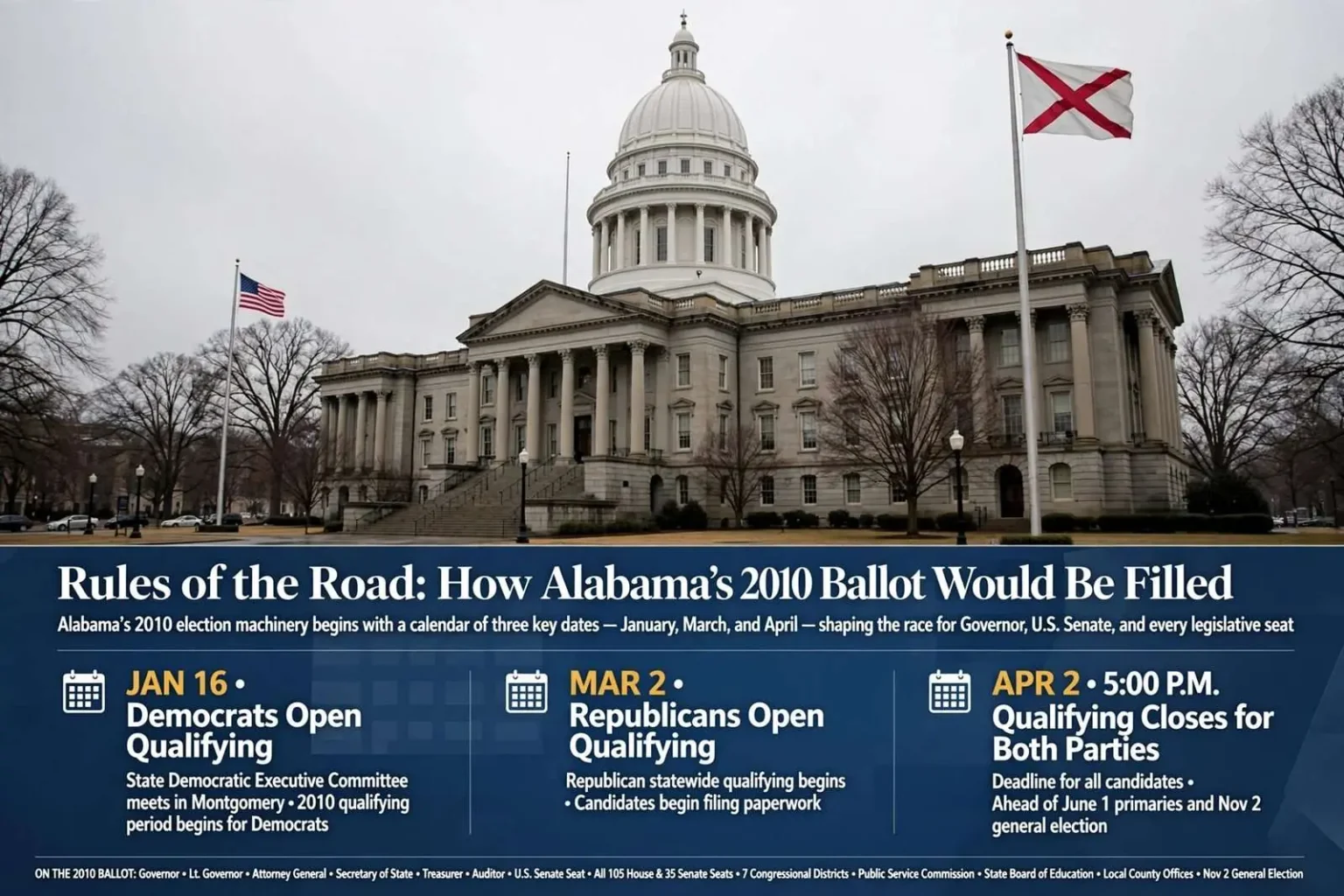
Alabama’s 2010 election machinery began turning this month, and for candidates the calendar was about to become the most important document in their lives.
State Democrats open qualifying for statewide office on Jan. 16, during the State Democratic Executive Committee meeting in Montgomery. Republicans will not open statewide qualifying until March 2.
Qualifying for both parties closes at 5 p.m. on April 2, two months before the June 1 primaries. The general election is Nov. 2.
Those three dates — a January opening for one party, a March opening for the other, and an April deadline for both — framed everything that followed. Qualifying is the moment a candidacy becomes official: the filing fee, the paperwork and the party’s receipt turn a might-run into a name on a ballot. Miss the deadline and there is no remedy; the June primary goes on without you.
Nearly everything is on the ballot
The 2010 cycle was as close to a complete turnover of Alabama’s elected government as the state’s calendar permits. On the ballot:
Governor, lieutenant governor and attorney general.
Secretary of state, treasurer and auditor.
Every seat in the Alabama House and Senate.
Several seats on the state’s appellate courts.
The U.S. Senate seat held by Richard Shelby.
All seven of Alabama’s congressional seats.
Seats on the Public Service Commission and the state Board of Education.
Circuit and district judgeships, district attorneys and circuit clerks.
Members of both parties’ state executive committees.
The only significant offices not in play were the state’s other U.S. Senate seat and those justices whose terms had not yet expired. Everything else — from the Governor’s Office to the county courthouse — would be contested in a single November election, the consequence of Alabama’s alignment of all its major terms to the same four-year clock.
Party officials cautioned that qualifying for county offices may run on a different schedule than for state offices. “Local parties will be able to open now if they want to,” said Democratic Party spokesman Brannon Walden. Republican official John Ross said local GOP qualifying had already begun in most counties.
The flexibility cuts both ways. County committees can move early to lock in incumbents and deter challengers, or wait to see how the statewide field develops. In practice, the local calendars in a big-delegation county like Mobile rarely stray far from the state’s, but every oddity — every locally scheduled deadline — becomes a candidate’s problem the moment it is missed.
The fundraising blackout
One date on the calendar mattered more than most, and it is easily missed. The last day contributions could be made or solicited for statewide candidates was Jan. 11 — the day before the 2010 legislative session convened. The window would reopen Feb. 1.
The rule reflected a principle written into Alabama law: legislators should not be raising money from the people whose bills they are voting on while the session is in progress. Alabama’s part-time Legislature is populated by business owners, lawyers and professionals who sit on the other side of the table from the interests their chamber regulates, and the blackout exists to keep campaign cash out of that window — at least in theory.
In practice, it produced a frantic scramble in the days before each session and another the day the window reopened. Fundraisers stacked up in the week before Jan. 11; contribution checks were dated, delivered and banked in a rush; and Feb. 1 became, overnight, the busiest fundraising date of the winter. Compliance offices at every campaign tracked the dates like fiscal quarter-ends, and the pattern repeated with every annual session until veteran candidates scheduled their fundraisers around the blackout without thinking. The blackout did not stop the money — it compressed it.
Why the timing mattered in South Alabama
The staggered qualifying periods — Democrats in January, Republicans in March — created a strategic asymmetry that both parties understood. A Democrat who qualified in January made his intentions public six weeks before Republicans had to declare theirs, giving GOP recruiters time to react, and giving potential Republican candidates the chance to see the field before committing.
In a normal year, the difference would be a footnote. In 2010 it was leverage. Republicans in Mobile, Baldwin and the surrounding counties believed the political wind was at their backs — a national anti-incumbent mood, an unpopular first year for the new Democratic administration in Washington, and a state Democratic Party already nursing internal fights — and the late qualifying window let them hold their decisions until the evidence accumulated.
Republicans across South Alabama would ultimately field candidates in legislative seats they had not seriously contested in years. Some of those decisions were made in the six weeks between Jan. 16 and March 2 — weeks in which a potential candidate could watch the Democratic field settle, poll the mood in the district, and step forward only when the path looked clear. The calendar did not create the wave, but it gave the party building the wave time to choose its surfers.
The Mobile County offices on the ballot were substantial in their own right: a district attorney’s race with no incumbent, following John Tyson Jr.’s decision not to seek another term; the sheriff’s office; county commission seats; the school board; and every legislative seat in the county.
An open district attorney’s race is a generational event in any county — the office prosecutes every felony from Prichard to Grand Bay, and Tyson’s departure meant the job would go to someone new for the first time in years. Combined with an open sheriff’s race and a full slate of commission and legislative contests, Mobile County’s 2010 ballot offered more simultaneous openings for ambitious local politicians than any cycle in recent memory.
For the region’s incumbent legislators, meanwhile, the guarantee that every seat would draw a challenger changed the arithmetic of the year. A legislator who might ordinarily coast through a recession-era session now had to qualify, raise money under blackout constraints, and campaign — in some cases against a well-funded first-time opponent who had watched the field from the Republican side for six weeks before jumping in.
The stakes
The whole exercise turned out to be the hinge of modern Alabama political history. On Nov. 2, 2010, Republicans captured both chambers of the Alabama Legislature for the first time since Reconstruction, won the governorship and swept the statewide offices. Every one of those results ran through the qualifying deadlines set in this unremarkable January memorandum about dates.
The magnitude of the sweep is easy to lose in the calendar’s fine print. Control of the Legislature had been the Democratic Party’s inheritance in Alabama for 136 years — through Reconstruction, the 1901 Constitution, the civil rights era and the gradual realignment of the state’s white conservative voters. In a single November night, the Republicans won the House, the Senate, eight constitutional offices and a majority of the state’s congressional delegation, and the Legislature’s committee chairmanships, the redistricting pen and the policy agenda changed hands all at once. No qualifying season in modern Alabama history has produced results to compare with it.
What made the machine work, in part, was the ordinary business recorded in this memo: candidates filed on time, paid their fees, worked the blackout window and met the April 2 deadline. Elections are won in November, but they are made eligible in qualifying season — and the 2010 qualifying files, opened in Montgomery that January and closed that April, contained every name the Republican wave would eventually elect.
The recruitment asymmetry deserves its own line in the record. Alabama’s qualifying calendar gave one party a public field to study and the other a private window to recruit in — and in a realigning year, that structure systematically favored the party whose candidates could wait. Political scientists will parse the 2010 sweep for years; a fair account of it has to start with a January document about dates and fees.
For candidates in January 2010, though, the calendar was simply a list of things that had to be done by certain days, in a year that would demand rather more of them than usual. The Democratic committee met in Montgomery on Jan. 16 and opened the books. Republicans opened theirs on March 2. Both parties closed at 5 p.m. on April 2, and Alabama went to the polls on June 1 to decide what November would look like.
What nobody writing the qualifying memo could have known is how much history would run through it — that the unremarkable chore of filing paperwork in Montgomery that winter was, in fact, the first step of the most consequential Alabama election in a century and a half.