
Alabama AG Steve Marshall frames federalism, Confederate monuments in Mobile speech
Alabama AG Steve Marshall frames federalism, Confederate monuments in Mobile speech Reported by South Alabama News from local coverage of the Mobile and.
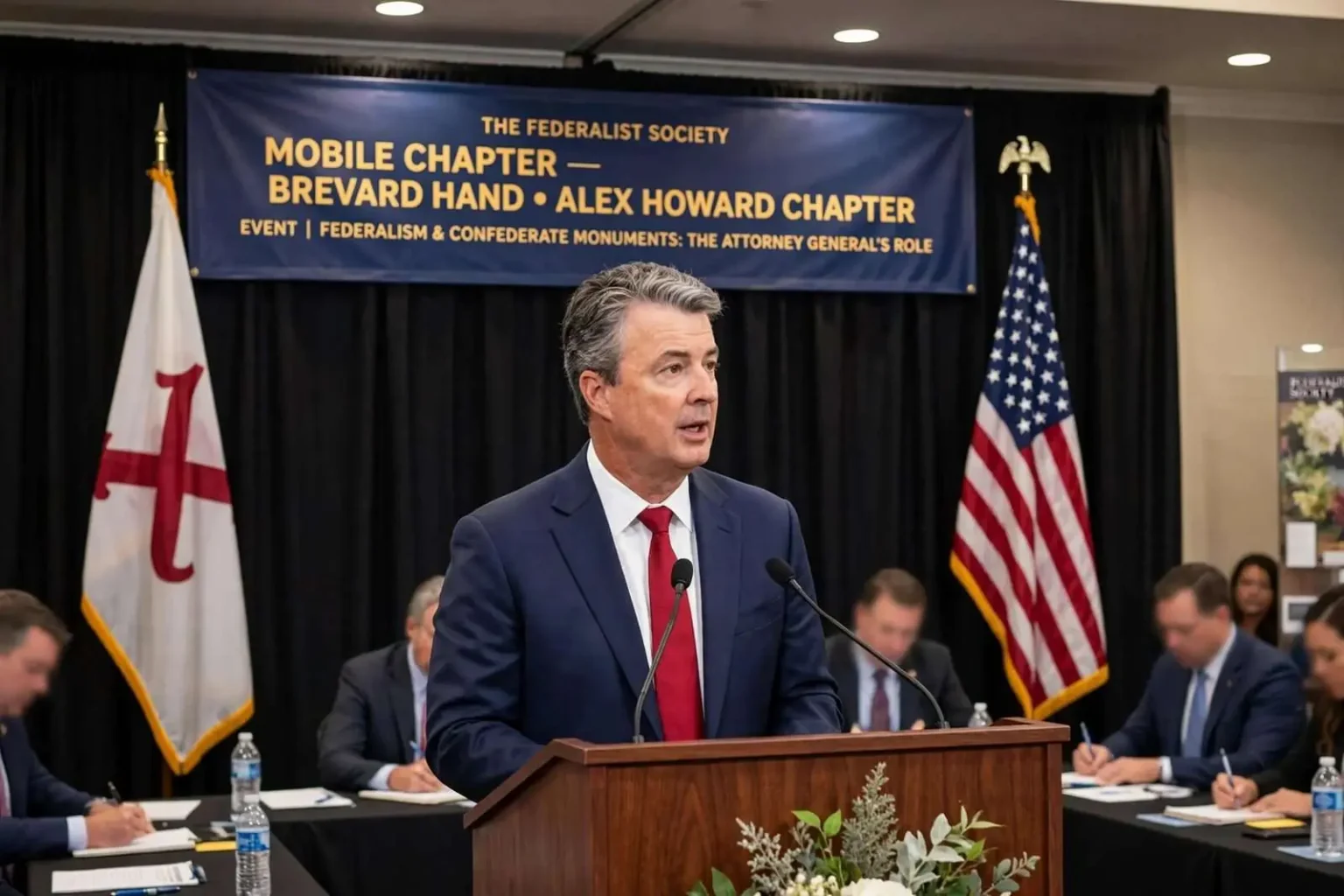
Alabama Attorney General Steve Marshall used a Mobile appearance to lay out his view of an attorney general’s proper role: enforcing the law, not making policy from the bench or the bully pulpit. Speaking to the Brevard Hand-Alex Howard Chapter of the Mobile Federalist Society, Marshall traced how attorneys general began expanding their reach in the 1990s, starting with the tobacco lawsuits, and later used litigation to shape regulation on issues from environmental rules to education policy.
The Federalist Society audience — named for two of Mobile’s most prominent judicial figures, the late U.S. District Judge Brevard Hand and former state Senator Alex Howard — is part of the national legal organization’s chapter network, a regular stop for statewide officials discussing constitutional questions. Marshall’s theme fit the setting: a warning that litigation has become a substitute for legislation, and a defense of the more limited office he believes the state’s chief legal officer should hold.
The Rise of the Activist Attorney General
“Historically, the attorney general has limited their role to what was occurring within their own state’s boundaries,” Marshall said, arguing that the proper relationship between state and federal government should rest on “principle, not partisanship.” In his telling, the modern multi-state lawsuit began in earnest with the state litigation against tobacco companies in the 1990s, a model that showed attorneys general they could reshape national industries and policy through coordinated lawsuits rather than legislation.
The practice grew from there. State attorneys general discovered that a single lawsuit — or a coalition of dozens — could force regulatory outcomes that legislatures had declined to order, and the multistate suit became a routine instrument of policy on both sides of the political spectrum. Marshall described that evolution with skepticism, positioning himself as part of a corrective: an attorney general who joins coalitions when the law requires it, not as a vehicle for advancing a personal or partisan agenda.
He noted Alabama had joined multi-state challenges to what it viewed as federal overreach, and said his office would litigate against a Trump administration action just as readily as against a Clinton one. That framing — challenges judged on principle rather than the party in power — was the centerpiece of his argument to the Mobile lawyers, and a standard he said should govern the filing of multistate lawsuits regardless of which party occupies the White House.
The economics of the model explain its spread. Contingency-fee arrangements, outside funding and the leverage of a thirty-state coalition gave attorneys general resources that no state legislature appropriates for its own lawyer, and the resulting settlements began to look like national regulation — industry-wide payments, changed business practices and court-supervised reforms with no legislature behind them. Marshall’s critique was aimed at that machinery: policy made by consent decree and settlement, he suggested, lacks the accountability of statutes passed by legislatures and signed into law by governors, and the remedy is to reserve the office’s litigation power for cases the law actually requires.
The Monument Law and the Birmingham Case
Marshall also addressed the recently enacted Alabama Memorial Preservation Act, which bars altering or removing monuments older than 40 years. The statute, passed as debates over Confederate memorials intensified nationwide, applies to monuments on public property and to the renaming of public buildings and streets, placing decisions about long-standing memorials under state rather than local control.
With momentum building nationally to take down Confederate statues, the city of Birmingham had covered a Confederate monument in a park while seeking a legal route to remove it. Marshall’s office sued. The dispute turned on a straightforward question of state law — whether a city could obscure and ultimately remove a monument the state had put off-limits — and it became the highest-profile test of the Preservation Act’s reach. Birmingham officials had argued that the monument’s presence in a downtown park, blocks from City Hall, offended a community whose population is majority Black; the state’s position was that the law was lawfully enacted and binding on all municipalities.
“My job is not to provide my personal belief about what should or shouldn’t happen, but when a law is lawfully passed, I’m there to enforce it,” Marshall said, adding he expected the Birmingham case to reach the appellate courts. The statement condensed his broader philosophy: the attorney general’s personal views about a monument — or any contested law — are beside the point once the Legislature has acted and the statute is on the books.
Federalism as the Underlying Question
Beneath both subjects — multistate lawsuits and monument litigation — Marshall placed the same constitutional question: the division of authority between states and the federal government. His remarks framed federalism as a working doctrine rather than an abstraction, the principle that determines whether a state may set its own rules about historical memorials, or sue Washington when it believes a federal agency has exceeded its delegated powers. The same principle, he argued, restrains state officials from using their offices to override the lawful decisions of the federal government.
The speech gave the Mobile audience a coherent account of how those threads connect. Attorneys general who treat litigation as lawmaking, in his view, erode the line between the executive and legislative functions just as surely as a federal agency that writes rules Congress never authorized. The remedy, in his view, is discipline: enforce what is lawfully enacted, challenge what exceeds lawful authority, and leave policy choices to the branches and levels of government designed to make them.
Marshall’s Tenure and the Office He Describes
Marshall came to the attorney general’s office in 2017, appointed by Gov. Kay Ivey to fill the seat vacated when Luther Strange moved to the United States Senate, and won election to a full term in his own right the following year. A former Marshall County district attorney, he built his career as a prosecutor rather than a policy advocate, and that background runs through the philosophy he described in Mobile — the view of the office as the state’s lawyer, not its second legislature.
The distinction matters in practical terms for how Alabama participates in national legal controversies. Under the standard Marshall described, the office joins a multistate suit when a federal action injures the state’s legal interests and stands down when it does not, regardless of the administration being sued. Defenders of the more assertive model argue that attorneys general are elected and therefore entitled to pursue the policies their voters chose; Marshall’s argument to the Federalist Society chapter was that the office’s oath runs to the law itself, not to a governing coalition.
The Stakes in the Monument Dispute
The Birmingham litigation carried stakes beyond one monument in one park. A ruling in the city’s favor would have invited every Alabama municipality to test the Preservation Act’s limits; a ruling for the state would confirm that monument decisions of long-standing sit beyond municipal reach. Cities across Alabama watched the case for exactly that reason, since the act constrains local governments that might otherwise respond to community sentiment about their own public spaces.
Marshall’s prediction that the case would climb to the appellate courts reflected the stakes on both sides. Whatever the ultimate outcome, the dispute exemplified the collision his speech described: a municipality exercising what it saw as local self-government against a state statute asserting statewide uniformity, with the attorney general cast not as an advocate for either position but as the enforcer of the state’s law. His argument was that the role is the same in every contested case — the personal views of the lawyer holding the office are not the standard.
A Message Tailored to Mobile’s Legal Community
The choice of venue reinforced the message. The Mobile Federalist Society chapter’s namesakes — Judge Brevard Hand, known for his distinctive views on states’ authority, and Alex Howard, a longtime legislative figure — made the audience a fitting one for a defense of limited, law-bound government. Marshall addressed a room of practicing lawyers who will litigate the very questions he described: the validity of state statutes, the limits of federal power and the proper use of the courts.
His conclusion returned to the theme with which he began. The expansion of the attorney general’s office into a national policy force, built over three decades since the tobacco settlements, is a fact of modern American government — and, in his account, a drift that states and the legal profession alike ought to resist. The Birmingham monument case, he suggested, would be an early test of whether that discipline holds: a lawfully passed statute, a city that disagreed with it, and an attorney general whose job, as he framed it, was simply to enforce the law as written and let the courts decide the rest.


