Alabama AG Steve Marshall Opens Up About His Wife’s Suicide and Her Battle With Opioids
Alabama Attorney General Steve Marshall publicly confirmed his wife Bridgette died by suicide after a struggle with opioid dependence and depression.
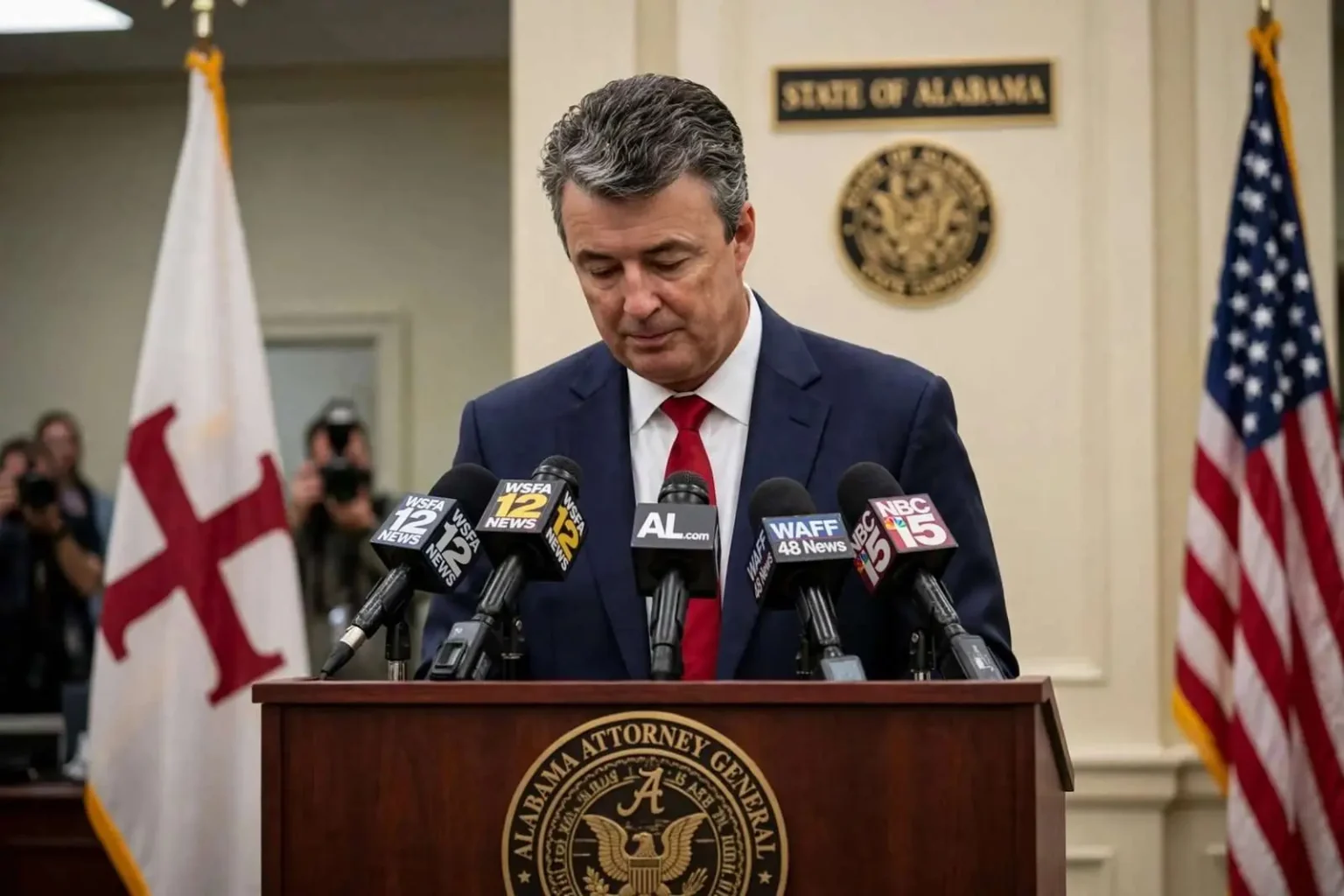
Alabama Attorney General Steve Marshall has spoken publicly for the first time about the death of his wife, Bridgette, telling reporters in Montgomery that she died by suicide after years of declining health tied to severe migraines and a subsequent dependence on opioids. Speaking four days after her death, Marshall became emotional as he described the family’s loss and pushed back against what he called reckless reporting about the circumstances surrounding it, saying his wife was not a public figure and deserved privacy in death as she did in life.
According to the attorney general, Bridgette developed an addiction to fentanyl while battling chronic migraines, and later struggled with major depressive disorder and anxiety. Her health decline, he said, unfolded over a long period, with the medication that was meant to manage her pain ultimately contributing to a dependence that reshaped the course of her life. He said she had moved out of Alabama shortly before her death because she feared her private health struggles would become public knowledge, a concern that weighed heavily on the family as she sought treatment away from the state where her husband holds statewide office.
A private struggle behind a public career
Marshall, who has served as Alabama’s attorney general since 2017, built much of his public profile on aggressive enforcement work, including the state’s litigation against opioid manufacturers and distributors and his office’s participation in settlement negotiations that have directed hundreds of millions of dollars toward abatement efforts in communities hit hard by addiction. That professional record, he told reporters, has always been intertwined with a personal commitment that most Alabamians never saw.
“Professionally, you hear me talking about opioids, it’s personal,” Marshall said. The remark punctuated a statement in which he made clear that the fight against opioid abuse in Alabama is not an abstract policy issue for his family but a burden they have carried firsthand. He noted that his office’s enforcement work on opioids and his involvement in recovery ministries are deeply personal to him, and that the loss of his wife has only deepened that conviction.
The attorney general did not take questions after delivering his statement. He asked that his wife be remembered for what she did for others rather than for the circumstances of her death, and he thanked Alabamians who had offered prayers and support to the family in the days following the loss.
Migraines, medication and the path to dependence
The account Marshall offered traces a pattern that addiction specialists have documented across the country: a legitimate medical condition, treated with powerful prescription painkillers, that gradually gives way to dependence. Fentanyl, a synthetic opioid far more potent than morphine, has driven a large share of overdose deaths nationwide, and public health officials in Alabama and across the Gulf Coast have repeatedly warned about its spread beyond the illicit market and into the lives of patients who first encountered opioids through prescriptions for chronic pain.
Chronic migraine is among the most disabling of common neurological conditions, and patients who suffer frequent, severe episodes can spend years cycling through treatments in search of relief. That search, over an extended period, can expose them to escalating doses and to combinations of medications that carry a serious risk of physical dependence. Marshall’s description of his wife’s decline underscored how a condition that begins as a matter of pain management can compound into depression and anxiety, further isolating the person who is suffering.
Privacy concerns and the burden on families
Marshall’s decision to move his wife out of Alabama before her death highlighted a dilemma familiar to many families in the state: the difficulty of seeking treatment privately in a place where one member of the household is a well-known public official. He said his wife feared that her health struggles would become public, and the family’s subsequent experience with reporting on her death convinced him that the concern was justified. In his statement, he drew a firm line between his own public role and the private life of his family, arguing that a spouse who never sought office or publicity should not be subjected to speculation about her most difficult moments.
Advocates for suicide prevention have long emphasized that how a death is discussed matters, both for the family left behind and for the broader public. Careless or sensationalized coverage of suicide has been associated with harmful effects on vulnerable readers, while careful reporting that focuses on prevention and treatment is considered best practice. Marshall’s pushback against what he described as reckless reporting placed his family’s experience squarely within that ongoing debate in Alabama newsrooms and beyond.
An office shaped by the opioid fight
Under Marshall’s leadership, the Alabama Attorney General’s Office has been among the state agencies confronting the fallout of the opioid epidemic, pursuing claims against the companies that manufactured and distributed prescription painkillers and later pressing cases connected to the flood of illicit fentanyl. Settlement funds from opioid litigation across the country have been directed toward treatment, recovery and prevention programs, and Alabama’s share of those funds has been the subject of ongoing attention from lawmakers and local officials deciding how best to spend it.
Marshall has also been involved with recovery ministries, work he described to reporters as inseparable from his personal story. Faith-based recovery programs play a significant role in Alabama’s treatment landscape, particularly in smaller communities where clinical resources are limited, and the attorney general’s participation in that world has given him a view of addiction that extends well beyond courtroom filings. His statement made clear that both strands of that work, the legal and the pastoral, will carry added meaning for him after his wife’s death.
For residents of south Alabama, the episode is a reminder of how widely the opioid crisis reaches, cutting across geography, profession and circumstance. Public health officials in Mobile, Baldwin and the state’s rural counties have spent years warning that dependence often begins not on a street corner but in a medicine cabinet, after an injury or a chronic pain diagnosis, and Marshall’s account of his wife’s decline followed exactly that trajectory.
Help is available around the clock
Marshall’s statement closed with an acknowledgment that many families in Alabama are living through versions of the same ordeal. If you or someone you know is struggling, help is available. In the United States, call or text 988 to reach the Suicide and Crisis Lifeline, free and confidential, at any hour. The lifeline connects callers with trained counselors at crisis centers in Alabama and nationwide, and it serves people experiencing suicidal thoughts, emotional distress, substance use concerns or any other kind of mental health crisis, whether the crisis is their own or that of someone they love.
Health officials also encourage residents to talk openly with family members and physicians about pain management and mental health, to store prescription opioids securely, and to dispose of unused medications promptly. Those steps, along with early treatment for depression and anxiety, are among the practical measures that communities across the Gulf Coast continue to promote as they confront a crisis that, as the state’s attorney general now knows more personally than most, can touch any household.
The attorney general asked for privacy as his family grieves and requested that Bridgette be remembered for what she did for others — a request that, in the end, framed both the grief of the statement and the resolve behind it.
What the statement means for the state’s opioid agenda
Observers in Montgomery noted that the attorney general’s personal revelation comes at a moment when Alabama is still deciding how to deploy the opioid settlement money flowing into state and local coffers, and when lawmakers continue to debate treatment access, particularly in rural counties where options for people in crisis remain thin. A statewide officeholder describing his own family’s experience with fentanyl dependence, depression and suicide is likely to give additional weight to those conversations, whatever policy directions ultimately emerge.
The episode also illustrates the scope of the crisis in Alabama, where coroners and health officials have reported fentanyl involved in a large share of overdose deaths in recent years, and where awareness campaigns have urged residents to carry naloxone, the nasal spray that can reverse an opioid overdose. While naloxone addresses overdose rather than the underlying dependence, its wide distribution has become a centerpiece of harm reduction efforts in Mobile County and across the state, promoted by health departments, courts and community groups alike.
Recovery advocates say stories like the one Marshall told are among the most effective tools for reducing the stigma that keeps people from seeking help. When a family of prominence acknowledges that addiction and mental illness reached into its own home, the calculus changes for neighbors, coworkers and church members who have been suffering quietly. That, in turn, is part of the reason Marshall chose to speak at all, four days after a loss that might have remained private if not for the reporting he pushed back against.
For now, the attorney general’s office continues its enforcement docket, and Marshall continues the recovery ministry work he described as deeply personal. Both, he indicated, will proceed with a sharpened sense of purpose. His wife, he said, should be remembered for what she did for others — and the statement he delivered in Montgomery was, in its own way, an effort to make sure that memory outlasts the circumstances of her death.
Anyone in Alabama seeking help for themselves or a loved one can call or text 988 at any hour, and local health departments, hospitals and recovery ministries across the Gulf Coast can connect residents with treatment options closer to home.