Alabama and Mobile County see tourism gains in 2017
Alabama's travel industry grew by $1 billion in 2017, with Mobile County up about 8 percent and the Gulf Coast leading the state in tourism revenue.
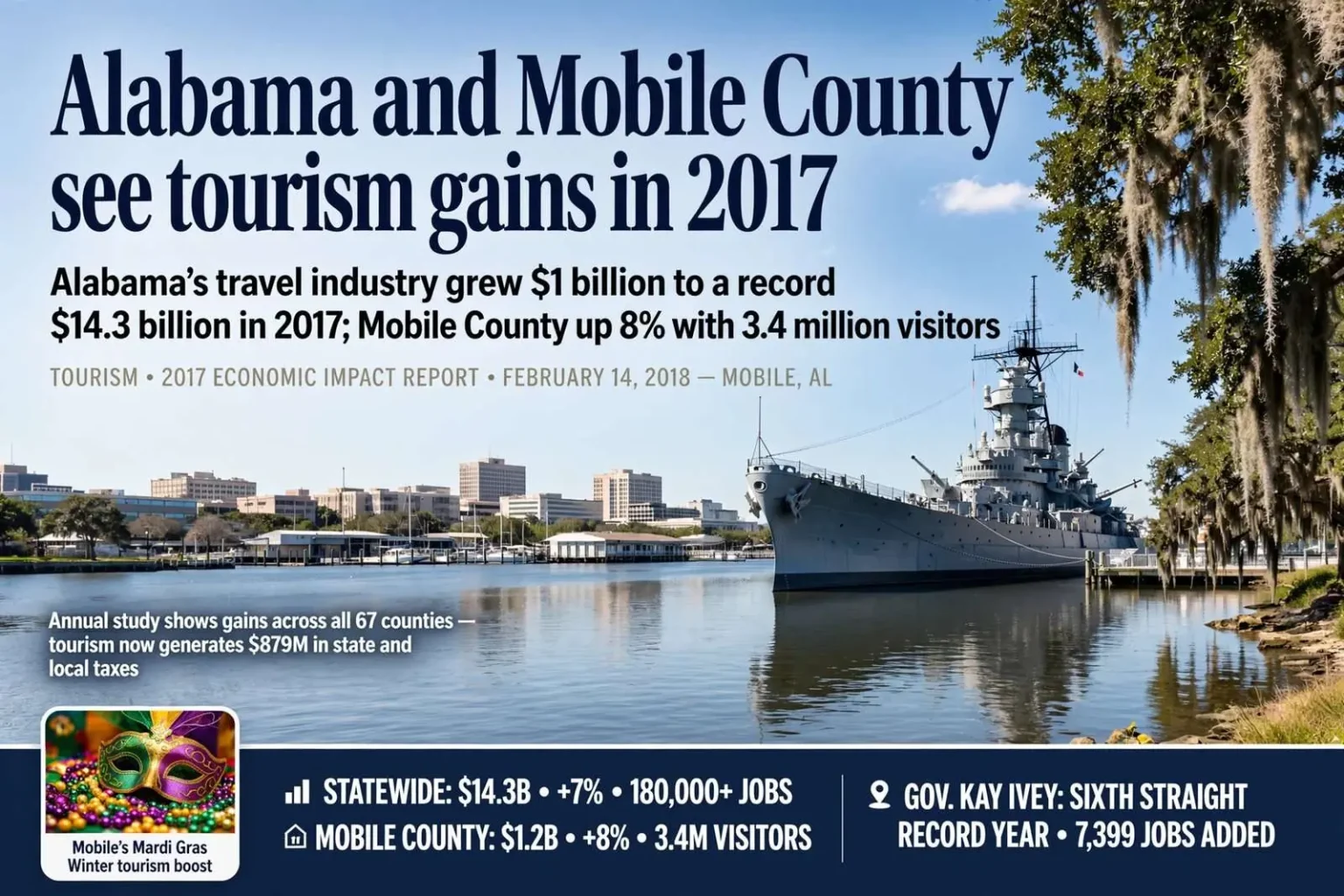
Alabama’s travel industry grew by $1 billion in 2017, and Mobile County posted similar gains of roughly 8 percent, Gov. Kay Ivey announced Tuesday. Tourism brought a record $14.3 billion to the state last year — a 7 percent increase — and added 7,399 jobs in a sector that now employs more than 180,000 Alabamians.
“Every part of the state saw dramatic growth, from the beautiful mountains of the Tennessee Valley to the stunning white sand beaches along the Gulf Coast,” Ivey said. The announcement, made as the state’s tourism industry gathered to review the year’s numbers, marked the sixth straight record for Alabama travel spending and confirmed the sector’s place among the state’s largest employers.
The figures came from the annual economic impact study the state commissions each year, which tracks visitor spending, employment and tax revenue across all 67 counties. The 2017 results showed growth not just at the state’s headline destinations but across the map — a point Ivey emphasized in crediting everything from North Alabama’s mountains to the beaches of Baldwin County.
Mobile County’s gains
In Mobile County, tourism grew about 8 percent as an additional 178,770 visitors pushed the total to 3.4 million people who spent $1.2 billion in the area — the fourth-highest tourism revenue among Alabama counties, behind Baldwin, Jefferson and Madison. The county’s tourism economy draws on a mix of attractions few counties can match: the historic districts of downtown Mobile, the USS Alabama at Battleship Memorial Park, Bellingrath Gardens, the Gulf Coast’s carnival season and a sports events calendar that fills hotels across the city.
Baldwin County, with Gulf Shores and Orange Beach, saw some of the highest economic activity in the state. Spending from 6.4 million guests added an estimated $4.4 billion to the local and state economy. The beach communities’ gains dwarfed every other county’s in raw dollars, as they have for years — Baldwin’s beaches function as the state’s tourism engine, drawing visitors from across the Southeast through the summer season and increasingly in the shoulder months.
Mobile County Commission President Connie Hudson said she has long preached the value of investing in sports tourism, museums and annual events like Mobile’s Mardi Gras. The county’s approach has treated attractions as assets that pay dividends: every event booked, every museum visitor and every tournament team filling hotel rooms translates directly into lodging taxes, restaurant sales and jobs that do not depend on a single industry.
The 3.4 million visitors who came to Mobile County in 2017 found a destination that had spent years building its case. The city’s Mardi Gras celebration — the oldest in the country — anchors the winter calendar, while the USS Alabama, the GulfQuest maritime museum and the RSA attractions downtown give visitors reasons to stay more than a day. Mobile’s convention business and its sports tournaments fill hotels on the same calendar the beach traffic next door peaks, making the two counties complementary rather than competing.
State Tourism Director Lee Sentell said the 2017 gains were the largest since the 2010 BP oil spill. The reference pointed to the Deepwater Horizon disaster, which battered Gulf Coast tourism in the summer of 2010 and required years of marketing recovery across Baldwin and Mobile counties. Seven years on, the industry had not merely recovered from that damage — it had climbed to records that dwarfed the pre-spill baseline, a recovery Sentell’s agency tracked through every annual study since.
What the numbers mean
A study by Montgomery economist Keivan Deravi estimated the hospitality industry generated $879 million in state and local taxes, and that without it each Alabama household would have paid $467 more in taxes to maintain current services. That framing — tourism as a tax offset, not just an industry — has become the standard argument state and local officials make for funding attractions, welcome centers and marketing.
The 7,399 jobs added in 2017 pushed the industry’s statewide employment past 180,000 Alabamians, a workforce spread across hotels, restaurants, attractions, event venues and the businesses that serve them. Tourism employment is often a first rung on the job ladder for young workers and a mainstay in small towns where few other industries employ at scale, which gives the sector’s growth a reach that headline spending figures understate.
Deravi, an Auburn University Montgomery economist who has produced the state’s tourism impact study for years, calculates those tax figures by tracing visitor spending through the economy — rooms, meals, fuel, retail — and measuring what state and local governments collect as a result. The per-household figure is the study’s most quoted number, translating billions of dollars into what every Alabama family would otherwise pay.
Regional geography of the growth
The county rankings in the 2017 study mapped the state’s tourism geography plainly. Baldwin County’s $4.4 billion from beach traffic led the state, followed by the metro economies of Jefferson County — anchored by Birmingham’s business and convention travel — and Madison County, where Huntsville’s attractions and events drive a steady visitor base. Mobile County’s $1.2 billion in fourth place reflected a destination whose strengths are concentrated in a historic downtown, a waterfront and a festival calendar rather than a beach.
That distribution is why state tourism officials talk about Alabama’s industry as a portfolio. The Gulf beaches draw multi-night family vacations from across the region; Birmingham and Huntsville draw business travelers, conventions and sports events; and Mobile leverages history, carnival season and the bay. Growth in one part of the state does not come at another’s expense — the 2017 numbers showed gains everywhere, which officials read as the industry lifting together rather than trading visitors among counties.
For south Alabama specifically, the two-county cluster matters. Visitors who come for Gulf Shores and Orange Beach pass through or alongside Mobile, and the city’s attractions convert some of that traffic into overnight stays. The roughly 8 percent growth Mobile County recorded in 2017 slightly outpaced the state’s 7 percent, suggesting the county’s investments in events and attractions were holding their own against the beach next door.
Sports tourism and the investment case
Hudson’s emphasis on sports tourism pointed to one of the fastest-growing parts of the industry nationwide. Youth and amateur sports tournaments — baseball, softball, soccer, volleyball — send traveling families into hotels and restaurants on weekends that would otherwise run thin, and communities across south Alabama have competed for those events by building fields and courting organizers. The strategy treats tournaments as repeatable, bookable economic events, more predictable than one-time festivals and easier to schedule around the off-season.
Museums and annual events play the same role in different months. Mobile’s Mardi Gras season fills downtown hotels and restaurants in the winter lull, Bellingrath Gardens draws its crowds across the Christmas season with Magic Christmas in Lights, and Battleship Memorial Park brings school groups and veterans’ reunions year-round. The pattern behind all of it is the one Hudson described: build and maintain attractions, market them, and let the visitor dollars follow.
The 2017 record gave that argument its strongest evidence yet. A $14.3 billion industry paying $879 million in state and local taxes while employing one in every 23 or so working Alabamians is not a side business, and the state’s tourism leadership framed the year’s numbers exactly that way — as proof that the money invested in the sector comes back, county by county, including the $1.2 billion spent in Mobile County and the 8 percent growth its officials have spent years working toward.
The recovery from 2010
Sentell’s comparison to the BP oil spill gave the 2017 record its historical weight. The summer of 2010 was catastrophic for Gulf Coast tourism: beaches emptied, fishing charters and charter boats sat idle, and cancellations rippled through Baldwin County’s rental market even where oil never came ashore. Perceptions of oiled water reached further than the oil itself, and recovery required sustained marketing to convince visitors the beaches were clean and open.
The rebound took years. Settlement money funded advertising campaigns aimed at the drive-in markets that supply most of Alabama’s beach traffic, and the state leaned on events and sports tourism to diversify the appeal beyond the sand. By 2017, the annual study showed the industry at $14.3 billion — roughly double the levels of the years before the spill’s damage, though officials cited the comparison more carefully as “largest gains since” rather than a simple doubling of any single year.
The lesson state tourism officials drew from those years shaped the sector’s strategy afterward: diversify. Beach-only tourism is vulnerable to a single event — a spill, a hurricane, a red tide — while a portfolio of conventions, sports tournaments, museums and cultural events spreads the risk. Mobile County’s growth pattern reflected exactly that diversification, and the county’s 8 percent gain in a record year showed the strategy working.
A record with room to run
Officials announcing the numbers noted that the streak of record years had become the industry’s normal — each annual study outpacing the last as population growth in the Southeast, cheap fuel and a strengthening economy pushed more travelers onto Alabama’s roads and into its hotels. The question each year is no longer whether the record falls but by how much, and 2017’s $1 billion increase was among the largest single-year jumps the study had recorded.
For Mobile County, the 2017 figures set the baseline the city’s tourism office would measure future years against: 3.4 million visitors, $1.2 billion in spending and a fourth-place statewide ranking behind counties with either beaches or big-city convention markets. The county’s tourism officials treated the number as validation of the strategy Hudson described — investing in what brings people, from tournaments to museums to Mardi Gras — and the governor’s announcement gave the region’s effort a statewide platform.
The growth also reinforced the connection between tourism and the quality of life residents experience. The attractions that draw visitors — parks, museums, festivals, clean beaches, a functioning riverfront — are the same amenities residents use every day, which is why tourism investment tends to enjoy broad local support in communities like Mobile. The record year funded that argument: every visitor who spent money here in 2017 helped pay for something locals still use when the visitors go home.