Alabama Anglers Face Another Nine-Day Federal Red Snapper Season in 2016
NOAA has set another nine-day federal recreational red snapper season for 2016, drawing criticism from U.S. Rep. Bradley Byrne, even as Alabama's own state waters will stay open to anglers for 66 days.
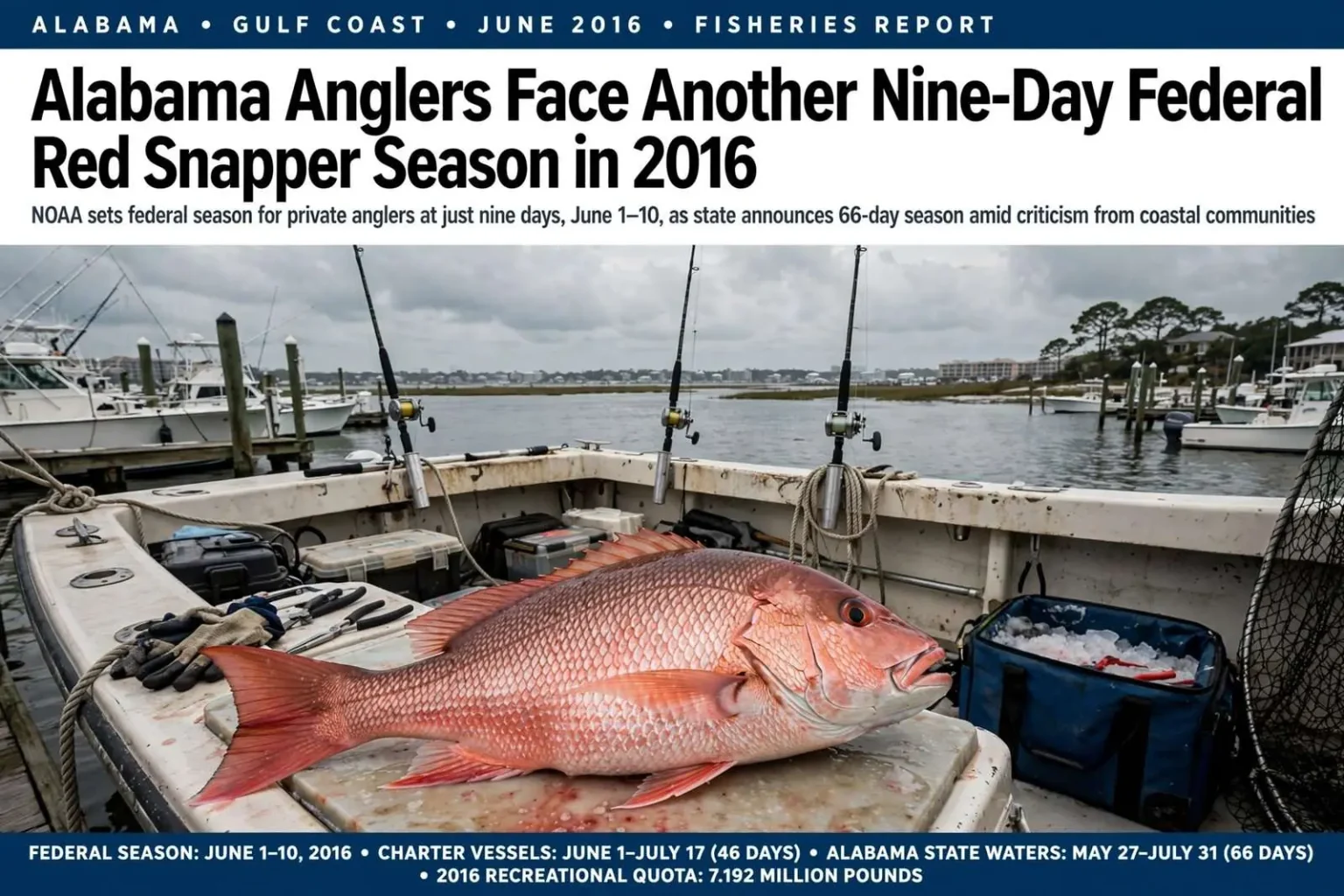
Recreational anglers along the Alabama Gulf Coast will again have only nine days to catch red snapper in federal waters this year, a decision announced by the National Oceanic and Atmospheric Administration that has drawn sharp criticism from the state’s congressional delegation and coastal fishing communities. Under the new rule, the private angling and recreational sector will be allowed to fish for red snapper in federal waters beginning June 1 and ending at 12:01 a.m. on June 10, 2016. Charter boats holding federal permits will have a considerably longer window, with a 46-day season running from June 1 through July 17.
The shortness of the federal season has become, for the fishing towns that line the Alabama coast, the defining grievance of the red snapper fishery. Orange Beach, Gulf Shores, Dauphin Island and the charter fleets that operate out of them were built in significant part on the snapper fishery — the structure-heavy waters off Alabama hold one of the densest concentrations of artificial reefs in the Gulf of Mexico, and red snapper gather around those structures in numbers that made the species the backbone of the recreational offshore catch. A nine-day window compresses that entire year of business into a single long weekend’s worth of federal opportunity, forcing families, weekend anglers, and visiting tourists into the same narrow slice of the calendar.
How the 2016 Season Was Set
The announcement follows more than a year of legislative pressure from Gulf Coast lawmakers, including U.S. Rep. Bradley Byrne, who have pushed to give Gulf states more authority over setting season lengths and monitoring the size and health of the red snapper population, rather than leaving those decisions solely to federal regulators. Along with the season dates, NOAA Fisheries approved a final rule reallocating how the overall snapper quota is split between commercial and recreational fishermen.
The allocation had previously favored the commercial sector 51 percent to 49 percent, but the new split shifts the balance in favor of recreational anglers, 51.5 percent to 48.5 percent. Federal officials said the change reflects updated data on the Gulf’s red snapper population gathered during the 2014 season that better accounts for the recreational fishery’s actual catch history. The shift was modest — a change of about two and a half points in either direction — but it carried symbolic weight in a fishery where the commercial and recreational sides have spent years contesting not just their shares of the quota but the underlying science used to divide it.
NOAA also released updated poundage quotas for the next two fishing years. The commercial quota is set at 6.768 million pounds for 2016, dropping slightly to 6.664 million pounds in 2017. The overall recreational quota was set at 7.192 million pounds for 2016 and 7.076 million pounds for 2017, with the private angling portion of that total set at 4.150 million pounds this year and 4.083 million pounds next year.
Those poundage figures are the arithmetic that produces the short season. Federal managers divide the recreational quota by their estimates of how quickly the fleet catches fish, and when the resulting number of fishing days comes out small, the calendar comes out small. The tension in the Gulf snapper fishery has always lived inside that calculation: the quota itself is not dramatically short of what the fleets want to catch — the disagreement is over how fast the fish are being caught, and over whether the surveys and models used to estimate the population reflect what anglers and researchers actually see on the water.
Congressional Reaction: ‘A Disgrace’
Seth Morrow, communications director for Byrne’s office, said the congressman was deeply frustrated by the announcement and remains convinced that Gulf states, not the federal government, should be responsible for setting red snapper seasons. Byrne himself was more blunt in his reaction, calling a nine-day season “a disgrace for Alabama’s fishermen.”
“This type of ‘derby-style’ season poses serious challenges and puts the safety of our fishermen at risk,” Byrne said. “There are plenty of red snapper in the Gulf, but the federal government continues to do a terrible job counting the number of fish as well as the number caught each year.”
Byrne’s frustration traces back to legislation passed in the U.S. House last June that would reauthorize the Magnuson-Stevens Act, the federal law governing fishery management in offshore waters. That measure included reforms authored by Byrne intended to shift more red snapper decision-making authority to Gulf states. The bill, H.R. 1335, has passed the House but remains stalled in the Senate.
The Magnuson-Stevens Act, first enacted in 1976 and reauthorized repeatedly since, is the framework under which the eight regional fishery management councils — including the Gulf of Mexico Fishery Management Council, whose members are drawn from the Gulf states — set catch limits, seasons, and allocation splits for federally managed species. Alabama’s delegation has argued for years that the council structure, whatever its merits for wide-ranging commercial stocks, fits poorly with a species like red snapper: the fish concentrate near fixed reefs close to shore, the states have their own reef programs and data collection, and anglers’ access decisions are best made by the governments that manage the nearshore waters where most of the fleet actually fishes.
The derby-style complaint Byrne raised is a practical one as much as a philosophical one. When thousands of boats know they have only a handful of days, the fishing grounds fill to capacity at once — ramps congest before dawn, boats stack up over the same reefs in weather that may or may not cooperate with the fixed dates, and catch rates spike as everyone fishes simultaneously. Safety officials and charter operators have long argued that a short, fixed season concentrates risk in a way a longer, more flexible season would not, and that a family caught sixty miles offshore when the season expires at 12:01 a.m. faces real consequences from fish that cannot simply be released legally without penalty.
Alabama’s Own, Longer Season
While the federal season remains short, anglers fishing in Alabama’s state waters will have far more opportunity to catch red snapper this year. Chris Blankenship, director of the Marine Resources Division within the Alabama Department of Conservation and Natural Resources, said the state season will run 66 days, opening May 27 and continuing through the end of July.
Blankenship said the longer state season was approved by Conservation Commissioner Gunter Guy based on years of research conducted in partnership with the University of South Alabama, which has found a substantially larger snapper population off Alabama’s coast than federal estimates suggest.
“We’ve been funding some research with USA for several years, and as part of that research Dr. Sean Powers estimates Alabama has around 20 million pounds of red snapper off the coast,” Blankenship said. “The landings for last year were right at a million pounds, and that leaves plenty of snapper in the water for us to support a season longer than nine days.”
The gap between those figures and the federal accounting is the heart of the dispute. University of South Alabama researchers have spent seasons conducting surveys of the reefs off the Alabama coast — counting fish on known structures with acoustics, cameras and sampling — in work that state officials say gives a far more direct measurement of the resource than the models federal managers rely on. If the population off Alabama really stands near 20 million pounds while the state’s annual landings run about a million, the argument runs, the federal season-length math is built on a foundation that understates both the size of the stock and the pace at which Alabama’s share of it is being taken.
Alabama’s state waters extend from the coastline out to nine miles into the Gulf of Mexico, a relatively narrow band compared to the deeper federal waters where most of the region’s artificial reefs are located. Blankenship acknowledged that state waters have fewer reefs than the federal zone farther offshore, but said the extended season still gives both recreational and commercial fishermen more opportunity to fish in the areas available to them.
“That’s why we think a season through July 31st is appropriate,” Blankenship said. “We’re not trying to keep it open year-round or anything like that, but we do think a season that length is commensurate with the resources we have available.”
The reef geography matters to how anglers use the state season. Alabama’s artificial reef program, one of the oldest and largest in the nation, has for decades deployed and permitted structures from the nearshore zones out to the edge of the continental shelf — pyramids, bridge materials, culverts, ships and the legacy oil and gas platforms that have been converted to reef habitat under the rigs-to-reefs concept. The densest of those structures sit in federal water, but the state zone holds a meaningful share, and nearshore snapper fishing in state water is accessible to the smaller center-console boats that make up most of the private fleet — vessels that cannot safely or economically run to the far-offshore structures on every trip.
A 66-day state season compared with a nine-day federal one also changes the character of the fishery rather than merely its length. Spread across two months, the state season lets anglers pick their weather, take visiting family members out in July as well as the end of May, and spread harvest pressure across the calendar — the opposite of the derby effect federal managers’ short season creates. Charter operators, meanwhile, face a split system: their federally permitted vessels can carry clients into federal water only during the 46-day federal charter season, while the same boats can work the state zone for the full 66 days, giving the for-hire fleet a longer commercial runway than the private-boat sector enjoys in federal water.
An Annual Flashpoint
The debate over red snapper season length has become an annual flashpoint along the Alabama coast, pitting federal fishery managers against state officials, university researchers and charter boat operators who argue the Gulf’s snapper population has rebounded far more than federal data reflects.
Red snapper were declared overfished in the Gulf decades ago, and the rebuilding plan that followed — with its shrinking seasons and hard quotas — predates much of the stock’s apparent recovery. Anglers and coastal businesses describe a fishery in which snapper are caught as quickly as baits can be dropped, a sign, they argue, of abundance that the catch-rate models used in federal assessments can misread. Federal managers respond that rebuilding obligations written into law bind them to the assessment numbers, whatever the dockside impressions may say, and that exceeding quotas even modestly forces compensating cuts in future years.
With H.R. 1335 still pending in the Senate, state officials and Gulf Coast lawmakers say they will continue pressing for a longer-term fix that would give Alabama and its neighboring Gulf states more direct control over the fishery in the years ahead. Until that sort of restructuring passes, the Gulf Coast expects the same rhythm it has come to dread each spring: a federal season announced in short days, a state season announced in long ones, and a fishery whose two halves disagree about how many fish are actually in the water.