Shrimp Festival Refund Dispute: First-Time Vendor Out $3,200 After Isaias Cancellation
Sweet Love ice cream owner Maggie Funk says she lost about $3,200 in booth fees when Hurricane Isaias canceled the National Shrimp Festival and was offered no refund or credit. Organizers say the vendor contract does not allow booth-fee refunds.
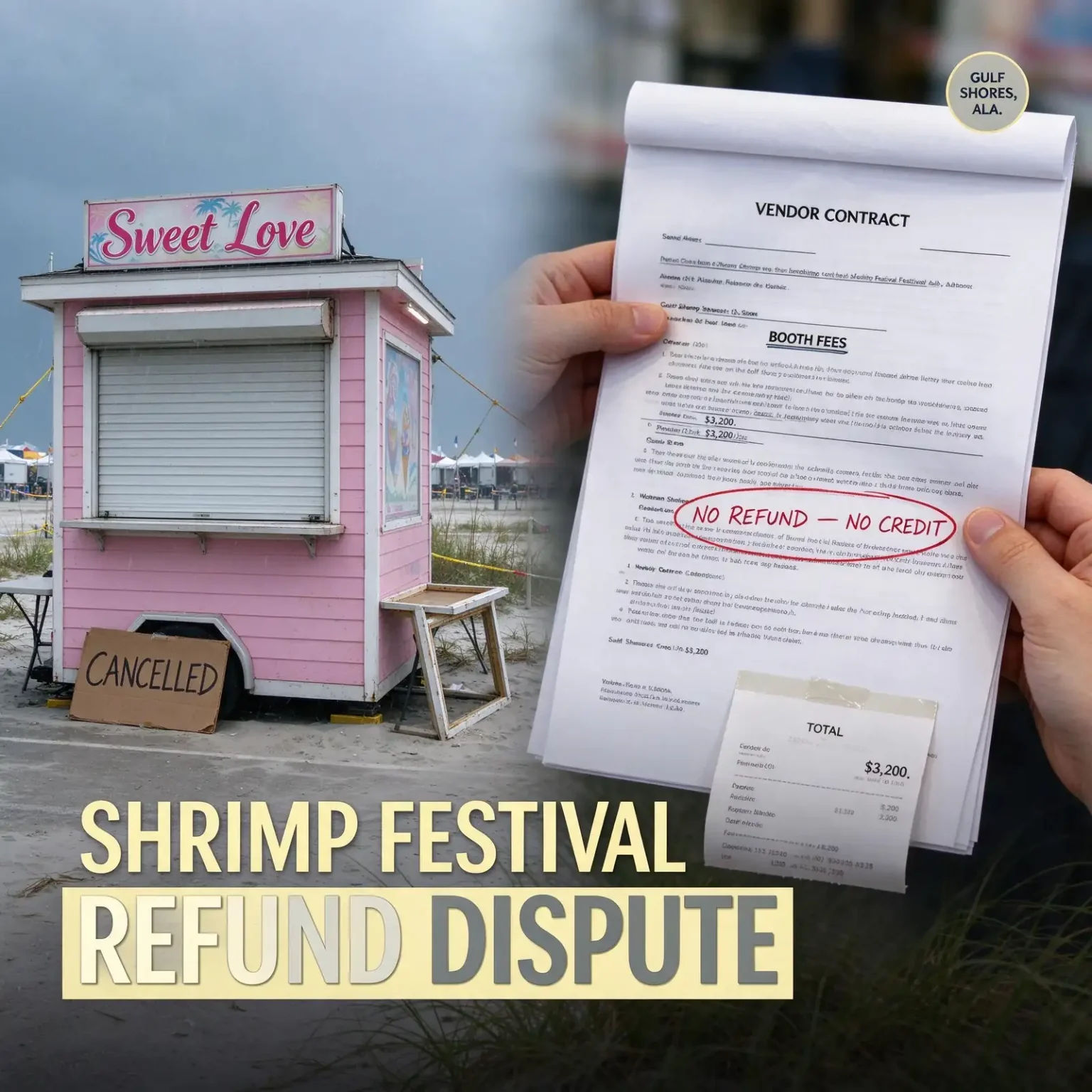
GULF SHORES, Ala. — A first-time vendor is questioning the National Shrimp Festival refund policy after Hurricane Isaias forced organizers to cancel this year’s event, leaving her out roughly $3,200 in booth fees with no refund and no credit toward next year.
Maggie Funk, who owns the ice cream business Sweet Love, said nothing about the experience felt sweet. She was one of more than 200 vendors who were about 24 hours away from opening when the 53rd annual festival was called off as the storm approached the northern Gulf Coast.
A vendor’s first festival, canceled a day out
Funk has been in business for four years, and this year would have been her first time selling at the Shrimp Festival in Gulf Shores, one of the largest and best-known events on the Alabama coast.
“Our fees totaled, I think, $3,200,” she said, “a little bit more when you have to pay for the licensing.”
The four-day festival had been scheduled for Oct. 8–11 on the Gulf Shores public beach. Organizers canceled it on Wednesday, Oct. 7, as forecasts showed Isaias heading toward the coast. The storm went on to make landfall near Destin, Florida, as a hurricane on the night of Oct. 9. Gulf Shores and Orange Beach were spared the worst of the damage, but a mandatory evacuation order for visitors and temporary bridge closures disrupted what would have been festival weekend.
Funk said she understood that refunds were not guaranteed. What frustrated her was the lack of any gesture at all.
“I never expected I would get a full refund; I wasn’t even sure if I would get a partial refund,” Funk said. “But what I did expect was a discount or a credit towards next year; that would have cost them zero to do.”
Organizers point to the vendor contract
At the time of the cancellation, the decision itself drew wide understanding. “It’s just not safe, and everybody’s got to do the prep to get out of here. So it makes good sense,” Terry Rinehardt said on the day the festival was called off. Steve Jones described it shortly afterward as “one of the hardest decisions we have ever had to make.”
On refunds, however, organizers have held firm. In a written statement, they said in part that the vendor contract does not allow booth fees to be refunded.
“These fees are the basis for us to be able to pay production costs that allow us to launch the festival,” organizers said.
A festival of this scale requires large up-front spending on staging, tents, security, sanitation, infrastructure and entertainment, much of which is committed well before opening day. When an event is canceled at the last minute, many of those costs have already been incurred.
A dispute over the contract’s language
Funk said she read the agreement differently, arguing that it contains provisions that point in opposite directions.
“The contract did say, ‘rain or shine,’ ‘Acts of War,’ they’re not responsible,” Funk said. “But it also said, and it’s a contradiction, that if they have to cancel, the contract is null and void.”
Clauses like the ones Funk described are common in event and vendor agreements. A “rain or shine” provision generally means an event will go on despite bad weather and that vendors accept that risk. A force majeure clause, which often lists events such as natural disasters, acts of war or government orders, typically excuses one or both parties from their obligations when something beyond their control prevents performance. How those provisions interact, and what happens to money already paid, depends on the specific wording of each contract.
The full text of the festival’s vendor contract was not made public, and organizers did not address Funk’s interpretation in their statement.
Some fees returned, but not booth fees
Funk said she is receiving refunds for her parking fees and her temporary business license. The booth fees, which made up the bulk of her costs, will not be returned.
She said she will not return to the festival, and that even a small gesture would have changed how she felt about the experience.
“It wouldn’t have cost them anything but an act of goodwill to say, we are all in this together, together we weather, we’re in this together, and we are going to give you 10 percent, 15, 20 — anything is better than ‘too bad, so sad, hope you can join us next year.'”
A financial blow for the chamber, too
Vendors were not the only ones hurt. The National Shrimp Festival is the main fundraiser for the Coastal Alabama Business Chamber, which organizes the event, and the chamber said it also took a tremendous financial hit from the cancellation.
The festival dates to the early 1970s, when local business leaders created it to extend the tourist season past summer and celebrate the area’s seafood heritage. It typically draws more than 300,000 people and features hundreds of arts, crafts and food vendors, live music and a children’s area. This year’s cancellation is the third in recent years; the festival was also called off in 2020 and 2021 because of the COVID-19 pandemic. Organizers have said the event will not be rescheduled this year.
Since the cancellation, the chamber has encouraged shoppers to support vendors by browsing the festival’s vendor directory on its Eventeny page, which includes contact information, websites and, in some cases, products available for purchase. Official festival merchandise is available at the chamber’s office at 3130 Gulf Shores Parkway.
Others in the community have stepped in as well. Merchants in Gulf Shores’ Waterway Village are hosting a Shrimp Festival Art Walk Pop-up on Saturday, Oct. 24, from 11 a.m. to 6 p.m., giving artists who lost the festival weekend a chance to sell their work at neighborhood businesses.
What vendors can learn from the cancellation
For small businesses that depend on festivals, the Shrimp Festival cancellation is a reminder of how much risk vendors carry when severe weather threatens. Business advisers commonly suggest that vendors:
- Read cancellation and refund terms closely before signing, paying particular attention to “rain or shine,” force majeure and cancellation clauses.
- Ask organizers directly what happens to booth fees if the event is canceled by weather or other causes, and get the answer in writing.
- Look into insurance options, such as event cancellation or business interruption coverage, that may help offset losses.
- Keep careful records of fees, licenses, inventory and other expenses tied to each event.
- Plan for perishables. Food vendors may want a plan for selling or storing inventory if an event is canceled on short notice.
For Funk, the lesson has already been learned the hard way. Her Sweet Love ice cream will not be part of the Shrimp Festival lineup in the future.