
Alabama Attorney General Indicts Mobile Homicide Detective On Tax Charges
Mobile Police homicide detective Donald Pears was indicted on federal tax charges by the Alabama Attorney General's Special Prosecutions Division.
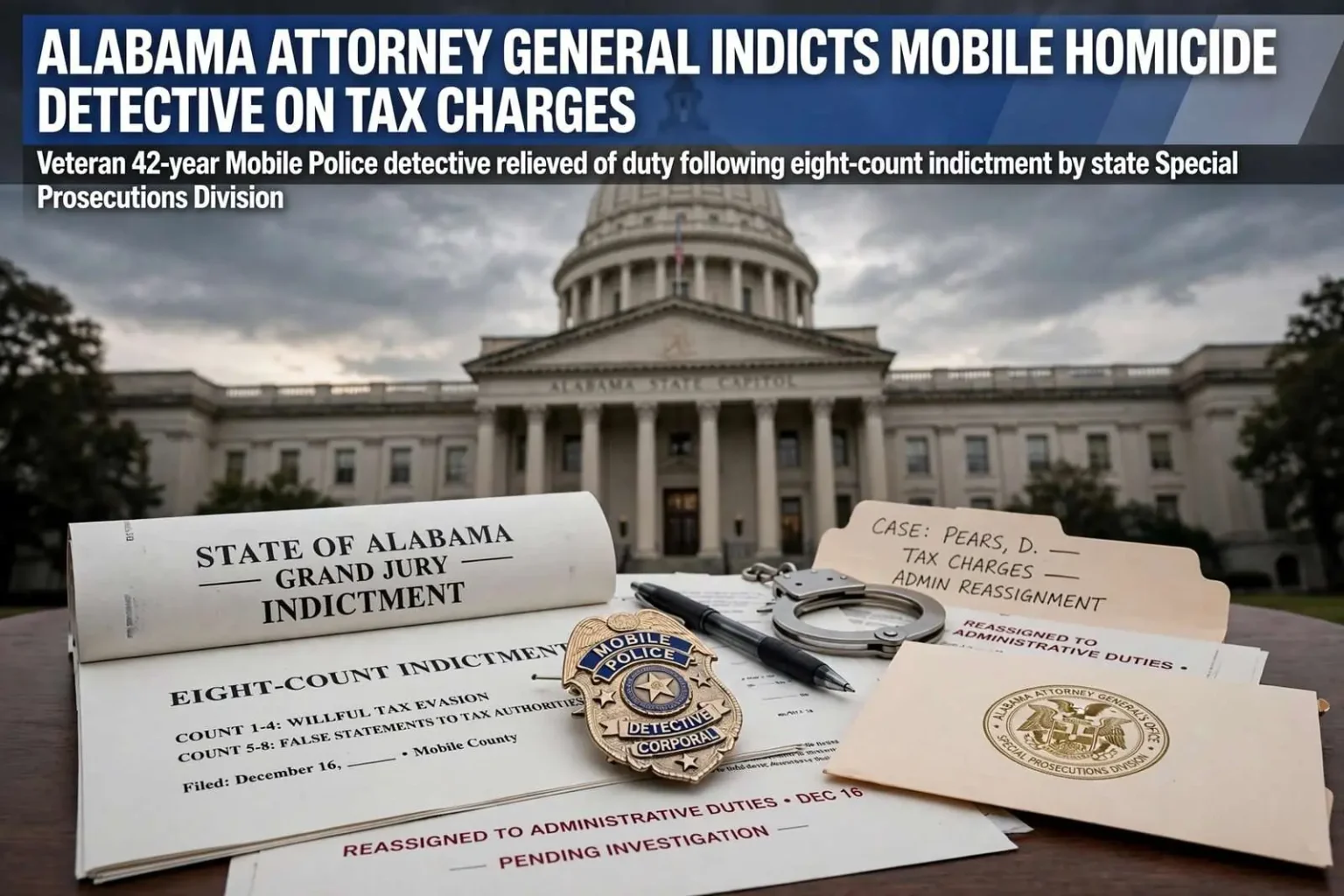
A veteran Mobile police homicide detective has been indicted on federal tax charges, the Alabama Attorney General’s Office announced Monday. Cpl. Donald Pears, who has spent more than 42 years with the Mobile Police Department, was relieved of duty Dec. 16 after a Mobile County grand jury returned an eight-count indictment presented by Attorney General Luther Strange’s Special Prosecutions Division.
Pears was reassigned to administrative duties pending an internal affairs investigation, according to the department. The move removes one of the department’s most experienced investigators from active casework while the criminal charge and the internal review both proceed. Homicide investigations demand continuity — cases stretch across months and depend on detectives who know their files cold — so the reassignment of a veteran corporal carries practical consequences inside the unit, whatever the ultimate outcome of the charges against him.
The Charges
The indictment accuses Pears of four counts of willfully attempting to evade or defeat taxes and four counts of willful fraud and false statements. The pairing is typical of tax prosecutions: the evasion counts allege conduct aimed at avoiding tax obligations, while the false-statement counts allege misrepresentation on returns or in dealings with tax authorities. Together the eight counts cover the alleged conduct across the period covered by the indictment, and prosecutors will have to prove each count separately for a conviction on any of them.
If convicted, Pears faces up to five years in prison and a $100,000 fine on each tax-evasion count, and up to three years and a $100,000 fine on each false-return count. Read at the maximums, the exposure is substantial — theoretically decades in prison and hundreds of thousands of dollars in fines — though sentences in tax cases typically run well below statutory maximums and depend heavily on the amounts involved, the defendant’s history, and the resolution of the case. As with any indictment, the charges are accusations, and Pears is presumed innocent unless and until proven guilty in court.
The Attorney General’s Office said it would release no further information at this time, a common posture while a case is pending. That silence leaves unanswered the questions that typically follow such an indictment: what period the alleged conduct covered, how the alleged scheme worked, and what triggered the referral in the first place. Those details, if they emerge, will come through court filings and proceedings rather than press releases.
How Such Cases Move
The case moved through a Mobile County grand jury, the panel that hears prosecutors’ evidence in secret and decides whether probable cause exists to indict. Grand jury proceedings differ sharply from trials: the defense is not present, the standard of proof is low, and the proceeding exists precisely to filter out cases that do not belong in court. An indictment is therefore a charging document, not a verdict, and it begins — rather than concludes — the criminal process.
That the Alabama Attorney General’s Office brought the case rather than a local district attorney reflects the office’s structure. The Special Prosecutions Division handles cases referred to the state’s top prosecutor’s office — often matters involving public officials, complex finances, or conflicts of interest that make local handling awkward. Tax-related prosecutions also draw on the Alabama Department of Revenue, whose agents investigate suspected tax violations and whose commissioner the Attorney General publicly thanked in this case. The combination of a grand jury, a special prosecutions unit, and revenue-agency investigators is the standard architecture for a state tax indictment of this kind.
For the department’s part, the internal affairs investigation that accompanies the reassignment runs on a separate track from the criminal case. Internal affairs reviews examine whether an officer’s conduct — whatever its criminal resolution — violated department policy, and their findings can lead to discipline independent of any court outcome. The two processes can take different lengths of time, and neither automatically resolves the other. An officer can be cleared criminally and still disciplined internally, or the reverse.
Separate Reviews Underway
The Police Department said it is also reviewing separate allegations tied to spending on trips taken by its Police Explorers program, a youth initiative that introduces teenagers to law-enforcement careers through training, ride-alongs and competitions. Reviewing spending on a program that involves fundraising, travel and adult chaperones is a bureaucratic necessity as much as an accountability measure: programs that handle money outside the department’s ordinary accounting chains are routinely audited, and trip expenses — transportation, lodging, meals — are exactly where documentation questions tend to surface. The review was described as separate from the Pears case.
The department is also conducting an inquiry into Third Precinct Commander Carla Longmire over an alleged on-duty relationship with a subordinate officer. Such inquiries fall under department conduct policies governing workplace relationships and the chain-of-command issues they can create, particularly in a precinct structure where a commander exercises direct authority over subordinates’ assignments and evaluations. The inquiry was disclosed in the same announcement as the Pears indictment but is unrelated to the tax charges, and the department did not indicate what disciplinary outcomes, if any, either review might produce.
Taken together, the three matters — the indictment, the Explorers spending review and the Longmire inquiry — amount to a demanding stretch for the department’s leadership, which must manage personnel issues across three separate units simultaneously. None of the matters involves street policing directly, but all three touch the department’s administrative integrity, and each will generate documentation that department officials, and potentially city officials, will have to respond to in time.
The People Behind the Case
Attorney General Luther Strange commended Assistant Attorney General Bill Lisenby for his work presenting the case to the grand jury. Strange also thanked Alabama Revenue Commissioner Julie P. Magee, whose department’s agents handle the investigative legwork in state tax matters, along with Assistant Attorney General and Assistant Counsel Glen Powers and the agents of the Alabama Department of Revenue who worked on the case. The acknowledgments sketch the full team behind the prosecution: the revenue agents who assembled the financial evidence, the prosecutors who framed it into charges, and the counsel who supported both.
Tax cases of this kind are built on paper. Revenue agents reconstruct income from employer records, bank deposits and financial documents, then compare what the reconstruction shows against what was actually reported and paid. The willfulness element — the word that elevates a civil tax dispute into a criminal charge — turns on intent, which prosecutors typically establish through patterns: unreported income streams, fabricated deductions, or records kept in ways that suggest concealment rather than error. That evidentiary work is slow, which is one reason tax indictments often arrive long after the conduct they describe.
What happens next in the Mobile case depends on scheduling and the defense. An arraignment will allow Pears to enter a plea, after which the case moves through motions and, absent a plea agreement, toward trial. Defense counsel in multi-count indictments routinely challenge the counts individually, seeking to have some dismissed before trial, and sentencing exposure is typically negotiated in practice even where it is statutory in theory. The timeline from indictment to resolution in a case like this can stretch well beyond a year.
What It Means for the Department
For the Mobile Police Department, an indictment of a 42-year veteran lands hard regardless of outcome. Pears spent more than four decades in the department, the last stretch of it in homicide — one of the most demanding assignments in policing, where caseloads are heavy and clearance depends on meticulous investigative work. Colleagues in the unit will absorb his cases during the reassignment, and the department will have to balance its obligation to withhold judgment against the reality that an indicted officer cannot carry normal duties while charges are pending. Administrative reassignment is the standard mechanism for that balance, keeping the officer off the street and out of sensitive assignments without prejudging the case.
The case also arrives amid broader public attention to how public employees handle tax obligations, a subject state revenue officials have emphasized in recent years. Whatever the resolution here, the structure of the case — a grand jury, a special prosecutions division, revenue-agency investigators — shows the machinery the state uses when it pursues tax charges against public figures, and it signals that employment with a government agency offers no insulation from that machinery. The Attorney General’s Office, for its part, has said it will release no further information, which means the next public developments will come from the courtroom.
For residents of Mobile, the immediate practical effect is minimal: homicide casework continues under the remaining detectives and leadership of the unit. The longer-term significance lies in the department’s personnel picture. The Explorers spending review and the Longmire inquiry will resolve on their own schedules, and the Pears case will move through the courts, but each matter represents a test of the department’s administrative processes — how it investigates itself, how it separates allegations from assumptions, and how it communicates with the public it serves. Those processes rarely make headlines when they work. They will be quietly tested over the months ahead.


