Alabama Attorney General Recuses Himself From Investigation Into Gov. Bentley’s Office
Alabama Attorney General Steve Marshall recused himself from the investigation into Gov. Robert Bentley's office, the first confirmation that the probe is.
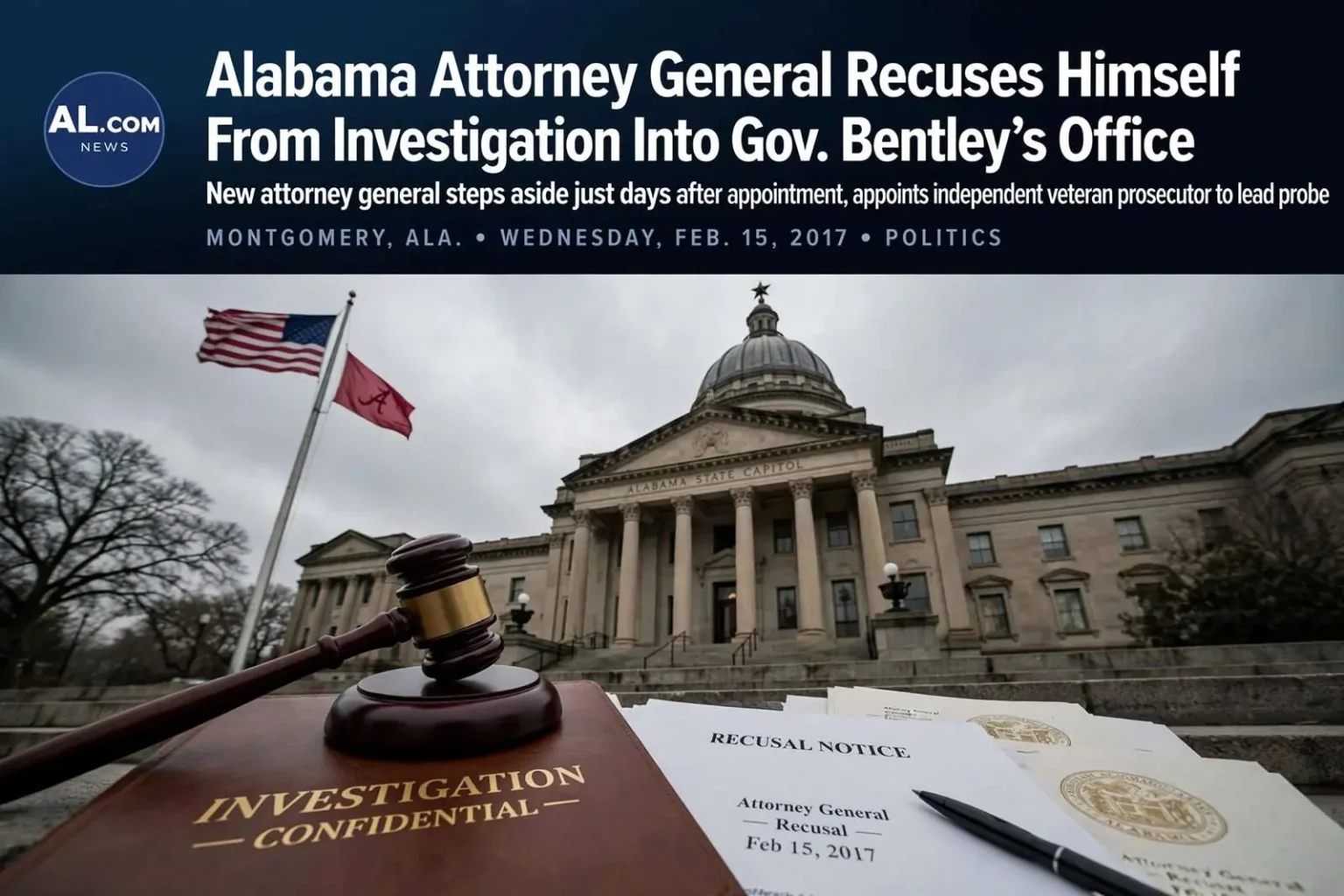
Alabama Attorney General Steven T. Marshall has stepped aside from his office’s investigation into Gov. Robert Bentley, marking the first official confirmation that an inquiry into the governor’s office has been underway. The recusal, announced in a news release Wednesday, untangled a conflict that had hung over the case since Marshall’s appointment — the attorney general confirming that the investigation exists while making clear it will not run through him.
Marshall, whom Bentley appointed to lead the Attorney General’s Office just five days earlier, said he had recused himself from the probe. The speed of the announcement was itself the story: a new attorney general, named by the very governor under scrutiny, declaring within a week of taking office that he would have nothing to do with the matter and handing it to someone with no ties to the administration.
The investigation has been the subject of suspicion since March 2016, when allegations first surfaced that the governor used state resources to facilitate an affair with former staff member Rebekah Mason. The allegations included recorded conversations and questions about the role of the governor’s security detail and state equipment, and they ignited parallel pressures on Bentley from lawmakers, ethics complaints and the press.
The recordings and the denials
Bentley has acknowledged having what he called “inappropriate conversations” with Mason, which were captured in recordings made by his ex-wife, Dianne, but has repeatedly denied a physical affair or any misuse of public funds. The recordings, first reported during the spring of 2016, transformed private speculation into public evidence of conduct, even as the governor disputed the most serious readings of what they showed.
From that point on, the question was never only personal. Whether state employees, state property or state money supported the arrangement was the part of the story that fell to investigators, and it is precisely the jurisdiction an attorney general’s office would examine. Bentley’s denials of misuse of public funds did not end the inquiry; they framed what it would have to test.
The governor’s predecessor in the U.S. Senate, Luther Strange, had also drawn questions about the matter. As attorney general before Marshall, Strange had overseen the office while the allegations mounted, and his handling of the file became part of the record. In a Nov. 3, 2016 letter to the House Judiciary Committee, Strange asked lawmakers to pause their interviews and investigation while his office completed what he described as “necessary related work,” while telling reporters his office had “never said that we’re investigating the governor.”
A veteran prosecutor takes over
Marshall said he named a veteran prosecutor to handle the matter independently. He pointed to the appointee’s 35 years with the Montgomery County District Attorney’s office, including serving as district attorney from 1993 until her 2014 retirement, calling her “an experienced prosecutor handling a variety of matters” who can “ensure that all the facts are pursued in [the] investigation.” The choice signaled an intent to insulate the inquiry from the appearance problems that had plagued it — a prosecutor with decades in Montgomery, outside the attorney general’s own chain of command.
When Bentley appointed Marshall on Feb. 10, the new attorney general said his first priority would be determining whether an investigation into the governor’s office was active, and he pledged to recuse himself if one existed. The pledge was an unusual commitment for a newly appointed official to make publicly, and it put the matter on a clock from his first day: either confirm the investigation and step aside, or explain why no inquiry existed at all.
On Wednesday, Marshall said he began that review within 48 hours of taking office, and that his decision “fulfilled [his] commitment to the people of Alabama.” The statement closed the loop on the pledge, and it drew notice in Montgomery for how directly it acknowledged what his predecessor would not: that an investigation into the governor’s office was, in fact, active.
The recusal also resets the relationship between the attorney general’s office and the Legislature’s own inquiry. The House Judiciary Committee has been weighing whether the governor’s conduct constitutes grounds for impeachment, and lawmakers have clashed with the attorney general’s office over information sharing — a dispute that colored Strange’s November letter asking the committee to stand down while his office worked. With Marshall out of the matter, the committee’s parallel investigation proceeds without the same entanglement.
How the pieces fit
Alabama’s constitutional machinery gives the House Judiciary Committee the job of investigating grounds for impeachment, with any articles it approves going to the full House and then to a Senate trial. The attorney general’s criminal investigation is a separate track: it examines whether laws were broken, not whether a governor should be removed. The two can run at once, sharing nothing or everything depending on the officials involved, and their coexistence has defined the Bentley saga.
An independent prosecutor running the criminal track reduces one risk that has shadowed the case: that an elected attorney general — appointed by Bentley, no less — would either bury the investigation or be accused of doing so. Recusal does not guarantee an outcome, but it removes the most obvious structural conflict, which is why ethics watchers have long cited it as the cleanest path in cases involving the officeholder’s own appointing authority.
The ethics complaint route also remains open alongside both tracks. The Alabama Ethics Commission reviews allegations of misuse of office and can refer findings to a district attorney or the attorney general for prosecution. Complaints filed in the Bentley matter have moved through that process in parallel, and any commission finding could feed the same independent prosecutor’s file.
For Marshall, the episode is the first defining test of an attorney general who has held the office for less than two weeks. Appointed to finish Strange’s term after Strange’s departure for the Senate, Marshall inherits an office at the center of the state’s most sensitive political matter, and his first major act — recusing himself and naming a 35-year Montgomery prosecutor to run the investigation — was aimed squarely at the credibility problem he did not create.
What happens next depends on the independent prosecutor’s review. She inherits a file built over more than a year, spanning recorded conversations, questions about state resources and the overlapping inquiries of the Legislature and the Ethics Commission. Her mandate, as Marshall described it, is to ensure that all the facts are pursued — an instruction that leaves open every outcome from a decision not to charge to criminal indictments, and one that gives her the room to follow the evidence without clearing each step through the attorney general’s office.
Prosecutors handling matters of this kind typically move through the same sequence: re-interviewing the principal witnesses, subpoenaing records where needed, and coordinating with the Ethics Commission on findings it may have reached. Nothing about the timeline is quick. Complex public-corruption reviews of this sort run for months, and prosecutors generally say little in public until a charging decision is made — a silence that will itself become part of the political story in Montgomery.
The Legislature’s timeline is separate. The House Judiciary Committee can hold hearings, call witnesses and draft articles of impeachment on its own schedule, and its members have made clear they do not consider the attorney general’s investigation a reason to pause indefinitely. The committee’s work is political in the constitutional sense — a judgment about fitness for office — and it can conclude even where a prosecutor declines to file charges.
Bentley, for his part, continues to deny wrongdoing and has resisted calls to resign. His position has grown more precarious as the investigations multiplied, with members of his own party joining in calls for him to step aside or face impeachment. The governor has maintained that his relationship with Mason, while inappropriate by his own description, involved no violation of law and no misuse of state money — the precise claims the independent prosecutor’s work would test.
For the state’s institutions, the case is a stress test of checks that rarely get exercised. A governor appointed his own attorney general; that attorney general then confirmed an investigation into his appointing authority and handed it to an outside career prosecutor. Each step depended on norms rather than statutes — the pledge to recuse, the review within 48 hours, the choice of an independent hand — and each step will be remembered when the next such conflict arrives in Alabama government.
Marshall’s statement Wednesday gave the public its first official acknowledgment of what had been reported for months: the investigation is real, it is active, and it now rests with a veteran prosecutor whose 35 years in the Montgomery County District Attorney’s office predate the governor’s administration entirely. Where the facts lead her is, by design, the only thing left to determine.