An Endangered Mouse the Size of Your Thumb Gets an Hour at Gulf State Park on Oct. 1
The South Alabama Land Trust will host a free SALT Talk on the endangered Alabama beach mouse from 5:30 to 6:30 p.m. Thursday, Oct. 1, at the Gulf State Park Interpretive Center. Registration is required and seating is limited.
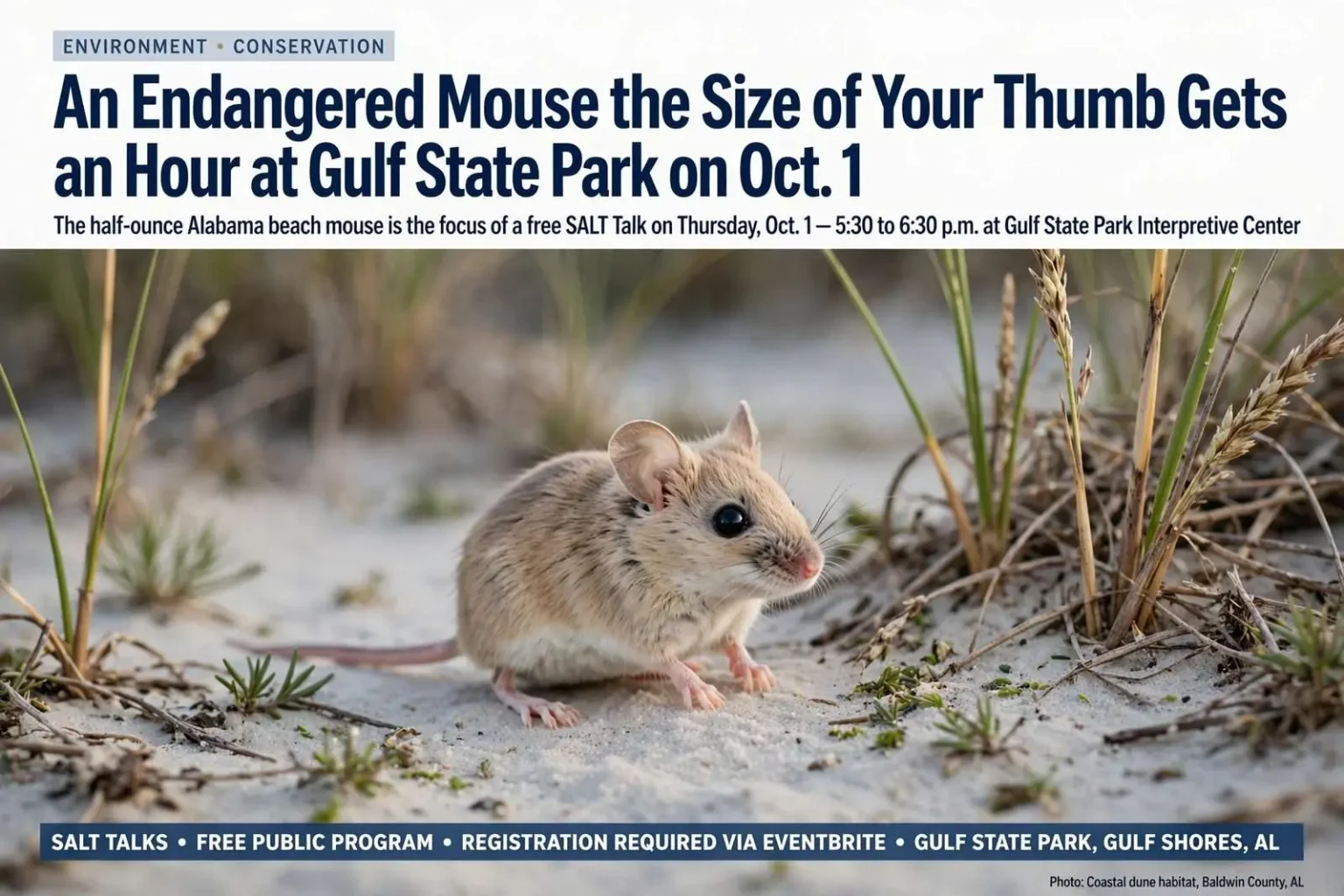
The most consequential animal on the Alabama coast weighs about half an ounce, comes out only after dark, and almost nobody who vacations here has ever seen one.
On Thursday, Oct. 1, the South Alabama Land Trust will spend an hour making the case for it. The organization, known as SALT, is hosting a free public program on the endangered Alabama beach mouse at the Gulf State Park Interpretive Center from 5:30 to 6:30 p.m. Admission costs nothing, but registration is required because seating at the venue is limited, and organizers are urging people to reserve early.
Registration is handled through Eventbrite using the link provided by SALT.
Who Is Speaking
Two speakers will lead the discussion. Carl Couret, a SALT board member and retired U.S. Fish & Wildlife field biologist, is among the featured experts. The second is Dr. Andrew Gentry, Senior Education & Research Manager at The Learning Campus at Gulf State Park.
That pairing covers both halves of how an endangered species is actually managed in this country. A federal field biologist works the regulatory and on-the-ground side — surveys, habitat assessments, consultations on development permits, recovery planning. An education and research manager at a state park works the other side, translating that work for the public whose behavior on the dunes ultimately determines whether any of it succeeds.
The event is part of SALT Talks, the land trust’s ongoing educational series, which aims to spark meaningful conversations about the future of Alabama’s natural landscapes. The series is designed to give the public a chance to hear directly from scientists and conservationists working in the field, and it has been offered at no cost, supported by donations. Organizers ask those who register to consider making a small donation when they reserve a ticket, to help keep future events free.
What the Alabama Beach Mouse Actually Is
The Alabama beach mouse is a subspecies of the oldfield mouse, a small North American rodent that has diverged into a set of pale, dune-dwelling populations along the Gulf and Atlantic coasts. Each of those populations is confined to its own stretch of shoreline, which is why the Alabama beach mouse exists nowhere in the world except a narrow band of coastal dune habitat in Baldwin County, roughly between the Fort Morgan peninsula and the Perdido Pass area. It has been federally listed as endangered since the mid-1980s.
Physically it is built for exactly one address. Where inland relatives are brown or gray, the beach mouse is a pale sandy buff on top with a white belly — coloration that makes it nearly invisible against the white quartz sand of the northern Gulf beaches, which matters enormously to an animal hunted by owls, herons, snakes, foxes and coyotes. Its eyes and ears are large, the standard equipment of a creature that does all of its business at night.
It lives in burrows dug into the sloping faces of dunes, typically near clumps of dune vegetation whose roots hold the sand together. A burrow generally consists of an entrance tunnel, a nest chamber and one or more escape tunnels that stop just short of the surface — so a mouse cornered by a predator at the front door can burst out through the roof somewhere else. Individual mice maintain several burrows across their home range rather than depending on a single one.
Its diet is the seeds of dune plants, supplemented with insects. Sea oats, beach grasses and the various low, salt-tolerant flowering plants of the dune system all feed it, and like many small rodents it caches seeds for later. That habit is the reason biologists describe the mouse as something other than a passenger in its ecosystem.
Why a Mouse Matters to a Dune
SALT says the animal plays a significant role in the health of coastal dune ecosystems, and that the mouse is far more important than its small size suggests, linking dune and habitat health to the broader coastal environment. The mechanism is worth spelling out, because it runs opposite to how people usually think about mice.
A dune is not a pile of sand. It is a pile of sand held in place by plants. Sea oats and their neighbors send out deep, spreading root systems that bind loose sand, and their stems slow the wind enough that airborne grains drop out and accumulate. Vegetation is what allows a dune to grow, and what allows it to rebuild after a storm strips it.
Beach mice participate in that process directly. By collecting seeds, carrying them away from the parent plant and caching more than they eat, they disperse dune vegetation across the system and plant a portion of it by accident. Their burrowing turns over and aerates sand. In a habitat where establishing a plant is the hard part, an animal that moves seeds around at night, every night, all year, is doing real ecological labor.
The dunes those plants build are the coast’s first line of defense. They absorb storm surge, break waves, and buy time for everything behind them — roads, utilities, houses, condominium towers. A healthy, vegetated dune field is functionally a piece of public infrastructure that maintains itself for free. When it is flattened or paved, the protection does not come back on its own.
That is the argument the mouse ends up carrying. It is a small, cryptic animal that happens to be a reliable indicator of whether the dune system it lives in is intact, because it cannot persist in dunes that have been fragmented, denuded or built over. A beach with beach mice on it is a beach whose natural defenses are still working.
The Pressures on a Species With Nowhere Else to Go
The threats to a coastal endemic are structural rather than dramatic, and they compound.
- Habitat loss and fragmentation. The same shoreline the mouse requires is the most valuable real estate in the state. Development that removes dunes eliminates habitat outright; development that leaves isolated patches creates populations too small and too separated to recover from a bad year.
- Storms. Hurricanes and tropical systems can strip frontal dunes down to flat sand in a matter of hours. Beach mice have survived storms for as long as there have been beaches, but their historical strategy depends on something that development has made scarce.
- Predation by domestic and feral cats. Free-roaming cats are efficient predators of small nocturnal rodents and are not part of the system the mouse evolved in.
- Competition and invasives. House mice can displace beach mice where human structures give them a foothold, and non-native fire ants prey on young in the nest.
- Artificial light and foot traffic. Bright lighting alters the behavior of a nocturnal animal that depends on darkness to forage safely, and heavy pedestrian and vehicle traffic collapses burrows and kills the vegetation holding the dune together.
The storm point deserves the elaboration, because it explains why conservation planning for this species focuses on land that is not on the beach. Dune systems are layered: primary dunes at the water’s edge, then interdunal swales, then older, more stable secondary and scrub dunes farther inland, often covered in scrub oak and rosemary. Beach mice use all of it. When a hurricane erases the front dunes, the animals that survive are generally the ones back in the scrub, and they are the source population that recolonizes the coast as the dunes rebuild.
Take away the back dunes — which is precisely the ground that is easiest and most attractive to develop, being higher, drier and set back from the surf — and the species loses its refuge. The front dunes still get destroyed by the storm; there is simply nothing left to repopulate them from. Protecting the inland edge of the dune system is therefore not a secondary concern in beach mouse recovery. It is the whole game.
What People Can Actually Do
The practical conservation measures for beach mice are unusually accessible, in the sense that most of them are things ordinary beachgoers and property owners control:
- Stay off the dunes and use marked crossovers and boardwalks. Walking through dune vegetation kills the plants that hold the sand and collapses burrows underneath.
- Leave sea oats and other dune plants alone. They are protected in Alabama, and they are the engine of the entire system.
- Keep cats indoors, and do not maintain outdoor feeding stations near dune habitat.
- Secure trash and avoid leaving food out, which attracts predators and competitors alike.
- Use shielded, low, long-wavelength outdoor lighting near the beach — the same practice that protects nesting sea turtles also benefits nocturnal wildlife on the dunes.
- Support dune restoration plantings and keep vehicles off the sand where they are not permitted.
None of that requires a permit, a budget or a policy change, which is a large part of why public programs like this one exist. Federal listing brings regulatory protection to a species, but regulation applies to permitted actions and construction projects. It does not govern where a family sets up an umbrella or whether a household lets the cat out at night.
Why the Venue Fits
The Gulf State Park Interpretive Center sits inside Gulf State Park in Gulf Shores, one of the largest state parks in Alabama and a rare stretch of the coast where the full dune sequence — beach, primary dunes, swales, scrub and the freshwater lakes behind them — still exists in something close to its natural arrangement. It is one of the better places in the state to explain what an intact coastal system is supposed to look like, because visitors can walk out and stand in one.
The park’s Learning Campus, where Dr. Gentry works, serves as a hub for environmental education and research along Alabama’s Gulf Coast. Hosting the October event there aligns directly with the park’s broader mission of connecting the public with the natural world.
What a Land Trust Does
SALT’s involvement reflects the particular role land trusts play in conservation. A land trust is a nonprofit that protects land directly — by acquiring property outright, by holding conservation easements that permanently limit development on land that stays in private hands, and by stewarding what it holds over the long term. It is a slower, quieter instrument than regulation, and in fast-developing coastal counties it is frequently the only mechanism that can permanently take a parcel off the development market.
Public programming is part of that work rather than a sideline to it. Land trusts depend on donors, volunteers and landowners who choose to place easements on their property, and all three depend on people understanding why a particular landscape is worth protecting. An hour spent explaining what a half-ounce rodent does for a dune field is, in that light, recruitment.
If You Want to Go
The SALT Talk on the Alabama beach mouse is set for Thursday, Oct. 1, from 5:30 to 6:30 p.m. at the Gulf State Park Interpretive Center in Gulf Shores. Admission is free and registration is required through Eventbrite. Seating is limited, and organizers encourage those interested to reserve their spot before the seats fill.